Swiss unemployment benefits 2026: how much, how long

The short answer
Swiss unemployment insurance pays 70% of your insured earnings, or 80% if you support a child or earned a low salary, on a salary capped at 12’350 francs a month. It normally pays 200 to 520 daily allowances, roughly 9 to 24 months, depending on your age and how long you paid in. The basic condition: 12 months of contributions in the last two years.
These federal rules (the Unemployment Insurance Act, known in French as the LACI, and its ordinance, the OACI) are the same from Geneva to the Jura. The law, the SECO brochure and the cantonal pages have no English version, so our links go to the French versions. The percentages don't tell you what will actually land in your account, though: the first days are often unpaid, the amount changes from month to month, and one mistake can cost you weeks of benefits. So we follow one case down to the last franc: a 34-year-old office clerk in Lausanne, no children, laid off with effect from the end of January 2027 after three years with the same company, on a salary of 5’800 francs gross paid twelve times a year.
Are you entitled to unemployment benefits?
Yes, if you were an employee and paid contributions for at least 12 months in the two years before you register. This two-year window is called the contribution period, and the 12 months can come from several jobs (LACI, art. 13). Months when you were under contract but ill or injured without pay also count, and so does military or civilian service.
The other conditions (LACI, art. 8): you've lost at least two days of work and the pay that goes with them, you live in Switzerland with a valid permit, you haven't reached the AVS pension age (AVS is the Swiss old-age and survivors' insurance), you're available for placement (ready, able and allowed to take suitable work) and you comply with the ORP's monitoring rules (the ORP is your regional employment centre, called RAV in German-speaking Switzerland). Your salary is only insured if it averages at least 500 francs a month (OACI, art. 40).
If you couldn't pay contributions for more than 12 months because of training, illness or maternity, or if a divorce or a death forces you back into work, you're exempt from that condition (LACI, art. 14). Your entitlement is shorter then, 90 allowances, and is based on a flat rate of 153, 127, 102 or 40 francs a day depending on your education and age (OACI, art. 41).
Our Lausanne clerk paid in without a break for the last 24 months. She is entitled to benefits, which brings us to the question that matters: how much.
How much is unemployment benefit in Switzerland?
You get 70% of your insured earnings, or 80% in three cases. Insured earnings are your gross salary subject to AVS contributions, averaged over the last six months, or over the last twelve if that average is higher (OACI, art. 37). They're capped at the same level as accident insurance, 148’200 francs a year (OLAA, art. 22), so 12’350 francs a month. Anything you earned above that isn't covered.
The rate rises to 80% if you have a duty to support a child under 25, if you receive a disability insurance (AI) pension of at least 40%, or if an allowance at 80% would not exceed 140 francs a day (LACI, art. 22). SECO's 2026 brochure “Être au chômage” (being unemployed) turns that threshold into insured earnings: 3’797 francs a month. Between 3’797 and 4’340 francs, the canton of Fribourg says you get a fixed 140 francs a day. That band stops a slightly higher salary from producing a lower allowance when the rate drops from 80% to 70%.
Benefits are worked out by the day. Your monthly insured earnings are divided by 21.7, the average number of working days in a month (OACI, art. 40a). The fund then pays five allowances a week, Monday to Friday (LACI, art. 21). So a month brings in 20 to 23 allowances, and the payment varies with it. Here's what that means with no dependent children:
| Monthly insured earnings | Rate | Per day (CHF) | Per month, on average (CHF) |
|---|---|---|---|
| 3’500 francs | 80% | 129.03 | 2’800 |
| 4’000 francs | fixed 140 francs | 140.00 | 3’038 |
| 5’800 francs (our example) | 70% | 187.10 | 4’060 |
| 12’350 francs or more | 70% | 398.39 | 8’645 |
With a dependent child, the last row goes up to 455.30 francs a day, about 9’880 francs a month. On top of that you get a supplement matching the family allowances, as long as nobody else already receives them for the same child.
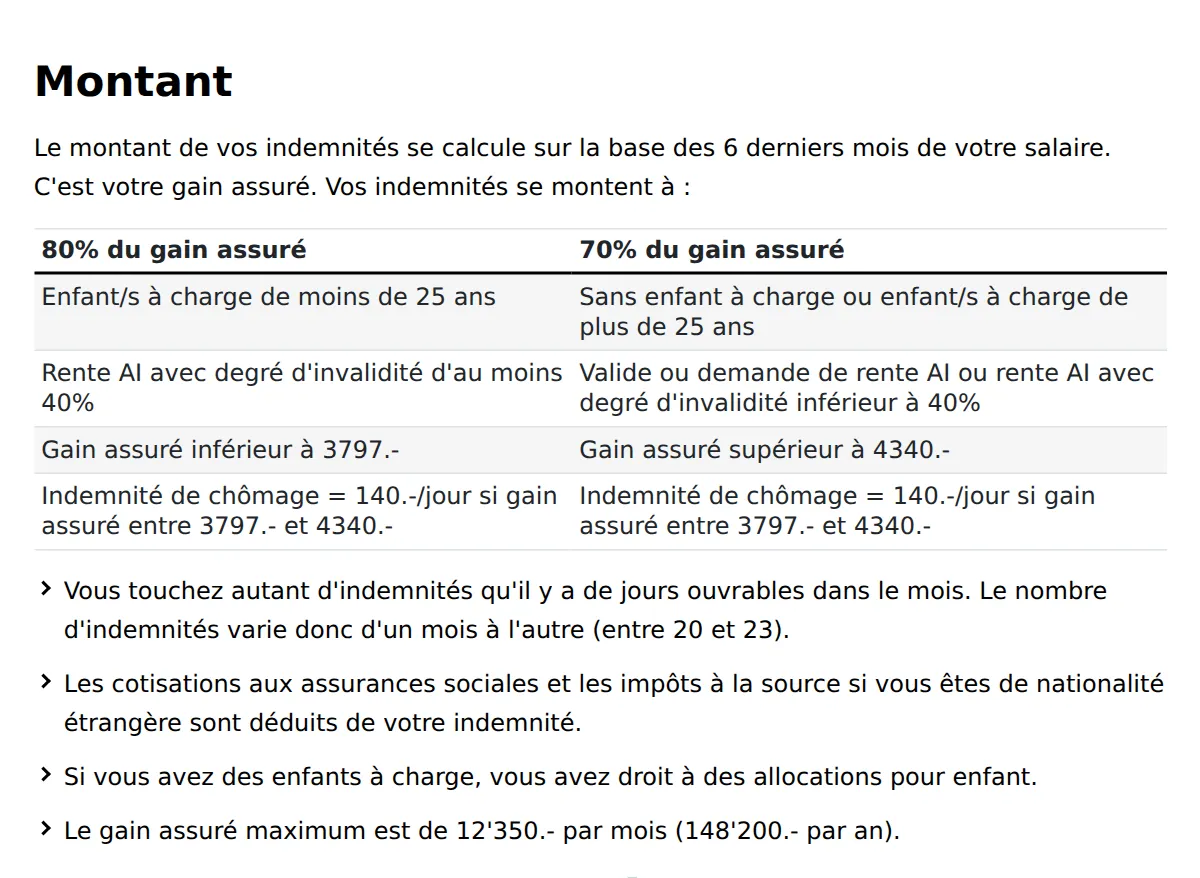
All these amounts are gross. The fund deducts the employee's share of AVS, disability and income compensation contributions, which is 5.3% (AVS leaflet 2.01), part of the premium for non-occupational accident insurance, and an occupational pension contribution that covers disability and death but not retirement (LACI, art. 22a). The allowances are also taxable income, since they replace a salary (Direct Federal Taxation Act, art. 23), and if you pay tax at source it's withheld directly. For our clerk, the 4’060 francs of an average month become about 3’845 francs after the AVS deduction, before the two small deductions and tax.
How long do unemployment benefits last?
Between 90 and 520 daily allowances, sometimes 640, depending on your months of contributions and your age (LACI, art. 27). With 12 to 17 months of contributions, you're entitled to 260 allowances. From 18 months, to 400. With at least 22 months, to 520 if you're 55 or over or receive an AI pension of at least 40%. Under 25 with no dependent children, the cap is 200, however long you paid in.
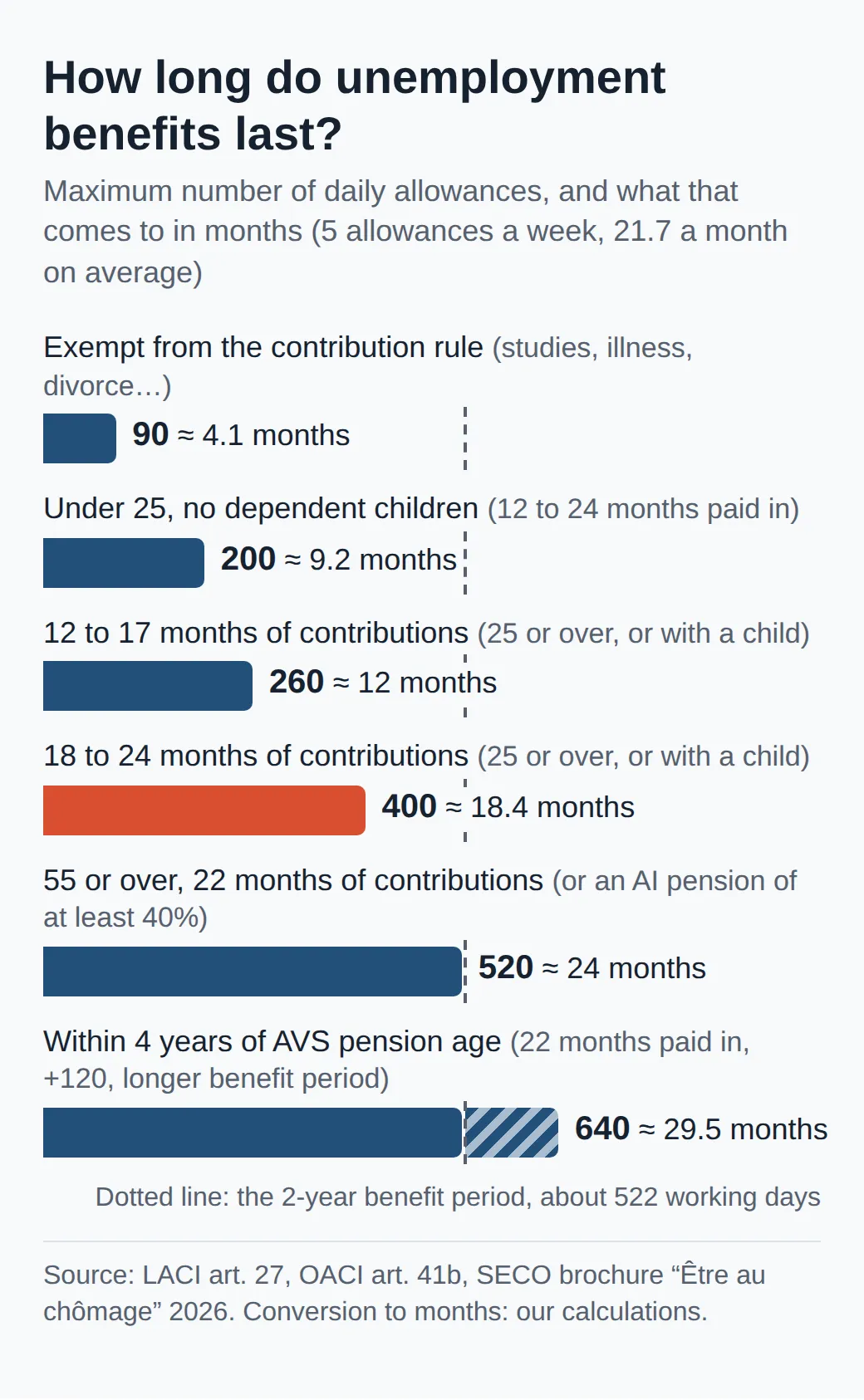
You can't draw these allowances whenever you like. They have to fit into a two-year benefit period, which starts on the first day you meet all the conditions (LACI, art. 9). The clock keeps running in months when you receive nothing, and whatever is left unused at the end of the two years is lost. Two years is about 522 working days, so 400 allowances leave some room and 520 leave almost none.
If you become unemployed within four years of AVS pension age, you get 120 extra allowances, and your benefit period is extended to the end of the month before your pension starts (OACI, art. 41b). Suspension days, on the other hand, come off your total (LACI, art. 30).
Our clerk is 34 and has 24 months of contributions. She's entitled to 400 allowances, 80 weeks or about eighteen and a half months, for a maximum total of about 74’840 francs gross. Those allowances don't start on day one, though.
Waiting days: the first days aren't paid
Before your first allowance, you serve a waiting period of 0 to 20 days, depending on your insured earnings and your children (LACI, art. 18). Only days on which you meet all the conditions count, and the waiting period applies just once per benefit period (OACI, art. 6a). Here's the scale from the SECO brochure, by annual insured earnings:
| Annual insured earnings | No child under 25 | With a child under 25 |
|---|---|---|
| up to 36’000 francs | 0 days | 0 days |
| 36’001 to 60’000 francs | 5 days | 0 days |
| 60’001 to 90’000 francs | 10 days | 5 days |
| 90’001 to 125’000 francs | 15 days | 5 days |
| over 125’000 francs | 20 days | 5 days |
Per month, the thresholds work out at 3’000, 5’000, 7’500 and about 10’417 francs. Special waiting periods apply in three cases: 1 day after seasonal work or in a trade where short contracts are the norm, 5 days if you're exempt from contributions after an illness, a divorce or a return from abroad, and 120 days if you're exempt after training. That last one mostly hits new graduates, who wait more than five months as a result.
On 5’800 francs a month, our clerk has insured earnings of 69’600 francs a year. With no children, she falls in the 10-day band: two full weeks without an allowance.
Our example, from day one to the last franc
Our clerk is out of work from Monday 1 February 2027. She registered with the ORP during her notice period, which you can do as soon as you're told you're being let go, and she meets every condition from that Monday. Her ten waiting days take up the first two weeks of February. The next ten working days are paid.
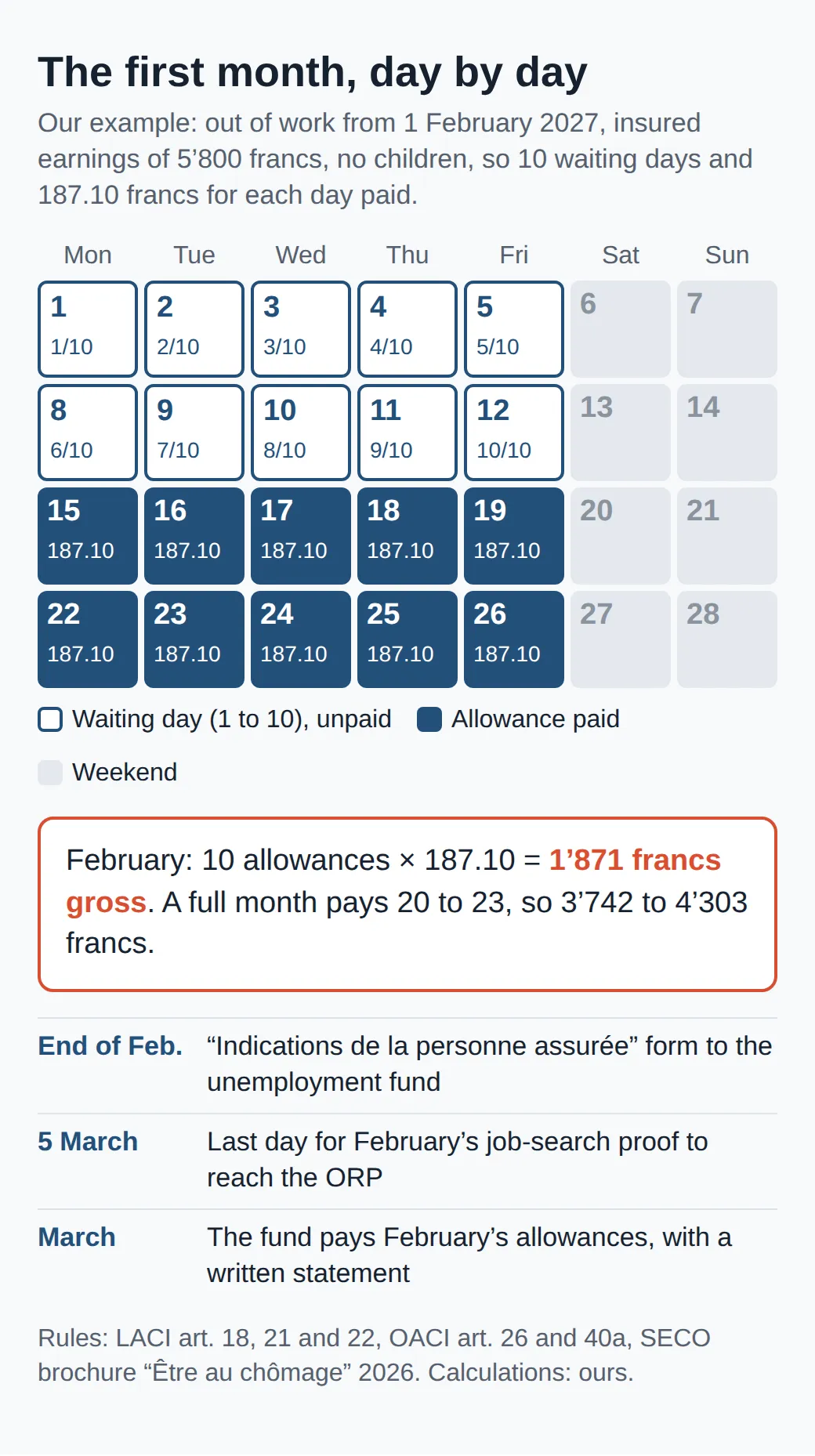
So February brings her only 1’871 francs gross, normally paid some time in March along with a written statement. The following months have 20 to 23 working days and pay her between 3’742 and 4’303 francs gross. If she draws her 400 allowances without a break, the last one falls at the end of August or early September 2028, depending on public holidays, within her benefit period, which runs until the end of January 2029.
The same case with a child under 25 changes three things. The rate goes up to 80%, which is 213.82 francs a day and about 4’640 francs a month. The waiting period drops to 5 days. And the child supplement is added if the other parent isn't already receiving the family allowances. The number of allowances stays at 400. At 56 with 22 months of contributions, it would be 520.
These figures only hold if she does what the ORP expects of her, and that starts before day one.
Registering with the ORP in Geneva, Vaud and elsewhere
You have to register in person as early as possible, and at the latest on the first day you're claiming an allowance for (LACI, art. 17). Nothing stops you registering the day your termination letter arrives. Start applying for jobs during your notice period too, and keep proof: the ORP will ask for your applications going back to the day you learned you were losing your job.
In the canton of Vaud, you register online on the federal Job-Room platform or at your ORP's front desk, no appointment needed (vd.ch). After registering online, the ORP calls you within 24 hours to complete it. Keep your phone on, or your registration may not be processed.
In Geneva, registration goes through the cantonal employment office (OCE), using an online form on ge.ch. Have ready a double-sided copy of your ID card or permit, a copy of your AVS card or health insurance card, a medical certificate if you're 100% off sick and, if you like, your termination letter. Only complete files are processed, and confirmation arrives within 5 working days. If you don't have internet access, the paper form is available at the OCE, rue des Gares 16.
In Fribourg, you register on Job-Room with your AVS number (fr.ch). The ORP then sends you an email that you must answer within 24 hours. In Valais, Neuchâtel and the Jura, the federal rule is the same: online or at the front desk of the ORP responsible for you (OACI, art. 19).
The ORP then invites you to a first interview within 15 days (OACI, art. 20a). Bring your AVS certificate or health insurance card, an ID document and your proof of job applications. By that interview at the latest, you choose an unemployment fund, public or private, which will calculate and pay your allowances. You're tied to that choice for the whole benefit period (OACI, art. 28). Send the fund your benefit claim and an employer's certificate from each employer you've had in the last two years. Don't hang about: allowances for a month that you don't claim within 3 months of its end are lost (LACI, art. 20).
What the ORP expects from you every month
Every month, you provide proof of your job search, fill in the fund's form and stay available. Proof of your applications has to reach the ORP by the 5th of the following month at the latest. After that, without a valid excuse, it no longer counts (OACI, art. 26). Geneva sets a minimum of 8 applications a month (ge.ch). The Vaud page gives no number, so ask your adviser at your first interview. Applications must be targeted, in response to real vacancies. According to the SECO brochure, unsolicited applications only count as an extra.
At the end of the month, you send your fund the form “Indications de la personne assurée” (details from the insured person). On it you report anything that affects your entitlement: earnings, illness, holidays. The ORP sees you at least every two months, and you must be reachable within one working day (OACI, art. 21).
You also have to accept any suitable work. The law spells out what isn't suitable (LACI, art. 16): a job paying less than 70% of your insured earnings, unless the insurance makes up the difference; a commute of more than two hours each way with no accommodation available nearby; and pay or conditions below local practice or the collective agreement. If you're under 30, you can be required to take a job unrelated to your skills. For our clerk, that 70% comes to 4’060 francs a month. She can still be required to take a job that pays less, because the fund then covers part of the gap: that's interim earnings, explained further down.
Every time you reach 60 days of supervised unemployment, you earn 5 days without supervision, the equivalent of holiday, which you announce two weeks in advance (OACI, art. 27). If you fall ill, tell the ORP within a week. The fund then pays you for up to 30 days per illness, and no more than 44 allowances over the benefit period (LACI, art. 28).
Sanctions: what a slip-up costs
If you fail to meet an obligation, your benefits are suspended for 1 to 60 days, and those days come off your total number of allowances. The law lists several grounds: being unemployed through your own fault, not applying for enough jobs, missing an appointment or a programme, and giving false or incomplete information.
The ordinance sets the length according to how serious the fault is (OACI, art. 45): 1 to 15 days for a minor fault, 16 to 30 for a moderate one, 31 to 60 for a serious one. Leaving a suitable job without the assurance of another, or turning down suitable work, counts as serious unless you had a valid reason. Repeat suspensions last longer, and any from the last two years are taken into account.
For our clerk, the sums are simple. A 31-day suspension costs her 31 × 187.10 francs, or 5’800 francs: exactly one month of her old salary. A 60-day suspension would cost her 11’226 francs. The Vaud ORP guide makes the point plainly: handing in your own notice without a new job to go to is treated as a serious fault.
You can challenge a decision by lodging an objection within 30 days. It's free (LPGA, art. 52), and the steps are set out on the decision itself. For a benefit statement, first ask for a formal written decision within 90 days of receiving it.
Interim earnings: a small job pays more
Taking a lower-paid job while unemployed increases your total income. The pay from that work is called interim earnings, and the insurance pays you 70% or 80% of the difference between your insured earnings and that pay (LACI, art. 24). The job has to pay what is usual for the trade and the region.
Back to our clerk. One month she takes a temp assignment that pays 2’000 francs gross. The fund then pays her 70% of 3’800 francs (5’800 minus 2’000), which is 2’660 francs. She ends the month with 4’660 francs gross instead of 4’060. Those months of work also count as contribution months, which helps if she ever needs to open a new benefit period. A temporary job is a straightforward way to find this kind of income.
There is a limit. If you have no child under 25 and are under 45, the top-up applies for the first twelve months of the same activity. With a dependent child or from 45, it lasts until the end of the benefit period. Always tell the ORP and the fund about the work before you start.
Before your last day at work
Check your notice period first. Unless your contract or a collective agreement says otherwise, it's one month, to the end of a month, in your first year of service, two months from the second to the ninth year, and three months after that. If you doubt your notice period is being respected, write to your employer straight away, by registered letter, saying that you want to keep working: the SECO brochure tells you to do so.
Don't resign without a signed contract elsewhere. Register with the ORP before your first day out of work, ask all your employers from the last two years for their certificates and choose your fund. As for accident insurance, you stay covered for 31 days after your right to at least half your salary ends, and then by Suva for as long as you receive allowances.
Above all, start looking now and log every application, with its date and the company: that proof counts towards your entitlement, and a job found during your notice period spares you the waiting days. Current vacancies are on our Geneva and canton of Vaud pages.
Common questions
- Can I get unemployment benefits in Switzerland if I quit my job?
- Yes, if you meet the other conditions, but leaving a suitable job without a new one lined up normally counts as a serious fault unless you had a valid reason. That costs 31 to 60 suspension days, taken off your total number of allowances. The ordinance makes an exception when you could not reasonably have been expected to stay in that job.
- Can a cross-border worker living in France get Swiss unemployment benefits?
- As a rule, no. If you live abroad and worked in Switzerland, your country of residence pays your benefits, under its own rules. Go to the employment service where you live, not to an ORP.
- Are self-employed people entitled to unemployment benefits in Switzerland?
- No. The self-employed do not pay into unemployment insurance and are not covered by it. Employees who run their own company (SA or Sàrl) as a director or partner are not covered either, as long as they can influence the company's decisions, and neither is a spouse or registered partner employed in the same company.
- What happens when Swiss unemployment benefits run out?
- A new two-year benefit period only opens if you have again paid contributions for at least 12 months within the new two-year window, for example through a job or interim earnings. If not, unemployment insurance pays nothing more, and you need to turn to the social services of your municipality or canton.