Maternity leave in Switzerland 2026: 14 weeks, 16 in Geneva

What the law guarantees
In Switzerland, an employed mother is entitled to 14 weeks of maternity leave paid at 80% of her salary, up to 220 francs a day. Geneva is the only French-speaking canton that goes further: 16 weeks, up to 329.60 francs a day. The other parent gets two weeks everywhere. Geneva's parental leave, approved by voters in 2023, isn't in force yet.
These figures hold across French-speaking Switzerland, but they don't tell the whole story. A mother in Vaud can stay home two weeks longer without pay, a cross-border worker employed in Geneva gets the Geneva benefit even if she lives in France, and above a salary of 8’250 francs a month the allowance no longer covers 80% of what you earn. On 1 July 2027, a revision of the federal law adds new rights for hospital stays and opens the door to Geneva's 24-week leave. Here's what each parent gets, canton by canton. The federal loss of earnings law, the Labour Act, parliamentary news and the cantonal pages have no English version, so those links go to the French texts.
How many weeks of maternity leave in French-speaking Switzerland?
Fourteen paid weeks everywhere, sixteen in Geneva. The federal minimum is set in the Code of Obligations (art. 329f): after giving birth, an employee is entitled to at least 14 weeks of maternity leave. The allowance that pays for it comes from the loss of earnings compensation scheme (APG in French, EO in German) and runs for 98 days from the birth (Loss of Earnings Compensation Act, LAPG, art. 16c). Geneva pays its own allowance for 112 days, or 16 weeks.
| Canton | Paid leave | Daily cap | Weeks 15 and 16 |
|---|---|---|---|
| Geneva | 16 weeks | 329.60 francs | paid |
| Vaud | 14 weeks | 220 francs | allowed, unpaid |
| Valais | 14 weeks | 220 francs | allowed, unpaid |
| Fribourg | 14 weeks | 220 francs | allowed, unpaid |
| Neuchâtel | 14 weeks | 220 francs | allowed, unpaid |
| Jura | 14 weeks | 220 francs | allowed, unpaid |
Those two extra weeks exist even where nobody pays for them, because of the Labour Act (art. 35a). For the first eight weeks after the birth, you aren't allowed to work at all. After that, and up to the sixteenth week, you can only be put to work if you agree to it. The canton of Vaud's equality office sums it up in its FAQ on pregnancy, maternity and paternity: you can take weeks 15 and 16 without risking reprisals, but they aren't paid in the canton. The FAQ suggests using some of your holiday to fill the gap.
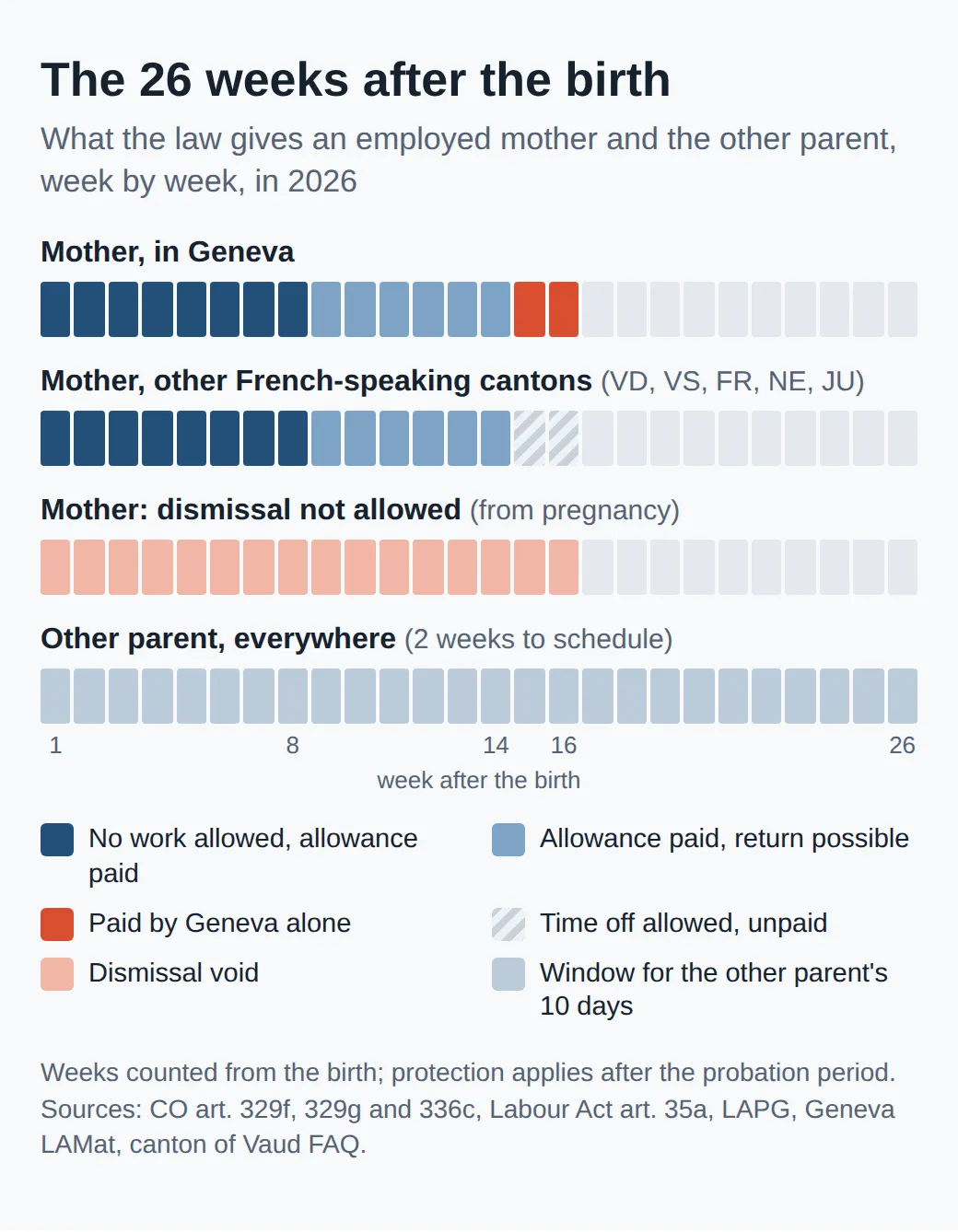
One rule catches people out: the allowance stops as soon as you go back to paid work, even part-time (LAPG, art. 16d). Going back two mornings a week in week nine costs you the rest of the 14 weeks. How much those weeks are worth depends on your salary.
How maternity allowance is calculated: 80% of your salary, up to 220 francs a day
The allowance is 80% of your average income before the birth, but no more than 220 francs a day (LAPG, art. 16f). For an employee, the compensation office divides the monthly salary by 30, then takes 80%. Leaflet 6.02 from the AVS, the Swiss old-age and survivors' insurance, gives the example of a salary of 5’250 francs: 175 francs a day, so an allowance of 140 francs, or 13’720 francs for the 98 days. The cap kicks in from 8’250 francs a month, which gives at most 21’560 francs for the whole leave.
The 220-franc cap won't move in 2027: the Federal Council's ordinance of 2 October 2026 on adjustments to wage and price trends keeps it, as the LAPG as it stands on 1 January 2027 shows. Above 8’250 francs, you therefore get a good deal less than 80% of your salary. To see where your pay sits against that threshold, read our article on salaries in French-speaking Switzerland.
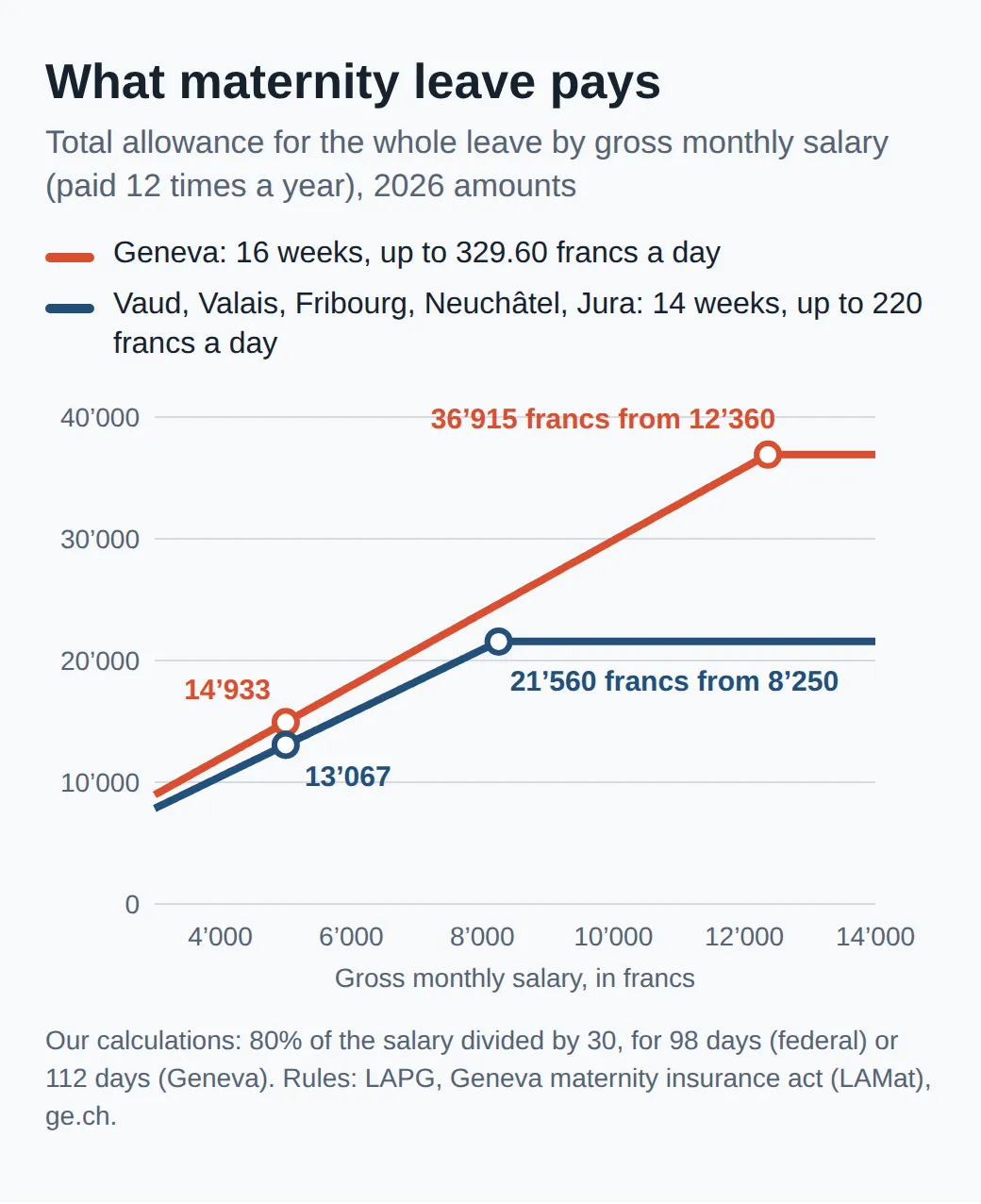
Three details matter for your budget. The allowance is income like any other: AVS, disability insurance, loss of earnings and unemployment contributions are deducted from it, says the same leaflet. Taking unpaid leave or cutting your working hours before the birth can lower the amount, since it's your average income beforehand that counts. And you have to meet two conditions: you must have been insured with the AVS for the nine months before the birth and have worked for at least five months during that time (LAPG, art. 16b). Months worked in the European Union or EFTA count.
You claim through your employer with form 318.750, and you have five years after the end of the leave to do so. In Geneva, a second allowance comes on top of the first.
Geneva: 16 weeks and a higher cap
Geneva pays two weeks more and raises the cap. Geneva's law on maternity and adoption insurance (LAMat) grants an allowance of 80% of insured earnings for 112 days, and those insured earnings can go up to the maximum of compulsory accident insurance. The canton's maternity insurance compensation fund sets its 2026 amounts on that basis: at least 69 francs a day, at most 329.60 francs.
For the first 14 weeks, the compensation office pays the federal allowance and Geneva tops it up to its own amount: the Geneva law deducts whatever the federal scheme pays (art. 5). In weeks 15 and 16, Geneva pays alone. On a salary of 10’000 francs, that means 266.67 francs a day for 16 weeks instead of 220 francs for 14, or about 29’870 francs instead of 21’560.
Geneva's rules follow where you work, not where you live. They cover employees who work in the canton for an employer with a permanent establishment there, as long as they've been in paid work in Geneva for five months in the nine months before the birth (LAMat, art. 3 and 4). For Swiss, EU and EFTA nationals, periods spent in another canton or in an EU or EFTA country are taken into account. The canton also extends the entitlement by up to 84 days if the newborn is in hospital, whereas the federal scheme stops at 56 days until the end of June 2027.
The insurance is funded by an extra contribution, split equally between employer and employees and capped at 0.1% of salary. For the other parent, though, Geneva still applies the federal minimum.
Paternity leave: two weeks for the other parent
The other parent is entitled to two weeks of leave, to be taken within six months of the birth (CO, art. 329g). That's the legal father, or the mother's wife when she is the other legal parent. Many people still call it paternity leave. For a full-time job, it comes to ten working days, which you can take all at once, by the week or day by day.
The allowance follows the same rules as for the mother: 80% of income, up to 220 francs a day. AVS leaflet 6.04 counts a maximum of 14 daily allowances, because a full-time employee who takes all ten days also gets paid for four weekend days. On a salary of 5’250 francs, that's 1’960 francs; at the cap, 3’080 francs. The allowance is paid once the last day of leave has been taken, which can delay the money by several months if you spread your days out.
Your employer can't refuse this leave on the grounds of business needs, the Vaud FAQ points out, but you do have to give notice. Nor can it cut your holidays because of it (CO, art. 329b). This leave doesn't protect you from dismissal, however: if your employer ends your contract before you've taken all your days, the notice period is only extended by the number of days you have left. For the mother, the protection is much stronger.
Dismissal during pregnancy and maternity leave: what the law bans
Once the probation period is over, your employer can't dismiss you during pregnancy or in the sixteen weeks after the birth (CO, art. 336c). A dismissal given during this period is void: it doesn't exist, and if the employer still wants to go ahead, it has to give notice again after the sixteenth week. If you got your letter before the pregnancy and the notice period hadn't run out, it stops and only starts again after those sixteen weeks.
This protection has limits that general guides often leave out. It doesn't apply during the probation period, although a dismissal linked to pregnancy can then be challenged as discrimination under the Gender Equality Act. A fixed-term contract ends on the agreed date, pregnant or not, as the Vaud FAQ and the Lausanne University Hospital (CHUV) guide to parents' rights (in French) both point out. The maternity allowance is still owed for its 98 days if you meet the conditions. And if you hand in your notice yourself, nothing protects you.
Two other rules work in your favour. Your employer can't cut your holidays because of maternity leave, or because of a pregnancy-related absence of up to two months (art. 329b). During pregnancy, if you can't work and the contract has lasted more than three months, the employer owes you your salary as it would for an illness: three weeks in the first year of service, more after that (CO, art. 324a), unless daily sickness insurance covers it instead. When they come back, many mothers want to work reduced hours, and that's where everything depends on the employer.
What your employer can add
The law sets a floor, and an employer can do better. If it keeps paying your salary during the leave, at 100% or another rate, the compensation office pays the allowance to the employer, according to leaflet 6.02.
The CHUV in Lausanne gives an idea of what a large public employer offers. According to its brochure published with Vaud's equality office in 2022, its employees who meet the federal conditions get four months of maternity leave at 100% pay, then a month of breastfeeding leave for those on permanent contracts. Fathers get 20 working days instead of ten, and unpaid parental leave of six to twelve months can be requested. Auxiliary staff, on the other hand, stay at 14 weeks at 80%.
To find out what applies to you, look at three documents: your contract, your employer's staff regulations and your industry's collective labour agreement if there is one. A collective agreement can also pay the other parent's days at 100%, the Vaud FAQ notes. As for your hours when you return, your employer doesn't have to accept a cut in your working hours without a medical certificate, according to the same FAQ. If negotiating gets you nowhere, looking for a part-time job may turn out to be the real answer. For cross-border workers, another question comes first: which country's rules apply.
Cross-border workers: Swiss law applies
If you work in Switzerland and live in France, the maternity allowance and the allowance for the other parent are Swiss. You're insured with the AVS through your job, and months worked in France count towards the nine months of insurance and the five months of work, leaflet 6.02 explains. You claim through your Swiss employer, just as a resident does.
In Geneva, the cantonal law also covers people who work in the canton, with no condition on where they live. A cross-border worker employed by a Geneva company is therefore entitled to the 16 weeks and the 329.60-franc cap. For weeks 15 and 16, the Geneva law deducts any maternity benefits paid by the country of residence (LAMat, art. 6). If France pays you something for the same period, Geneva only pays the difference.
In Vaud or Valais, a cross-border worker gets the federal 14 weeks, like her colleagues who live in Switzerland. For the G permit and health insurance, see our article on working across the border from France. On the federal side, the rules change in 2027.
What changes on 1 July 2027
On 19 December 2025, Parliament passed a revision of the LAPG that brings parents' benefits into line with those of people doing military or civilian service. At its meeting of 26 August 2026, the Federal Council set it to come into force on 1 July 2027. The number of weeks and the 80% rate don't change, but four situations are better covered.
First, the mother's own hospital stay finally counts. Until the end of June 2027, the allowance is only extended if the newborn stays in hospital for at least two weeks, and by 56 days at most. From July 2027, the extension also applies when the mother is in hospital for at least two weeks within two weeks of the birth, and it lasts as long as the hospital stay, with no 56-day cap. Protection against dismissal covers this extension for up to 12 weeks.
Second, the other parent gets extra leave if the mother is in hospital for at least two weeks within the 14 weeks after the birth: it runs from the third week of the hospital stay and lasts as long as the stay, up to twelve weeks (84 daily allowances) at most. During this extended leave, the other parent can't be dismissed. If the child is stillborn or dies within two weeks, the other parent keeps the leave and the allowance, to be taken in one block from the day after the death.
Third, parents on leave can claim an allowance for childcare costs for their children under 16, when a health reason has kept them from looking after them for at least two days in a row and a nursery or other childcare cost them extra. Self-employed people who run their business also get an operating allowance, set at 34% of the maximum amount, or 74.80 francs a day. Fourth, the care allowance becomes available from four consecutive days in hospital for a child, without the child having to be seriously ill, except for a hospital stay right after the birth.
If you're in hospital when the revision comes into force, the new rights apply to the days left from 1 July 2027, not to the days before. Finally, the revision contains a short article, article 16m bis, that lets cantons give the other parent a higher or longer allowance. That's the article that unblocks Geneva.
Geneva's 24-week parental leave: where does it stand?
On 18 June 2023, Geneva voters approved initiative 184, « Pour un congé parental maintenant ! » ("Parental leave now!"). Article 205 of the Geneva constitution now guarantees insurance of at least 16 weeks for the mother and at least 8 weeks for the other parent, funded equally by employers and employees, with the option of transferring two weeks between parents. The two federal weeks are included in the eight, the canton of Geneva says: a couple would go from 18 to 24 weeks.
The text first ran into federal law. In May 2024, the Federal Council proposed refusing the federal guarantee, because the LAPG didn't allow a canton to fund an allowance for the other parent in this way. The 2025 revision removed that obstacle. The Council of States granted the guarantee on 15 June 2026, then the National Council on 22 September 2026. The guarantee is partial: foster families who take in a child permanently without adopting remain excluded.
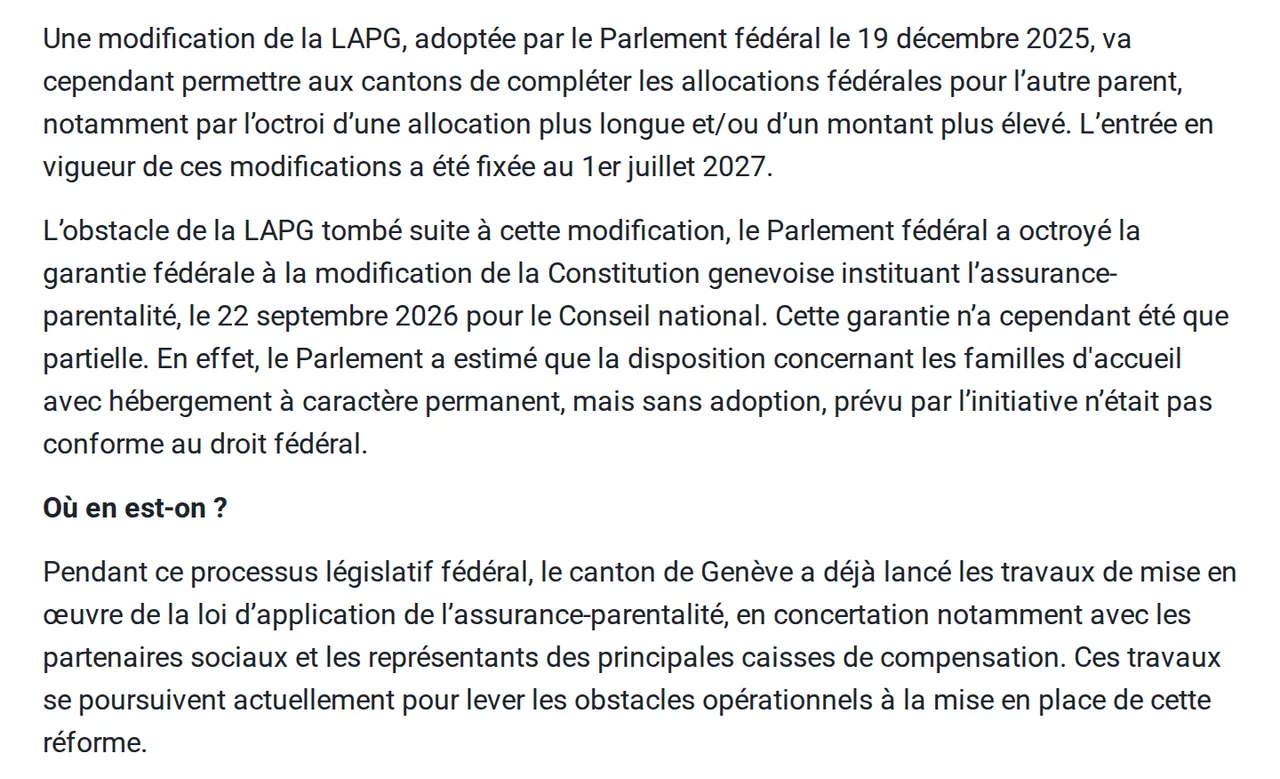
Nothing is being paid yet. Geneva's implementing law still has to be written. According to the Geneva government page on the implementation steps, the draft will have to go to the Federal Social Insurance Office, the Federal Council may have to authorise the compensation offices to collect the contributions, and then the Council of State will have to adopt the text and the Grand Council pass it. Compensation offices and employers will then need time to get ready. No date has been set. One limit is certain: the federal article that lets cantons go further for the other parent only comes into force on 1 July 2027, so Geneva's 24-week leave can't start before then. The Geneva Green Liberals, who launched the initiative, are hoping for 1 January 2028, according to RTS, the Swiss public broadcaster, but that's only a hope.
So for a child due in 2027, in Geneva as elsewhere, count on the current rules. Elsewhere in French-speaking Switzerland, Fribourg pays a supplementary maternity allowance to mothers living in the canton whose federal allowance is very low or nil, but it doesn't extend employees' leave.
Before the birth: what to sort out
A few weeks before your due date, ask your employer whether it will keep paying your full salary or just pass on the allowance, and get the answer in writing. If you earn more than 8’250 francs a month outside Geneva, work out the gap between your salary and 220 francs a day, because that's the shortfall you'll have to absorb.
If you work in Vaud, Valais, Fribourg, Neuchâtel or the Jura and want to stay home for sixteen weeks, plan to cover weeks 15 and 16 with holiday, or accept that they'll be unpaid. In Geneva, check that your employer really has an establishment in the canton. For the other parent, agree the dates of the ten days with the employer before the birth and keep the six-month limit in mind.
If going back part-time is your plan, raise it early, because your employer doesn't have to agree. And if you lose your job during this time, find out how unemployment insurance works in Switzerland. If you're unemployed when the baby is born, the maternity allowance replaces your unemployment benefits during the leave.
Common questions
- Can I get maternity allowance in Switzerland if I'm unemployed when my baby is born?
- Yes, if you're already receiving unemployment benefits or have paid in long enough to be entitled to them. You then get the maternity allowance instead of your unemployment benefits, and it's at least as much as the daily allowance you received before the birth. You claim it directly from the compensation office.
- Is maternity leave extended if I get sick during my leave?
- No. The leave lasts 14 weeks even if you're ill during that time, and the maternity allowance remains the only benefit paid. Only the newborn's hospital stay, and from 1 July 2027 the mother's, can extend the payments. If the illness goes on after the leave, your employer's daily sickness insurance or its duty to keep paying your salary takes over.
- Can I go back to work part-time before my 14 weeks of maternity leave are over?
- Not before the end of the eighth week, as you're not allowed to work at all until then. After that you can go back, but any return to paid work, even part-time, ends your right to the rest of the allowance. If you want a gradual return, it's better to plan it for after the fourteenth week.
- Does maternity allowance count towards my Swiss pension?
- For the AVS, yes: the allowance is income from which AVS, disability insurance and loss of earnings contributions are deducted, plus unemployment insurance for employees, and it's recorded in your individual account. For your occupational pension, if you're an employee you stay insured on the same terms during the leave, on the same coordinated salary, unless you ask for it to be reduced.
More posts
All posts
Average salary in Geneva, Vaud and Romandy: 2024 figures
Median salary in 2024: CHF 7,893 in Geneva, 6,810 in Vaud, 6,434 in Valais. Official figures by canton and sector, plus minimum wages in Romandy.

Swiss unemployment benefits 2026: how much, how long
70 or 80% of insured earnings, 200 to 520 daily allowances, waiting days by income: Swiss unemployment benefits worked out to the franc, and ORP registration.

Temporary work in Switzerland: your rights as a temp in 2026
2 days' notice, at least CHF 25.70 an hour, 13th salary, pension and sick pay: what Swiss law and the staff hire CLA guarantee temps in Romandy.