Swiss G permit 2026: cross-border rules, renewal, LAMal

What you need to know
The G permit is the cross-border commuter's permit: you're an EU or EFTA national, you live in France, you work in Switzerland for a company based in Switzerland and you go home at least once a week. It's valid for five years with a permanent contract or one lasting more than a year, and it's renewed on proof of employment. From your first day at work, you have three months to choose between Swiss health insurance (LAMal) and the French system.
Most pages on the subject stop at the application. Yet what costs money comes afterwards: a form the CPAM (the French health insurance office where you live) has to stamp before you send it to the canton, a French contribution calculated on what you earned two years earlier, a 14-day deadline every time you change jobs. So we follow the process in order, using the rules published by the Confederation and the cantons of Geneva and Vaud, and we put figures on the health insurance choice. Many of the cantonal and French pages exist only in French, so those links go to the French versions.
Who is entitled to a G permit?
You're entitled to one if you're a national of an EU or EFTA state, your main home is in one of those states and you work in Switzerland, returning home "as a rule every day, or at least once a week". The definition comes from the Agreement on the Free Movement of Persons (AFMP, Annex I, Article 7), and the State Secretariat for Migration (SEM) repeats it almost word for word. The agreement even states that cross-border commuters don't need a residence permit: the G permit is the document the canton gives you to prove your right, not a favour it grants.
The old border zones no longer apply to Europeans. According to the SEM, you can live anywhere in the EU or EFTA and work anywhere in Switzerland. What counts is your nationality, not the country you live in: a Portuguese or Italian national living in Annemasse qualifies just like a French one.
Geneva sums up the rule in three conditions on the website of its Cantonal Population and Migration Office (OCPM): live in an EU or EFTA state, be employed by a company based in Switzerland, go home at least one day a week. The permit is tied to an employer, so you can't get one to look for work. And any activity needs one, unpaid internships included.
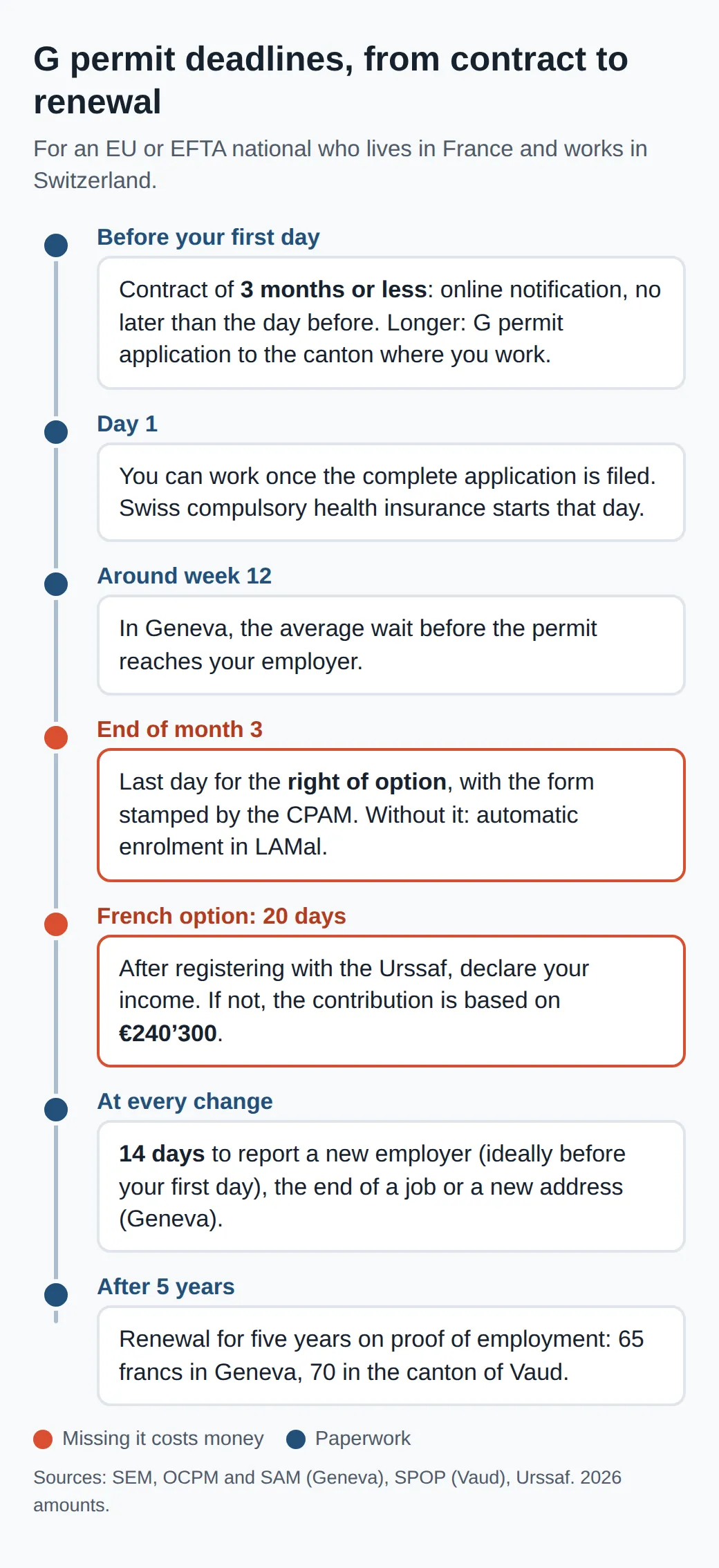
A job of three months or less per calendar year doesn't need a permit. Your employer registers it online, no later than the day before you start (SEM, notification procedure). Watch out when it adds up, though: if you've already worked three months in Switzerland that year, or held a valid permit, Geneva requires a G permit application.
For other nationalities, the G permit remains the exception. In the canton of Vaud, a first permit for a non-EU national requires a long-term residence card, six months' residence in the French border zone and an employer who proves it couldn't find anyone on the Swiss labour market. Vaud's employment office (DGEM) charges 200 francs to examine the case (vd.ch). In Geneva, British nationals are treated as Europeans only if they hold a valid C, B or L permit obtained before 31 December 2020 or, if they change employer without a break, a G permit obtained before that date (ge.ch).
Whatever your nationality, the condition that raises the most questions is the last one: going home every week.
Going home at least once a week
The rule asks you to return to your main home at least once a week, not every evening. So you can sleep in Switzerland during the week. Vaud spells it out on its cross-border permits page: cross-border workers « peuvent séjourner en Suisse pendant la semaine, à condition de s'annoncer auprès de leur commune de résidence » (may stay in Switzerland during the week, provided they register with the municipality where they stay).
In Lausanne, for example, a G permit holder who spends more than 90 days a year in accommodation in the city has to register it as a secondary residence within 14 days. You register by post, sending among other things a copy of your permit, proof of your home abroad (a certificate, a recent tax notice or an electricity bill) and the lease or a signed statement from your host (lausanne.ch).
What doesn't work is living in Switzerland while keeping a token address in France. The G permit assumes your main home is abroad. If you move to Switzerland for a job of more than three months, you need a residence permit, which you apply for at the municipality where you live (vd.ch). The reverse move has its own rule too: in Geneva, swapping a residence permit for a G permit starts with registering your departure.
Once you meet these conditions, the question is where and how to apply.
Applying for a G permit in Geneva, Vaud and elsewhere
You apply in the canton where you work, not the one where the company has its head office. Vaud, for instance, issues G permits to people working on its territory wherever the company is based. In both cantons, you don't have to wait for the card before you start.
In Geneva, the OCPM handles the application, which is filed online before your first day at work. You need a colour copy of a valid ID, a photo with your full name on the back and a certificate from your employer or a copy of your contract. If you're placed by an agency, add the assignment contract. You can start as soon as the complete file has been sent, and the permit then goes to your employer, after 12 weeks on average. While you wait, your employer normally receives two emails from the OCPM, and the second, sent once the documents have been checked, counts as a work authorisation if there's an inspection (OCPM FAQ). The OCPM fee schedule puts a first G permit at 65 francs for an EU adult.
In the canton of Vaud, the application goes to the population service (SPOP) on online form G1, and you can start work as soon as it's filed. The card data has to be recorded at the biometrics centre in Lausanne. The appointment letter, the invoice and the permit are sent to your employer, who passes them on to you. The whole thing costs 70 francs: 65 for the permit and 5 for registered post. Your employer is liable for it together with you, so it's up to them whether to pay it or pass the cost on to you.
In Neuchâtel, Jura, Valais or Fribourg, the principle is the same, with each canton's own forms and fees. The SEM keeps a list of the cantonal migration authorities.
With the application filed, another clock has already been running since the day you started: health insurance.
Three months to choose: LAMal or French health insurance
From your first day of work in Switzerland, you're subject to Swiss compulsory health insurance under the Health Insurance Act (LAMal), even though you live in France (Institution commune LAMal). The agreement with the EU lets you be exempted so that you stay insured in France: this is called the right of option. You have three months from the start of your job to use it. If you haven't made your choice known by then, you're automatically enrolled with a Swiss insurer (Urssaf).
Many people still call the French option the « CMU frontalier ». In practice, you join the CPAM where you live and pay a contribution to the Urssaf, the French agency that collects social security contributions.
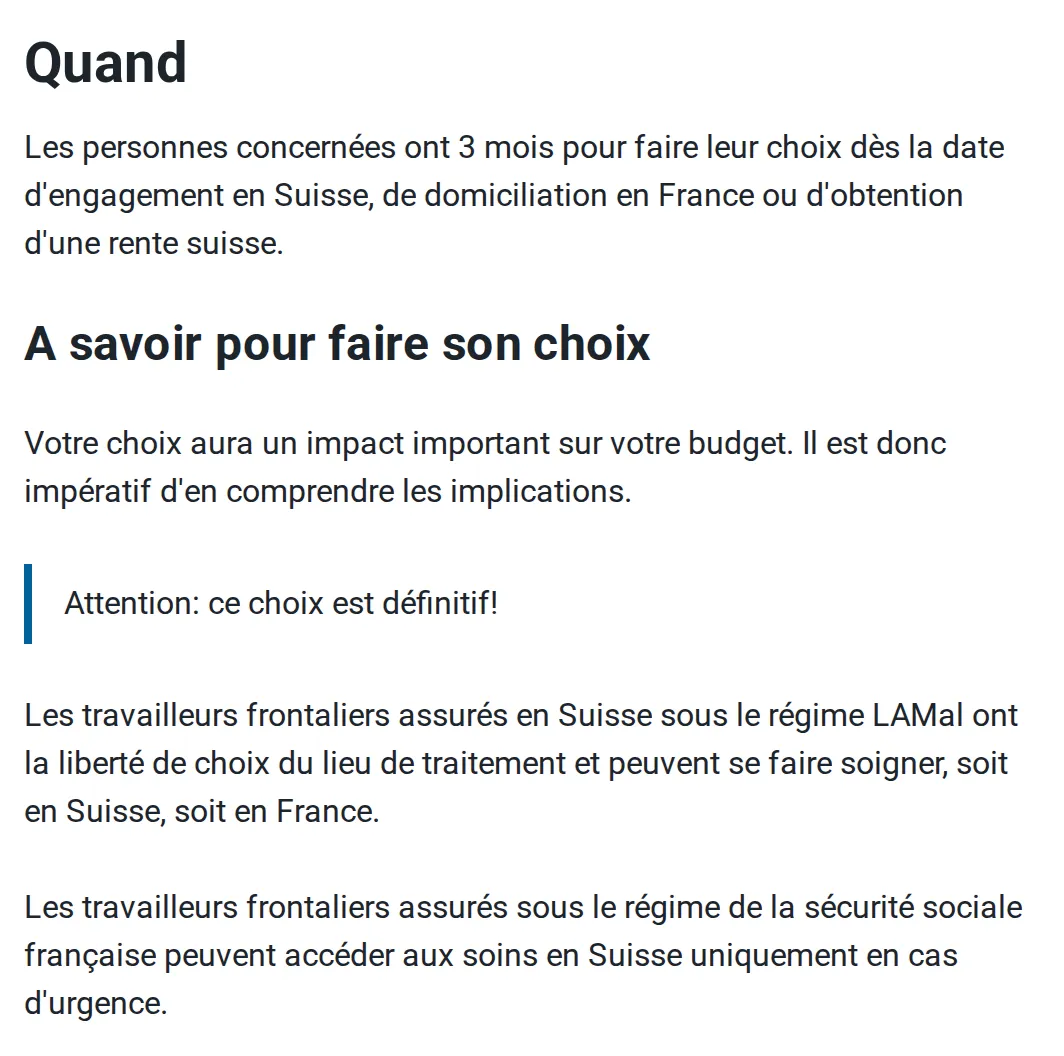
The choice is final for as long as you keep working in Switzerland without a break. According to the Institution commune LAMal sheet on the right of option for border workers, it doesn't reopen when your salary changes, when premiums go up, or when you change employer or canton. For cross-border workers from France, a marriage or a birth doesn't reopen it either. It does reopen when you go back to work in Switzerland after a documented break, such as a spell of unemployment, when you move to France or when you retire (SAM FAQ).
The paperwork goes through two offices, in this order. You fill in the form for choosing your health insurance system up to section 5 and sign it. The CPAM where you live stamps it in section 6, whichever option you choose. You then send it yourself to the cantonal office where you work, because the CPAM doesn't forward it (ge.ch). If you choose LAMal, enclose the insurance certificate from your Swiss insurer. Geneva warns that the stamp can take a while. In Haute-Savoie, the CPAM offers an online service to speed things up.
Which office gets the form depends on the canton where you work, according to the Institution commune LAMal list:
| If you work in | Send the form to |
|---|---|
| Geneva | Service de l'assurance-maladie (SAM) |
| Vaud | Office vaudois de l'assurance-maladie (OVAM), online form |
| Neuchâtel | Office cantonal de l'assurance maladie |
| Jura | Caisse de compensation du canton du Jura |
| Valais, Fribourg | the municipality where you stay or work |
If you've missed the deadline, all is not lost. In Geneva, automatic enrolment can be cancelled under certain conditions, using the same form stamped by the CPAM (ge.ch). To stay with LAMal but at the insurer of your choice, the certificate has to start no later than the date of automatic enrolment. For the French option, the stamp is essential: without it, automatic enrolment in LAMal becomes final.
Your family follows your choice. With LAMal, your non-working spouse and your children have to be insured in Switzerland too, each paying their own premium. If your spouse works in France, the whole family stays insured in France and your children can't be insured in Switzerland. With the French option, you can add your spouse, unmarried partner or PACS partner (the French civil partnership) and your children as dependants.
Which leaves what decides it for most people: the price.
LAMal or CMU: what each option costs
On the French side, the contribution is 8% in 2026, calculated on your income after a deduction equal to 25% of the French social security ceiling (Urssaf). That ceiling is €48’060 in 2026 (Urssaf), so the deduction is €12’015. On an income of €60’000, that comes to about €3’839 a year, or €320 a month, paid monthly or quarterly before the 5th of the month it falls due. Your Swiss employer can pay all or part of it if it chooses to (Urssaf).
The catch is the income it's based on. The Urssaf doesn't use your current salary but your income from two years earlier: the 2027 contribution is calculated on 2025 income, as shown on your 2026 tax notice. If you earned less in France before crossing the border, your first contributions are low, and the bill goes up two years later. In the year you arrive, the contribution is prorated by the number of days you're covered. Once you've registered with the Urssaf, you have 20 days to declare your income. If you don't, the Urssaf assesses you on a notional income of €240’300 in 2026, five times the ceiling, and a late declaration raises the assessed income by 10%.
In Switzerland, the premium doesn't depend on your income, but on the insurer, your age and your deductible (the franchise). For 2026, the Canton of Geneva's premium table for people living in France ranges, for an adult aged 26 or over with a 300-franc deductible, from 215 to 885 francs a month with accident cover, and from 200 to 823.10 francs without it. If you work at least eight hours a week for the same employer, its accident insurance also covers you outside work (OLAA, art. 13), so the version without accident cover is enough. A child costs 49.40 to 265 francs a month, accident cover included.
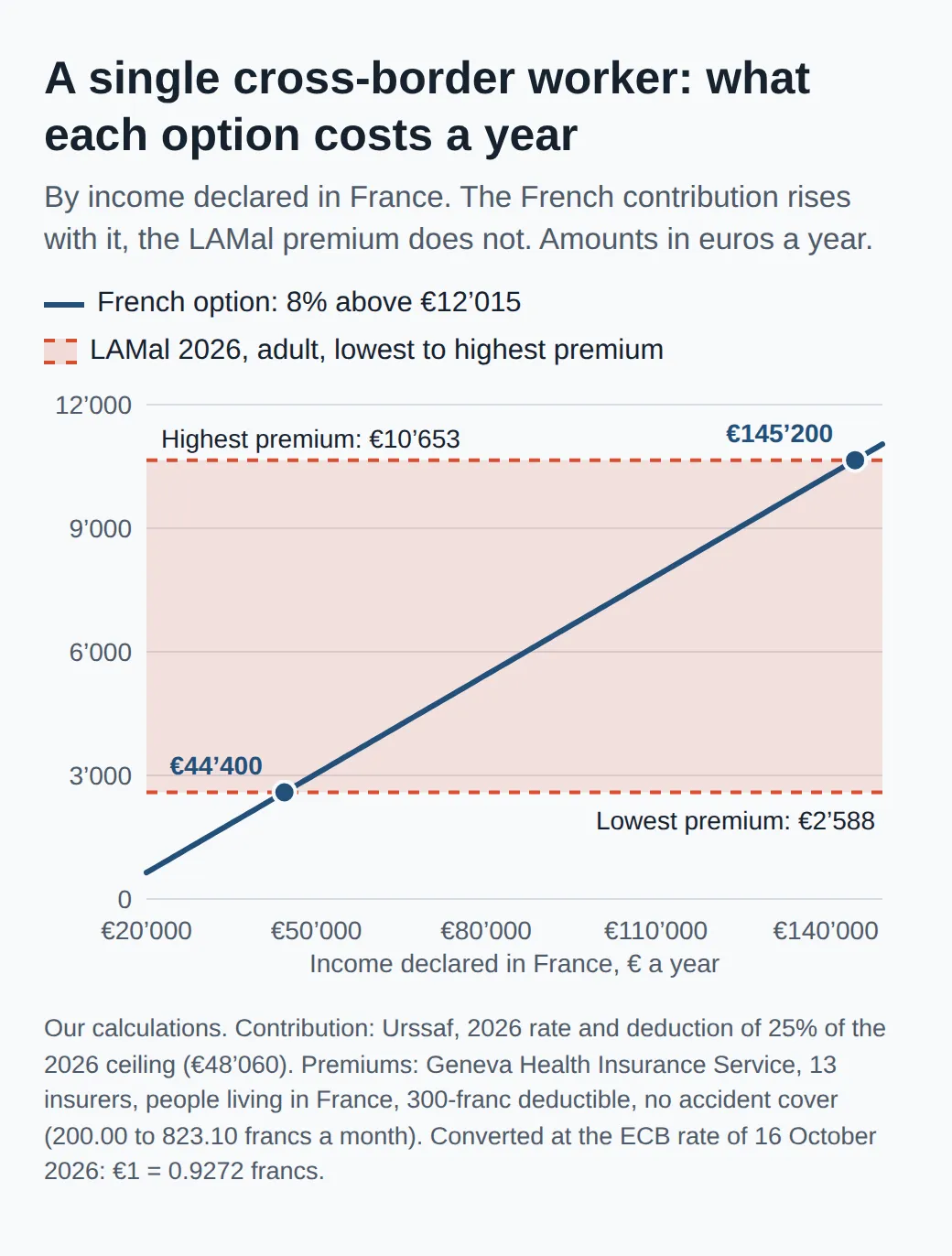
For a single person, with 2026 amounts and the rate of 16 October 2026, the dividing line is therefore around €44’400 of declared income. Below it, the French option costs less than the cheapest Swiss insurer. Above it, it costs more, and beyond about €145’200, more than the most expensive one. These thresholds shift with the franc's exchange rate and with each year's premiums, so redo the sums with the table for the year you start.
For a family, the sums change. Take a cross-border worker who declares €70’000, with a spouse who doesn't work and two children. The French option costs a single contribution, about €4’639 a year in 2026. With LAMal, at the cheapest insurer in the 2026 table, they pay 200 francs for themselves, 215 for their spouse, who needs accident cover, and 49.40 per child: 513.80 francs a month, or 6’165.60 francs a year, about €6’650. At the most expensive insurer, the same family would pay 26’857.20 francs a year.
Price isn't everything. With LAMal, you can be treated in Switzerland or in France. With the French option, Switzerland treats you only in an emergency, which matters if you'd like to see a doctor near work. LAMal also leaves you a deductible to pay, 300 francs a year in the table, but Geneva can grant premium subsidies to cross-border workers insured under LAMal, depending on their income. Once you've made your choice, the permit runs for five years, with obligations of its own.
What to report while your permit is valid
Your G permit is tied to your employer, and every change has to be reported, as a rule within 14 days in Geneva. Here's what the OCPM asks for:
- New employer: report it online, ideally before your first day, because one OCPM page counts the 14 days before you start the new job and another counts them after the change. You need an ID, a certificate from the new employer or the signed contract, and form R from your previous employer (ge.ch). You can start as soon as the complete file has been sent. Geneva charges 65 francs; Vaud issues a new card for 55 francs.
- End of employment: your employer reports it with form R within 14 days, and your permit stops being valid.
- New address abroad: report it within 14 days; it costs 25 francs in Geneva.
- Work in another canton: you have to cancel the Geneva permit and apply for a new one in the new canton, even if you stay with the same employer.
If you lose your job, it's normally France that pays your benefits, not Switzerland: we explain how in our article on unemployment benefits in Switzerland. And when you find work in Switzerland again after that break, you get a new right of option too, with a fresh three-month deadline.
Renewing your G permit
The permit is renewed for at least five years if you prove you're still in work, under the free movement agreement. With a contract of more than three months but less than a year, it's valid only for the length of the contract (SEM).
In the canton of Vaud, the Confederation sends an expiry notice to your employer, not to you. You apply for renewal with form G2, online or on paper, enclosing a copy of a valid ID, your latest payslip and that notice. You can keep working from the moment you file it, and renewal costs 70 francs. Biometric data is valid for five years: if the card is renewed before then, you don't need to go back to the biometrics centre. In Geneva, renewal goes through the same online form as the first application, and the OCPM fee schedule sets an extension at 65 francs for an EU adult.
Renewal doesn't reopen the right of option: your health insurance choice holds for as long as you work in Switzerland without a break.
Before you sign your Swiss contract
A few simple steps head off most of the trouble. Ask your future employer who files the permit application and when, since the employer is the one who'll receive the card and, later, the expiry notice. Note the permit's expiry date yourself. Book a CPAM appointment in your first month of work, not your third, because the stamp takes time. And before choosing between LAMal and the French option, dig out the tax notice showing your income from two years earlier, count who lives under your roof and redo the sums with that year's premiums: you won't get a second chance.
If you're still at the application stage, our guide to writing a cover letter for Switzerland will help you with that first step.
Common questions
- Do I need a G permit for an unpaid internship in Switzerland?
- Not always, but it has to be reported at the very least. In Geneva, any activity needs authorisation, unpaid internships included. An internship of less than three months goes through the online notification, free of charge. Beyond that, you need a G permit, just as you would for a job.
- Can I work for two employers with a G permit?
- Yes. According to Geneva's population office, a second job on the side doesn't have to be reported if you already hold a valid permit with a Swiss employer. You do have to report it if the new job's workload percentage is higher than the first one's. In total, you can't work more than 50 hours a week.
- Is the non-EU spouse of an EU citizen entitled to a G permit?
- No, the free movement agreement doesn't give them that right. They can still apply, and the application is then handled under the Foreign Nationals and Integration Act. In the canton of Vaud, a first G permit for a non-EU national requires, among other things, six months' residence in the border zone and an employer who couldn't find anyone on the Swiss labour market.
- What should I do if my G permit card is lost or stolen?
- In the canton of Vaud, report the loss or theft at a Swiss police station, then send form G2 to the population service (SPOP) with the police certificate. In Geneva, a replacement card costs 65 francs for an EU adult, including the capture of your biometric data.
More posts
All posts
Average salary in Geneva, Vaud and Romandy: 2024 figures
Median salary in 2024: CHF 7,893 in Geneva, 6,810 in Vaud, 6,434 in Valais. Official figures by canton and sector, plus minimum wages in Romandy.

Working for an international organisation in Geneva
UN, WHO, ICRC or an NGO in Geneva: legitimation card, tax, AVS and health insurance by employer, UN salaries in 2026 and how to apply.

Geneva and Vaud tax at source: correction or TOU by 31 March
Geneva and Vaud: what a tax at source correction fixes, when to ask for a TOU (subsequent ordinary assessment), the 90% rule and the 31 March 2027 deadline.