Cover letter in Switzerland: structure and examples
Before you write
In French-speaking Switzerland, a cover letter fits on one A4 page, in three parts: why this company and this job, what you bring with evidence, then a request for an interview. The subject line names the job and where you saw it. The style is direct and plain, the signature handwritten, and the letter goes out as a PDF.
These rules don't come from a coach. They're set down in black and white by the people who support jobseekers: the brochure « Qu'est-ce qu'une bonne candidature ? » ("What makes a good application?") from the State Secretariat for Economic Affairs (SECO), handed out by the ORPs (the regional employment centres, called RAV in German-speaking Switzerland); the guide from Vaud's careers guidance office (OCOSP); and the University of Lausanne's career centre. Most of these documents exist only in French, so most of our links go to the French versions. We start from these texts and add our own examples of phrasing, before and after.
What the letter is for, and who reads it
The letter is there to get you an interview, not a job. The UNIL career centre puts it this way: the point of an application is to get you an interview, which then serves to confirm your letter, your CV and your certificates. The ORP brochure is even blunter: the letter is what decides whether you're invited or not.
It never arrives alone. A complete application contains the letter, the CV, copies of all your work certificates and copies of your diplomas. Work certificates can surprise newcomers: this document from your employer describes your job and assesses your work. The SECO brochure reminds you that you're entitled to that assessment, advises never to leave a job without a certificate, or at least a confirmation of employment, and to send only copies.
The question is how much time you'll get. The Canton of Geneva, in its advice to people registered as unemployed, sums it up in one sentence:

Read less, but still required: so the letter has to make sense within a few seconds. What matters most goes at the top, and nothing should make the recruiter search. That starts with its length.
How long should a cover letter be in Switzerland?
One A4 page, no more. The SECO brochure says one A4 page should be enough, as do the OCOSP guide and the EU's EURES portal in its page on Switzerland: the letter is typed and should not exceed one A4 page.
The Vaud guide adds the layout: the same typeface as your CV, a 10 or 12 point font, plenty of white space. Once the header, the subject line, the closing line and the signature are in place, there's room for three or four short paragraphs. That's deliberate. A letter that spills onto a second page mostly says you couldn't choose.
The CV, on the other hand, can run to two pages, according to both the SECO and the Canton of Geneva. So keep what belongs in the CV out of the letter. The letter explains a choice; the CV gives the detail. Let's see how to fill that page, block by block.
The structure of a Swiss cover letter, block by block
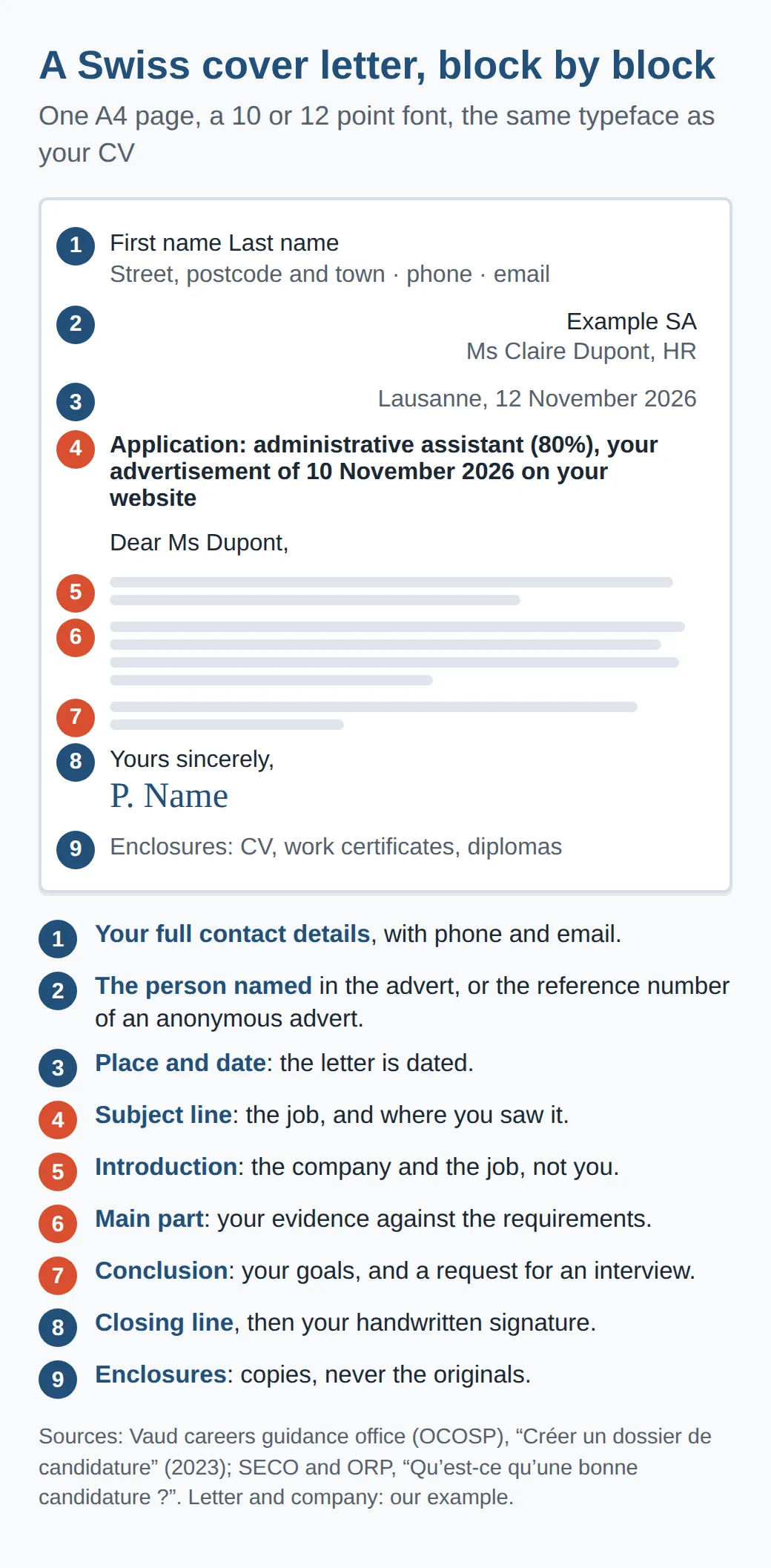
The letter follows a fixed order. The OCOSP guide describes it step by step, and the SECO brochure asks for the same three parts in the middle: your contact details, the recipient, place and date, the subject line, the salutation, the introduction, the main part, the conclusion, the closing line, the signature and the enclosures.
The header and the subject line
Your contact details go at the top: name, address, phone number and email address. Address the letter to the person named in the advert. If the advert runs under a box number, meaning it's anonymous, give its reference number. Date the letter and add the place.
The subject line is the first thing the recruiter sees, the SECO points out. It asks you to state where you heard about the job: an advert, a conversation with a client, a friend, or the ORP. The OCOSP also wants the place and date the vacancy was published. A complete subject line fits on one line:
Application: administrative assistant (80%), your advertisement of 10 November 2026 on your website, ref. 4512
No name? The SECO suggests calling the company's switchboard to find out: a letter addressed to someone always makes a better impression. Otherwise, « Madame, Monsieur » (Dear Sir or Madam) is still the correct form.
The introduction: the company first
For the OCOSP, the introduction puts the focus on the company that's hiring and on the job, not on you. One or two sentences are enough to show you've read the advert and looked at what the company does. The SECO brochure suggests searching online, or in the commercial register, for what sets it apart.
The main part and the conclusion
The heart of the letter links your background to the job's requirements, with facts. The conclusion states your goals and invites the employer to continue the conversation in an interview. Then come the closing line, your handwritten signature, which the Vaud guide explicitly asks for, and the list of enclosures. The main part is the one that takes work. It deserves a method of its own.
Building the main paragraph from the job advert
The ORP brochure offers a simple method: divide a sheet into two columns, with your qualifications and experience on one side and those the advert asks for on the other. It draws a general rule from this: if you meet 80% of the requirements, it's worth applying. So there's no need to tick every box before you write.
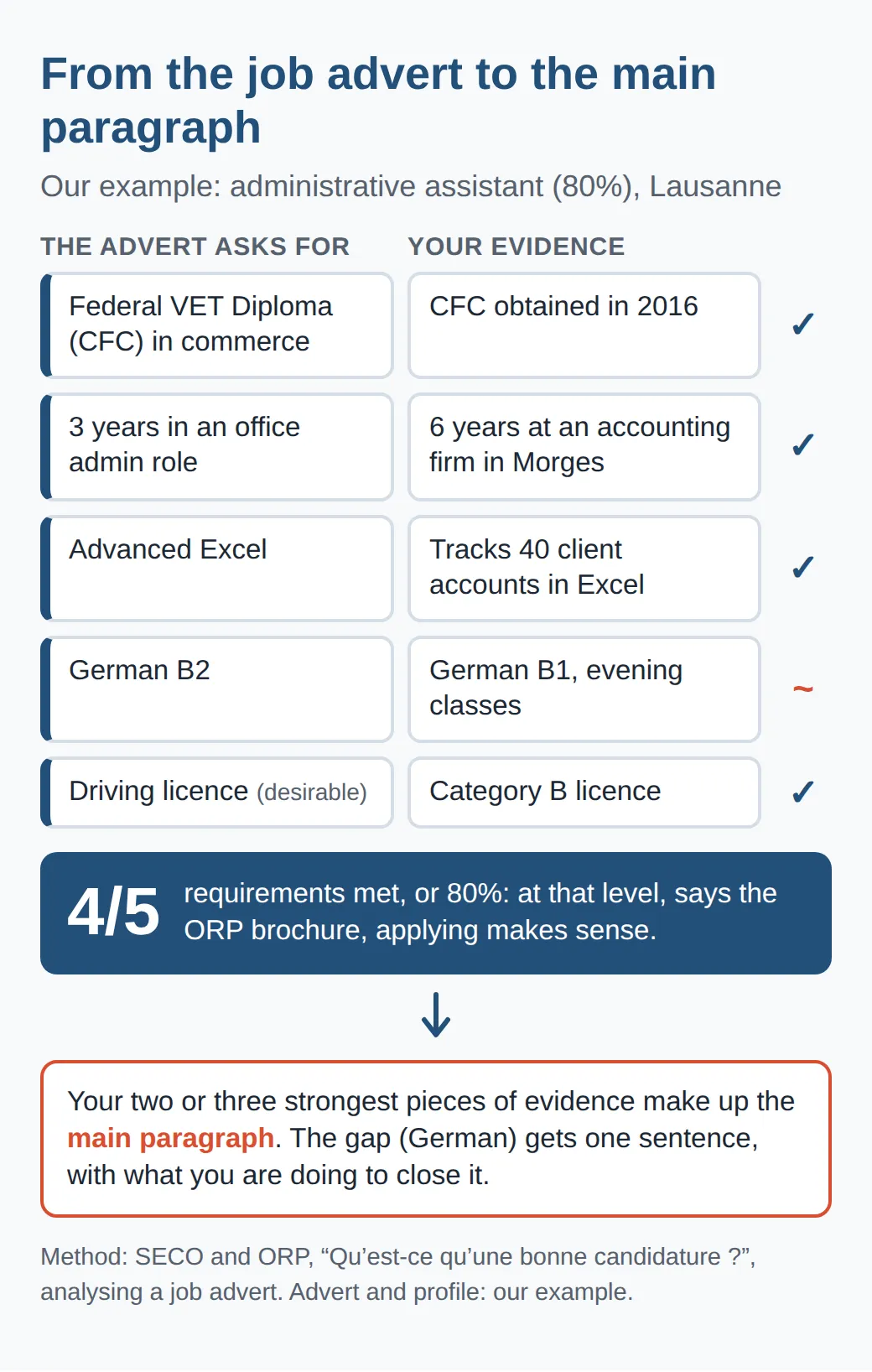
The grid does more than reassure you. It gives you the content of the main paragraph: take the two or three strongest lines and turn them into sentences. For the CV, the SECO advises backing up what you say with figures and choosing action verbs; the rule works just as well for the letter. In our example, it might read:
For six years I have run the office of an accounting firm in Morges, where I am solely responsible for tracking 40 client accounts in Excel. My Federal VET Diploma in commerce (CFC) and this experience directly match the profile you describe.
And the requirement you don't meet? Say it in one sentence, with what you're doing to close the gap: "My German is at B1 level; I'm taking evening classes to reach B2 by the summer." Give the level on the European scale (the CEFR, A1 to C2), as the Vaud guide and the Canton of Geneva ask. A recruiter would rather see a gap named than discover it in the interview.
If the advert leaves you with a question, the SECO suggests calling the person named in it before you write. You learn more about the job, and you can then refer to the call in your letter. What's left is finding the right style to say all this.
Style: direct, precise, no empty phrases
The expected style is plain and direct. The ORP brochure sums up what it wants in three lines: short, clear sentences, personal and targeted wording, a direct style. It also advises writing your own text, even if you start from a template, because that's what sets you apart from other candidates.
The most common trap is a quality claimed without proof. The brochure makes the point about interviews, and the example holds for the letter: saying "I'm good at communication" makes a poor impression, while naming the project where you drew up a staff participation plan proves the same thing. Here are a few rewrites in that spirit. The starting sentences are the ones you read everywhere; the rewrites are our examples, to adapt to your own background.
| Sentence to avoid | Rewrite |
|---|---|
| I am writing to apply for the position. | Your advert of 10 November for an assistant at 80% matches what I have been doing for six years. |
| I am dynamic, motivated and versatile. | In 2025, I took over reception and invoicing on my own while a colleague was on leave. |
| I have no experience in this field. | My six years at an accounting firm taught me the strict deadlines your department works to. |
| Please do not hesitate to contact me for further information. | An interview would let me show you the files I have handled. |
For the set phrases, stick to the classics. In a French letter, the SECO prefers the direct style of « Vous remerciant de l'attention que vous voudrez bien porter à ma candidature » (thanking you for considering my application) to a « Je serais heureux » (I would be happy), and for email it gives « Madame, Monsieur » and « Sincères salutations » (Yours sincerely). Don't apologise either: for the CV, the ORP brochure already asks you to drop pessimistic or negative words, and the rule holds for the letter. Tricky situations are easier to handle with a ready-made sentence.
Phrasing for tricky situations
Four situations come up often, and the official sources offer guidance on each.
A gap in your CV. The SECO advises not to hide it and to mention it in the letter, for example: "I would be glad to tell you about my break from work in 2024 at the interview." Better to own it than to lie, the brochure says: a lie can always come out.
References. The SECO advises leaving them off the CV and giving them on request or at the interview; the Vaud guide, by contrast, gives them a section of the CV. In the letter, if the advert asks for them, one sentence is enough: "I would be happy to provide references at a personal interview." Let the people concerned know before you give their names.
Salary expectations. Only mention them if the advert asks. The ORP brochure lists salary among the interview questions, and orientation.ch, the official Swiss careers guidance portal, advises arriving with concrete figures on the usual pay for the job and aiming towards the top of a reasonable range. Our advice, if the advert insists: give an annual gross range, without justifying it with your living costs.
Your permit and languages. Your residence permit goes in the personal details of your CV, according to the Vaud guide. In the letter, mention it only if it changes something for the employer, such as the date you could start. For a career change, the same logic applies: explain the choice in one sentence, then show what carries over.
Once the letter is written, you still need to send it off without undoing all that work.
Applying by email or through an online portal
Most of the time, applications are made online, notes orientation.ch, which asks you to upload your documents as PDFs and in the right order. Many large companies have you apply on their own website, the SECO notes. The State of Geneva, for example, generally asks for an up-to-date CV, a cover letter, work certificates and diplomas and a copy of your ID, attached to the form before the deadline in the vacancy notice.
For an email application, the SECO brochure is specific:
- The email's subject names the job and the source, for example "Application for the manager position (50%), in reply to your advertisement in Le Temps". "My application" isn't enough.
- One email per application, never a mass mailing.
- The letter goes in the body of the email or as an attached PDF. In that case, keep the email short.
- For a first contact, the CV with a photo and the letter are enough. If you're asked for the rest, put all the documents into a single PDF of five pages at most and under 2 MB.
- Write from a professional address in your own name, never from your current employer's computer, and to the person in charge rather than to an address like info@company.ch.
Keep the editable version too: in its advice for future apprentices, orientation.ch recommends keeping the letter as a Word file so you can adapt it for each new application. These precautions take care of mistakes in form. That leaves the mistakes of substance.
The mistakes that cost you an interview
The most common is the one-size-fits-all letter. EURES notes that employers tend to disregard speculative applications sent as standard letters, and the SECO asks for a targeted letter even for a short application.
Next come spelling mistakes. The ORP brochure asks for an error-free letter and advises rereading it with fresh eyes, two hours later or the next day, asking yourself four questions: do you meet the requirements, are you happy with how you come across, is the message clear, and does the letter make them want to meet you? The OCOSP adds that someone with a good command of French should read it over.
The other mistakes are less obvious: copying out your CV instead of explaining a choice, misspelling the name of the company or the person, running over one page, or sending original certificates. The SECO insists on that last point: certificates can't be replaced, and a copy is enough and doesn't need to be certified. If you're registered as unemployed, one last mistake costs more than an interview.
If you're registered with the ORP
Your letters also serve as proof. The Unemployment Insurance Ordinance (OACI, art. 26) requires targeted job search efforts, as a rule using the usual ways of applying, with proof handed in by the 5th of the following month at the latest, or the next working day. After that deadline, without a valid excuse, they no longer count. The SECO brochure « Être au chômage » ("Being unemployed") states that unsolicited applications are only a complementary method.
The ordinance doesn't set a number of applications. Geneva, for example, asks for at least 2 applications a week, or 8 a month, even before you register as unemployed. The Vaud ORP guide asks you to keep copies of your applications and of the replies you receive, from the moment you know you're losing your job.
So file each letter with the advert behind it, the date you sent it and the reply. The SECO advises keeping rejection letters too. A rushed letter sent just to make up the numbers won't help you: the ORP checks your job search every month, and insufficient efforts can lead to your benefits being suspended. What that costs in francs is set out in our article on unemployment benefits in Switzerland.
After you apply: follow up without pushing
Following up is recommended. If you don't get an acknowledgement of receipt, the ORP brochure advises calling a few days later to check your application arrived and to say you're interested in the job; its sample timeline mentions asking after about ten days without a reply. Avoid questions that tell you nothing, such as how the selection process works.
Your next letter
Open the advert that interests you, draw up the two-column grid, then write the introduction last: that's often where you see most clearly what makes this job different from the others. Current vacancies in French-speaking Switzerland are on our Lausanne, Geneva and office and administration pages.
Common questions
- Should a cover letter in Switzerland be handwritten?
- No, unless the advert asks for it. Vaud's careers guidance office advises typing the letter, in the same typeface as your CV. Only the signature is done by hand. For an online application, orientation.ch suggests scanning your signature and adding it to the letter before saving it as a PDF.
- Does the photo go on the cover letter or on the CV?
- On the CV. The Vaud guide says a photo is usually expected, and the Canton of Geneva asks for a recent, professional photo centred on your face. The cover letter has no photo.
- Should I mention my residence permit in my cover letter?
- It belongs in the personal details of your CV, next to your nationality, as the Vaud guide recommends. In the letter, one sentence is enough if the advert asks about it or if your status changes the date you can start.
- Do unsolicited applications count towards my ORP job search?
- They count, but only as an extra. The SECO points out that your job search should, as a rule, follow the usual ways of applying, and that applications not made for an advertised vacancy are only a complementary method. Keep a copy, as you do for the others.
- Can I use the same cover letter for several jobs?
- You can keep the same base, not the same letter. In its advice for future apprentices, orientation.ch recommends keeping the letter as a Word file so you can adapt it for each application, and sending the final version as a PDF. The subject line, the introduction and the main paragraph change every time.
More posts
All posts
Geneva and Vaud tax at source: correction or TOU by 31 March
Geneva and Vaud: what a tax at source correction fixes, when to ask for a TOU (subsequent ordinary assessment), the 90% rule and the 31 March 2027 deadline.

Temporary work in Switzerland: your rights as a temp in 2026
2 days' notice, at least CHF 25.70 an hour, 13th salary, pension and sick pay: what Swiss law and the staff hire CLA guarantee temps in Romandy.

Foreign diploma recognition in Switzerland: who decides
Regulated job or not: who recognises your French diploma in Switzerland (SERI, Red Cross, FOPH, EDK), the fees, the processing times and the language rules.