Foreign diploma recognition in Switzerland: who decides

Before you apply
You only need recognition if your profession is regulated in Switzerland: doctor, nurse, state-school teacher or architect in Geneva and Vaud, for example. For every other job, you work with your French diploma as it is. One search on the recognition.swiss portal tells you which case you're in and which authority decides.
It's the question newcomers ask too late, or at the wrong door. One Frenchman with a brevet professionnel in restaurant service asked the federal administration twice to assess the level of his diploma, in 2012 and again in 2023, then challenged the answer all the way to the Federal Administrative Court. He lost, paid 1’000 francs in court costs, and the ruling points out in passing that he needed no paperwork at all to wait tables (Federal Administrative Court, ruling B-442/2024, in French). This guide spares you that detour: first whether it concerns you, then who to write to, then what it costs, how long it takes and what you can do in the meantime.
Is your job regulated in Switzerland?
A profession is regulated when the law sets a training requirement for it: without the required diploma, or its recognition, you're not allowed to practise. SERI, the State Secretariat for Education, Research and Innovation, puts it plainly in its fact sheet on architects: holders of foreign qualifications who want to pursue any other occupation "are free to do so without obtaining recognition of their qualifications", and it's the job market that decides whether they find work.
The list is shorter than most people think. It covers the health professions, state-school teaching, part of the building trade (electrical work, fire protection, surveyors, crane operators), private security, ski instructors and hiking guides. SERI publishes a fact sheet for each field. A waiter, a shop assistant or a developer usually needs nothing: their French diploma is enough, and the employer judges it.
The catch is that the rule can come from the Confederation or from the canton. Architecture is the clearest example. No federal law regulates it, but seven cantons do: Geneva, Vaud, Fribourg, Neuchâtel, Ticino, Lucerne and Valais. In Geneva, you have to be listed on the tableau des mandataires professionnellement qualifiés (MPQ) to sign a building permit application. In Vaud, it's registration with the REG, the Swiss register of engineering and architecture professionals, with three years' experience. In Zurich or Basel, a French architect works with their diploma, no formalities needed.
So the first step is always the same: look up your profession on recognition.swiss, SERI's portal. It tells you whether recognition is required and who grants it. If your profession isn't listed as regulated, you can stop there as far as your right to work goes, and read on only if an employer asks you to place your diploma in the Swiss system.
Who decides: five authorities, depending on your diploma
There's no one-stop shop. The canton of Geneva sums up who does what in its step-by-step guide (in French, like all the cantonal pages linked here), and each authority has its own procedure.
| Your diploma | Who decides | What you get |
|---|---|---|
| Vocational training (CAP, BEP, BP, bac pro) | SERI | Recognition or level certificate |
| Nursing, physiotherapy, midwifery, occupational therapy, paramedic | Swiss Red Cross | Recognition, then entry in the register |
| Doctor, dentist, pharmacist, vet, chiropractor | FOPH, MEBEKO commission | Recognition, then entry in MedReg |
| Teacher, speech therapist, psychomotor therapist | EDK | Recognition of the teaching qualification |
| University degree for an unregulated job | Swiss ENIC (swissuniversities) | Level certificate, not binding |
The FOPH is the Federal Office of Public Health, and the EDK, called CDIP in French, is the Swiss Conference of Cantonal Ministers of Education. SERI also handles higher education degrees when the target profession is regulated, as architecture is. The Swiss Red Cross, despite its name, is the competent authority for around twenty non-university health professions. And for a few jobs, the canton does the recognising itself: the canton of Valais names hotel and restaurant operators, forestry workers and construction machine operators.
Once you've found the right door, you still need to know which document to ask for, because there are two, and they're worth very different things.
Recognition or level certificate: two different documents
Recognition gives you the right to practise a regulated profession; a level certificate places your diploma in the Swiss system and doesn't let you do anything more. SERI's FAQ draws the line clearly: a level certificate states the level and length of your training, without looking at what it covered and without pointing to a specific Swiss diploma. Recognition, by contrast, certifies that your qualification is equivalent to a particular Swiss one.
The criteria are in the Vocational and Professional Education and Training Ordinance (VPETO, Art. 69a and 69b). For a level certificate, the level and the length of training have to match. For recognition, the content must also be comparable, and the training must include practice, gained during the course or through work experience. In a notice from September 2026 (in French) written for the boards that run federal professional examinations, SERI restates the basic rule: two years of training generally corresponds to a Federal VET Certificate (AFP), three or four years to a Federal VET Diploma (CFC).
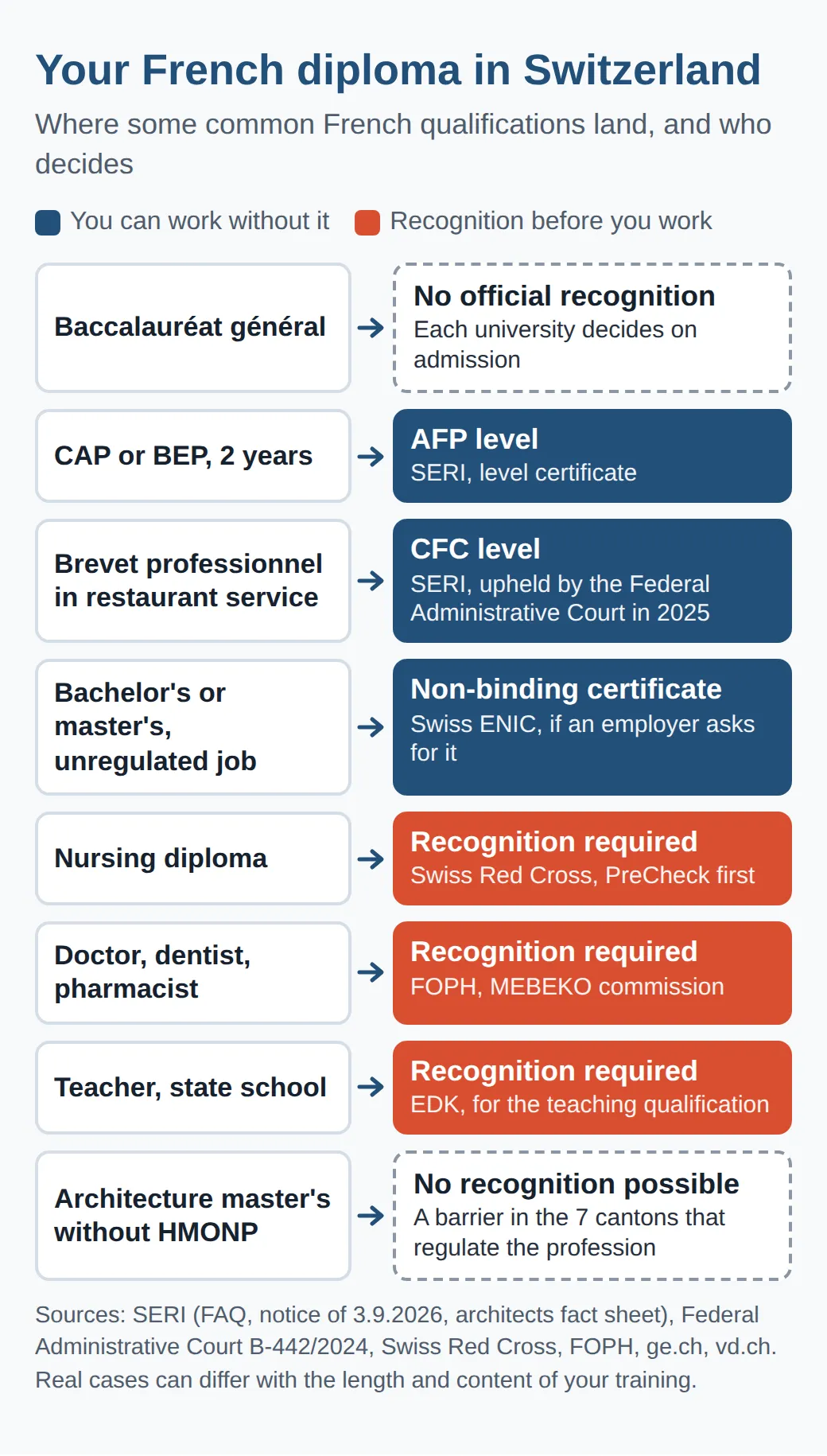
The January 2025 ruling shows what this means for a French diploma. The appellant held a CAP and a BEP in restaurant service, then a brevet professionnel (BP) obtained in 2000. SERI placed the BP at CFC level. He wanted the level of the Federal Vocational Baccalaureate, or even of a Federal PET Diploma, arguing that in France the BP is worth a bac pro. The court sided with SERI: the BP doesn't give access to higher education, so it can't reach the level of the vocational baccalaureate, and its two years of training are too short for a higher qualification. The court added that the CAP and the BEP, both two-year courses, correspond to AFP level. Appeal dismissed, and he had to pay 1’000 francs in costs.
Keep two things in mind. A level certificate doesn't move you up a step, it places you; if your profession isn't regulated, all it does is reassure an employer who doesn't know your diploma. And for a regulated profession you need full recognition, which often relies on the EU directive.
Your French diploma and the EU directive
As an EU national with a French diploma, you benefit from the Agreement on the Free Movement of Persons (AFMP), whose Annex III (in French: Fedlex has no English version) applies EU Directive 2005/36 on the recognition of qualifications in Switzerland. SERI sums up the legal basis: the directive guarantees mutual recognition of qualifications between the EU and Switzerland. It only comes into play, though, if Switzerland regulates the profession, and the Federal Administrative Court says as much in the ruling above: a profession that is unregulated in Switzerland falls outside EU law on diplomas.
The directive sets a second condition that people often miss: you must be fully qualified in France. SERI's architects fact sheet gives the example of a French architect with a master's degree but without the HMONP, the habilitation à la maîtrise d'œuvre en son nom propre, who cannot have their qualifications recognised because they aren't allowed to practise in France. The same logic applies to a nurse who hasn't finished training: SERI only recognises completed training, and the canton of Geneva states that training backed only by a certificate of attendance cannot be recognised.
For a few professions, including architects, general care nurses, midwives and the medical professions, the directive provides for automatic recognition of the diplomas listed in its annexes, with no review of the syllabus. For an architect in that position, SERI issues a letter that opens the way to the cantonal registers, within two to three weeks on average according to its 2023 fact sheet. For everyone else, the authority compares the training and may impose a compensatory measure: an aptitude test, lasting from a few hours to one or two days, or an adaptation period of a few months to one or two years, which you have to find yourself. SERI's FAQ says there's no formal deadline for completing them, but advises against waiting, since the Swiss reference training may change in the meantime.
If you stay based in France and only come over to provide services, for at most 90 working days per calendar year, you don't need full recognition. For a regulated profession, you declare your qualifications to SERI before you start; for the medical professions, the FOPH asks you to do so at least 30 days ahead. The days themselves are reported on easygov.swiss, even for an unregulated job. A cross-border commuter employed by a Swiss company isn't in this situation: they follow the ordinary procedure, with their G permit.
That leaves the question that often decides a move: how long, and how much.
Fees and processing times, authority by authority
Expect anywhere from nothing to just over 1’000 francs, and from a few weeks to ten months, depending on the authority and the type of decision, not counting compensatory measures. None of them offers an express procedure.
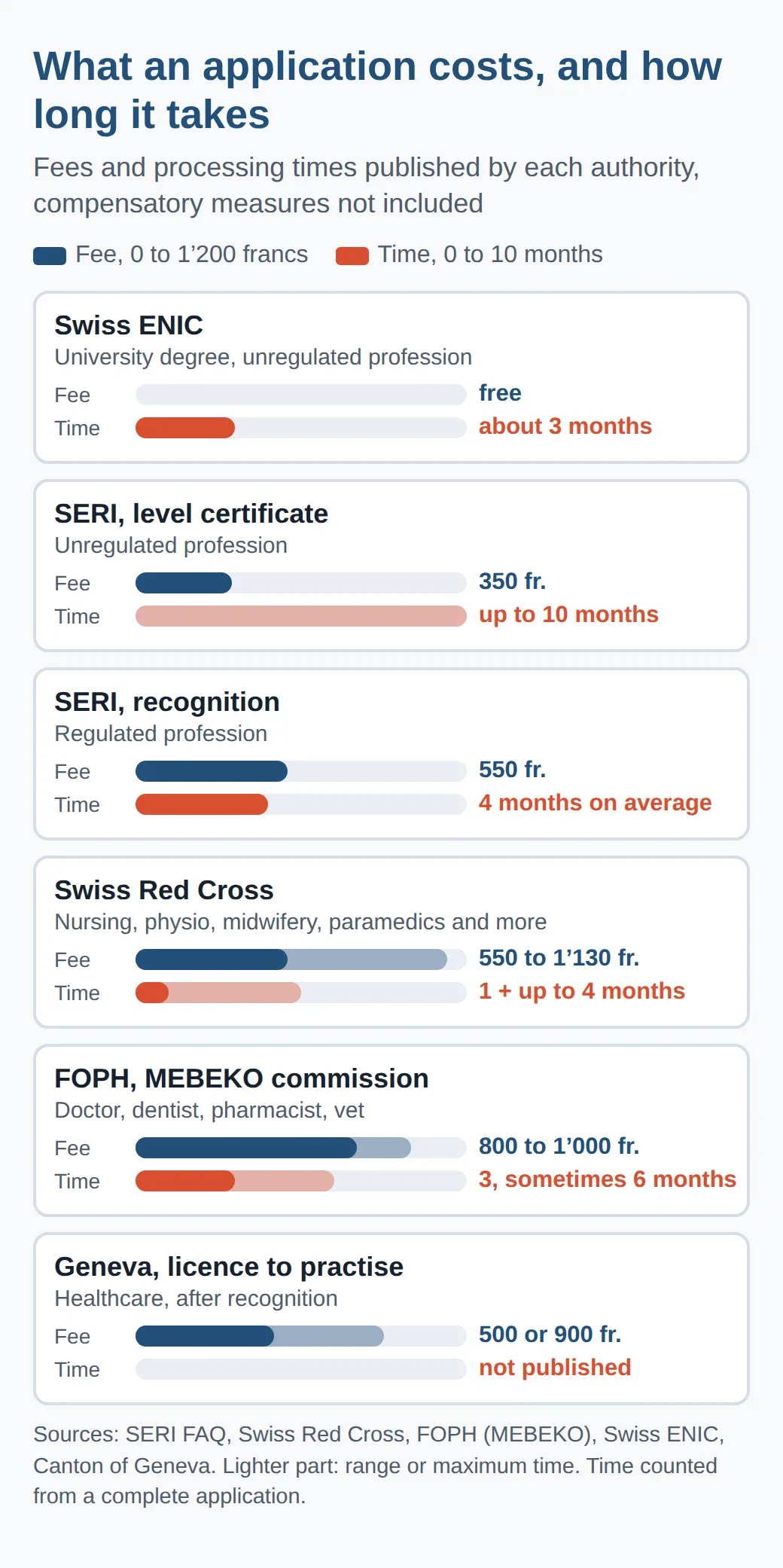
At SERI, a level certificate costs 350 francs and recognition 550 francs. You apply online through the SERI portal, and SERI emails you within four weeks with the next steps. Processing takes 4 months on average for regulated professions, which get priority, and up to 10 months for a level certificate. You pay by a single bank transfer, in Swiss francs rather than euros, with bank charges at your expense. The review only starts once the file is complete and paid, and SERI asks you not to chase it: every extra email slows everyone down.
At the Swiss Red Cross, everything starts with a free, compulsory PreCheck, answered within four weeks at most. The application itself leads to a first decision within four months at most of receiving a complete file. The fee is 550 francs for a nursing or midwifery diploma listed in Annex V of the directive, 930 francs without compensatory measures and 1’000 francs with them. Depending on the profession, entry in the national register adds 130 francs.
At the FOPH, the Medical Professions Commission (MEBEKO) charges 800 to 1’000 francs (page in French) for direct recognition. The file goes by post only, in a single envelope, with certified copies, as nothing is sent back. The office quotes about three months of processing, and up to six in its FAQ.
At Swiss ENIC, the certificate for a university degree is free and takes about three months, but it's only issued if four conditions are met: you want to work in Switzerland, you've applied for Swiss vacancies in the last three months, an employer explicitly asks for it, and the profession you're aiming for isn't regulated. It has no legal effect on your title.
Teachers: the EDK, before you apply
To teach in a state school, you need your teaching qualification recognised by the EDK, which publishes its procedure and an FAQ on its page on foreign diplomas. The canton of Vaud requires the EDK certificate to be attached to your application to teach at an upper secondary school or a vocational school, and Geneva requires the same recognition for its state schools. So start the process before the application season, not after it.
Healthcare: the canton's licence on top
In healthcare, federal recognition isn't enough: the canton then grants you a licence to practise. In Geneva, it costs 900 francs for a doctor, dentist, vet, chiropractor or pharmacist working under their own professional responsibility, and 500 francs for the other professions. You attach a criminal record extract and a medical certificate less than three months old. And a language certificate, with some exceptions.
Language: B2, which you may already have proved
For the health professions, the required level is B2 in the language you'll work in. For a French national moving to French-speaking Switzerland, that's usually a formality, but you need to know how to prove it.
Geneva exempts native French speakers and people trained in French from the certificate. Vaud does it differently: its page on the required language level asks for B2 in every profession and C1 for doctors who bill basic health insurance. It accepts three kinds of proof for B2: postgraduate training taken mainly in French, three years of work experience in French within the last ten years, or a DELF B2 less than six years old. Language school certificates and the TCF don't count. A nurse who has worked for three years in Lyon or Annecy therefore already meets the requirement through experience.
For entry in the federal register of medical professions (MedReg), the FOPH accepts the same kinds of proof: a certificate less than six years old, a diploma obtained in that language, or three years of experience within the last ten years. SERI only asks for a language certificate case by case, and the ones it accepts include the DELF, the DALF, the TELC French B2 and the certificate of the Geneva Chamber of Commerce, Industry and Services (CCIG). Language is rarely what holds up a French application; missing documents are far more often to blame.
The application: what you'll be asked for
SERI and the canton of Geneva describe the same basic file, in three parts: an identity document, the diploma in its original language and, if it isn't in French, German, Italian or English, an official translation. So a French diploma doesn't need translating. The rest depends on the authority:
- Certified copies: from a town hall or your commune of residence in Switzerland (except in Vaud, Geneva and Ticino), an embassy, a consulate, a lawyer or a notary. It's the copy of the original diploma that gets certified, not the translation.
- Programme of study and proof of experience: SERI may ask for the list of courses you took and a document from your employer describing your role, your tasks, your employment percentage and how long you worked there.
- Certificate of good standing for healthcare: the Swiss Red Cross requires a certificate from the authority of the last country where you practised, a Certificate of Current Professional Status or Letter of Good Standing, less than three months old when you submit. In France, it's up to you to request it.
Also know what will never be recognised, so you don't waste the fee: school-leaving certificates, the general bac, continuing education (CAS, DAS, MAS), unfinished training, and a private-school diploma that the French state doesn't recognise or that no official body has accredited.
While your application is pending
What you can do depends on one thing: the status of your profession.
Unregulated job: apply now
If your profession isn't regulated, don't wait for anything. You can send the level certificate later, or suggest that the employer ask for the Swiss ENIC certificate. In your cover letter, give the French diploma's name as it's written and say in one sentence what it covers; our article on the cover letter shows how.
Regulated job: what stays open
If your profession is regulated, the rule is strict. The FOPH says it bluntly for doctors: no practising until the procedure is over and you're entered in MedReg. But only the regulated activity is closed to you. In principle, then, a nurse can take a job that doesn't require the title while she waits, and an architect can work in a practice as long as someone else signs the building permit applications. Vaud has also made an exception for language: an employee of an inpatient care facility or a care home can get a provisional 12-month licence, on condition that they produce their DELF B2 before it runs out, with no extension possible.
On timing, you can apply from France: SERI accepts applications from abroad as long as you're entitled to settle in Switzerland. You might as well start the procedure before you move.
And if no recognition is possible, other routes remain. The REG runs its own exams for architects and engineers without a recognised diploma, after several years of practice. For a trade covered by vocational training, an experienced adult can go straight for the CFC, a route described in our article on changing careers. If a decision looks wrong to you, it states how to appeal; the ruling on the brevet professionnel shows what a lost appeal costs.
Where to start
Look up your profession on recognition.swiss first, then check that you're fully qualified in France, with the final diploma and not a certificate of attendance. If the job is unregulated, start applying and save the 350 francs. If it's regulated, run the preliminary check without delay (the Red Cross PreCheck doesn't need the certificate of good standing yet), get certified copies made before you move, while the town hall is still round the corner, and only ask the French authorities for the certificate of good standing when you submit, since it must be less than three months old. For a health profession or one handled by SERI, then allow four to six months between a complete file and the decision, plus the canton's licence in healthcare: those are the times the authorities publish themselves, and none of them promises to go any faster.
Common questions
- Is a French baccalaureate recognised in Switzerland?
- No Swiss body officially recognises a foreign general baccalaureate or Matura. For work, that's almost never a problem, since the bac doesn't qualify you for any regulated profession. To study, each university decides whether to admit you, based on the country-by-country requirements published by swissuniversities.
- Do I need to translate my French diploma for recognition in Switzerland?
- No. SERI and the canton of Geneva only ask for an official translation when a diploma is in a language other than French, German, Italian or English. You do need a certified copy of the diploma in its original language, though.
- Can I speed up recognition if an employer is waiting for me?
- No. SERI says an accelerated procedure isn't possible, even in urgent cases, and it handles complete applications in the order they arrive. The FOPH applies the same rule to the medical professions. The only thing you can do is send a complete file and pay straight away.
- Is recognition obtained for Geneva also valid in Vaud?
- Recognition from SERI, the Swiss Red Cross or the FOPH is valid across Switzerland. The licence to practise, on the other hand, is cantonal: if you move from Geneva to Lausanne, you apply to the canton of Vaud for a new licence, without redoing the recognition.
- Can I use my French title, such as engineer or master's, in Switzerland?
- You can use your foreign title exactly as it's written on the diploma. Recognition gives you the same right to practise as a Swiss graduate, but not the right to use the protected Swiss title. There's no national rule on academic titles: the cantonal laws on higher education govern them.
More posts
All posts
Temporary work in Switzerland: your rights as a temp in 2026
2 days' notice, at least CHF 25.70 an hour, 13th salary, pension and sick pay: what Swiss law and the staff hire CLA guarantee temps in Romandy.

Career change in Switzerland: who funds retraining in 2026
Free career review from 40, a 750-franc cheque in Geneva, unemployment, disability insurance, grants, adult CFC: who funds retraining in Romandie.

Average salary in Geneva, Vaud and Romandy: 2024 figures
Median salary in 2024: CHF 7,893 in Geneva, 6,810 in Vaud, 6,434 in Valais. Official figures by canton and sector, plus minimum wages in Romandy.