Career change in Switzerland: who funds retraining in 2026

The short answer
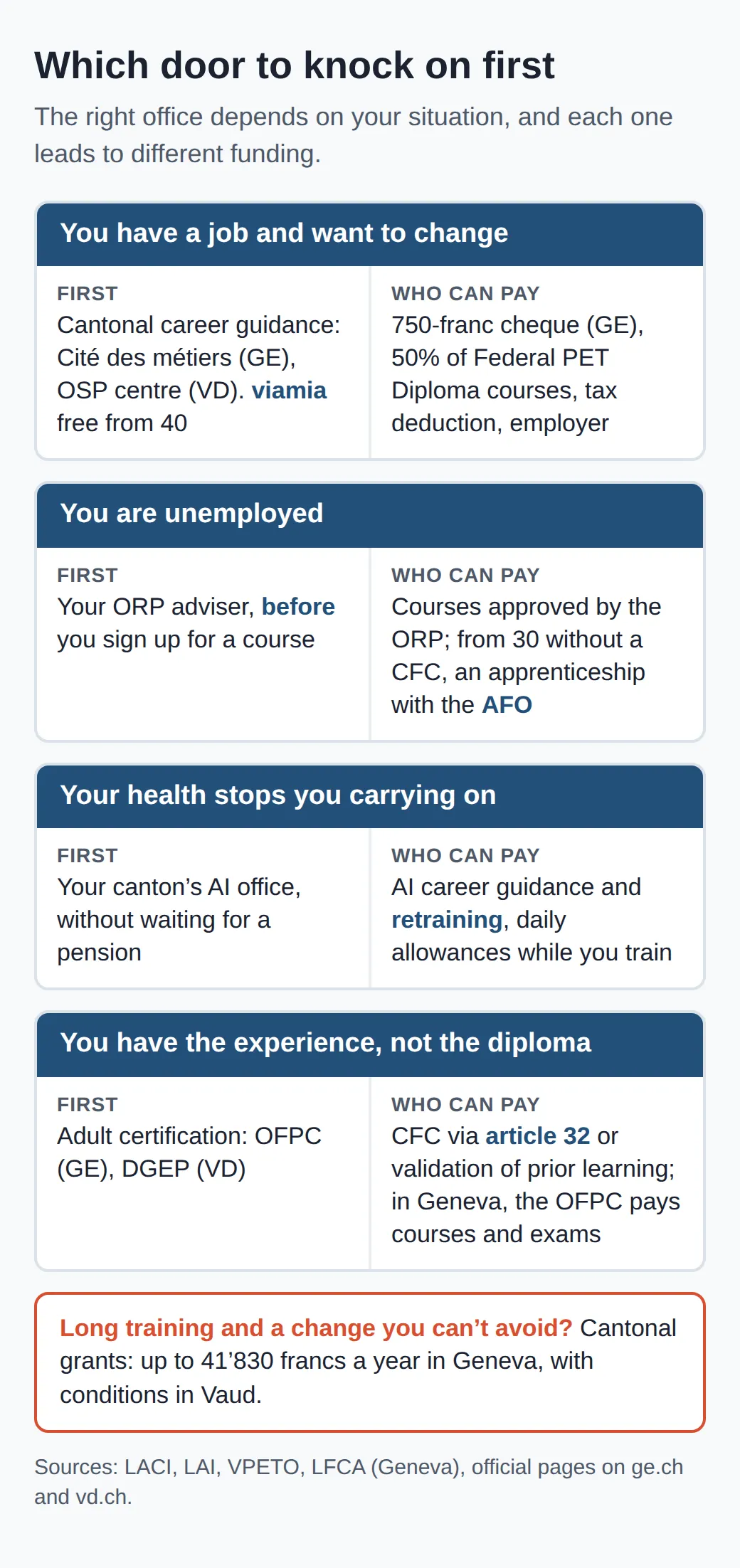
A career change in Switzerland is rarely paid for from a single source. The first review is often free (viamia from age 40, public career guidance in Geneva), Geneva gives you 750 francs a year towards a course, the Confederation refunds half the cost of Federal PET Diploma courses, and unemployment insurance, disability insurance or a grant can take over depending on your situation.
There's no national training account like the one in France. The money comes from four sources that don't always talk to each other: your canton, the Confederation, unemployment insurance and disability insurance. Each has its own way in, its own deadlines and its usual reasons for saying no, and the order in which you approach them often decides what you end up with. So this guide starts from your situation, not from a list of benefits. We checked every amount and every condition in the law or on the official page that sets it, mainly for Geneva and Vaud, along with the federal rules that apply everywhere. Most of these texts exist only in French, so that's where our links go; the federal training ordinance is the exception, and we link its English version.
Take stock before you pay for anything
Start with a public career guidance interview: it's free in Geneva for people who pay tax in the canton, free everywhere with viamia from 40, and it points you to the right kind of help. Private assessments are expensive and only make sense afterwards, if you need a particular document.
In Geneva, the way in is the Cité des métiers at rue Prévost-Martin 6, run by the cantonal office for career guidance and vocational and continuing education, the Office pour l’orientation, la formation professionnelle et continue (OFPC). You can walk in without an appointment for a short interview, and if needed the adviser then offers you an adult career guidance consultation with a psychologist trained in career guidance. According to the Cité des métiers, that consultation is free for Geneva taxpayers. If you don't live in Geneva, you show a payslip from the current year.
In the canton of Vaud, career guidance for adults is the job of the cantonal guidance office, the Office cantonal d’orientation scolaire et professionnelle (OCOSP), which belongs to the directorate for post-compulsory education (DGEP). You call the guidance centre for your region or fill in a request online. These centres offer three kinds of review: a career review, a reorientation review and a skills analysis (vd.ch). The cantonal page doesn't publish a fee for these consultations, so ask when you book.
If you're 40 or over, ask for viamia. It's a free career review: one or more sessions with an adviser, ending with concrete next steps. In Vaud, you first fill in an online questionnaire and send an up-to-date CV. The programme was launched with federal money, and since 2026 the cantons have paid for it. It's offered everywhere except Aargau. One condition applies in every canton: you're not eligible if unemployment insurance, disability insurance or social assistance already offers you something similar. Vaud also requires you to live in the canton (vd.ch), and Geneva to live or pay tax there.
A private skills assessment, the bilan de compétences, has its place when a course requires one or when you want a full written assessment. The Bilan-Portfolio recognised by ARRA, the association for the recognition of prior learning, takes 20 to 30 hours in a group and 30 to 100 hours of work on your own. Prices vary by provider. In Geneva, CEBIG lists 2’000 francs plus VAT, or 750 francs plus VAT if you work for a Geneva company, thanks to a subsidy. That reduced rate already shows how Geneva works: a lot of its help depends on your status as an employee or taxpayer in the canton.
Turn your experience into a CFC
If you've worked in a trade for years without the diploma for it, the shortest route is often adult certification. The CFC is the Federal Diploma of Vocational Education and Training, the standard Swiss qualification at the end of an apprenticeship. The federal rule is simple: someone who learned their trade outside a formal training programme can sit the CFC exams with at least five years of work experience (VPETO, art. 32). This is known as the "article 32" route. The second route, validation of prior learning (VAE in French), replaces the exam with a portfolio that proves your skills. It only exists for some trades.
In Geneva, certification goes through the OFPC. You must have lived or paid tax in the canton for at least 12 months without a break, have worked at least five years in total, several of them in the trade you're aiming for, and be free to attend courses or a VAE process. The OFPC pays for the courses and the exams. You pay for books, software licences, travel, tools and work clothes yourself.
In Vaud, the DGEP requires you to live in the canton, or to work there if you're a cross-border commuter, and to have at least five years of full-time experience, two to five of them in the trade you're aiming for, depending on that trade's ordinance (vd.ch). You also need French at B1 level for a CFC, or A2 for an AFP, the two-year Federal VET Certificate. The canton recommends sending your application by spring at the latest for classes that start in August. A later application may have to wait for the following year's intake.
This is no fringe route. An article published by the Vaud guidance office counts 1’333 people over 25 certified in 2024, up from 1’110 in 2021, 60% of them through article 32 or VAE, with an average age of 39. It tells the story of a restaurateur who got her CFC through article 32 after twelve years in the trade, with nine months of classes one Monday a week, and of a logistics worker who came to Switzerland from Italy at 20 and went through VAE: about 250 hours on his portfolio, with nine months of support. With a CFC in hand, a move into a management role or a Federal PET Diploma becomes possible, and that's where the Confederation comes in.
Federal PET Diploma: half the course fees come back
The Confederation refunds 50% of the fees for a course that prepares you for a federal professional examination, which leads to the Federal PET Diploma (brevet fédéral), or for an advanced federal professional examination, which leads to the Advanced Federal PET Diploma (diplôme fédéral). Fees count up to 19’000 francs for the first and 21’000 for the second (VPETO, art. 66f). So the most you can get back is 9’500 or 10’500 francs. This help applies throughout Switzerland and doesn't depend on your income.
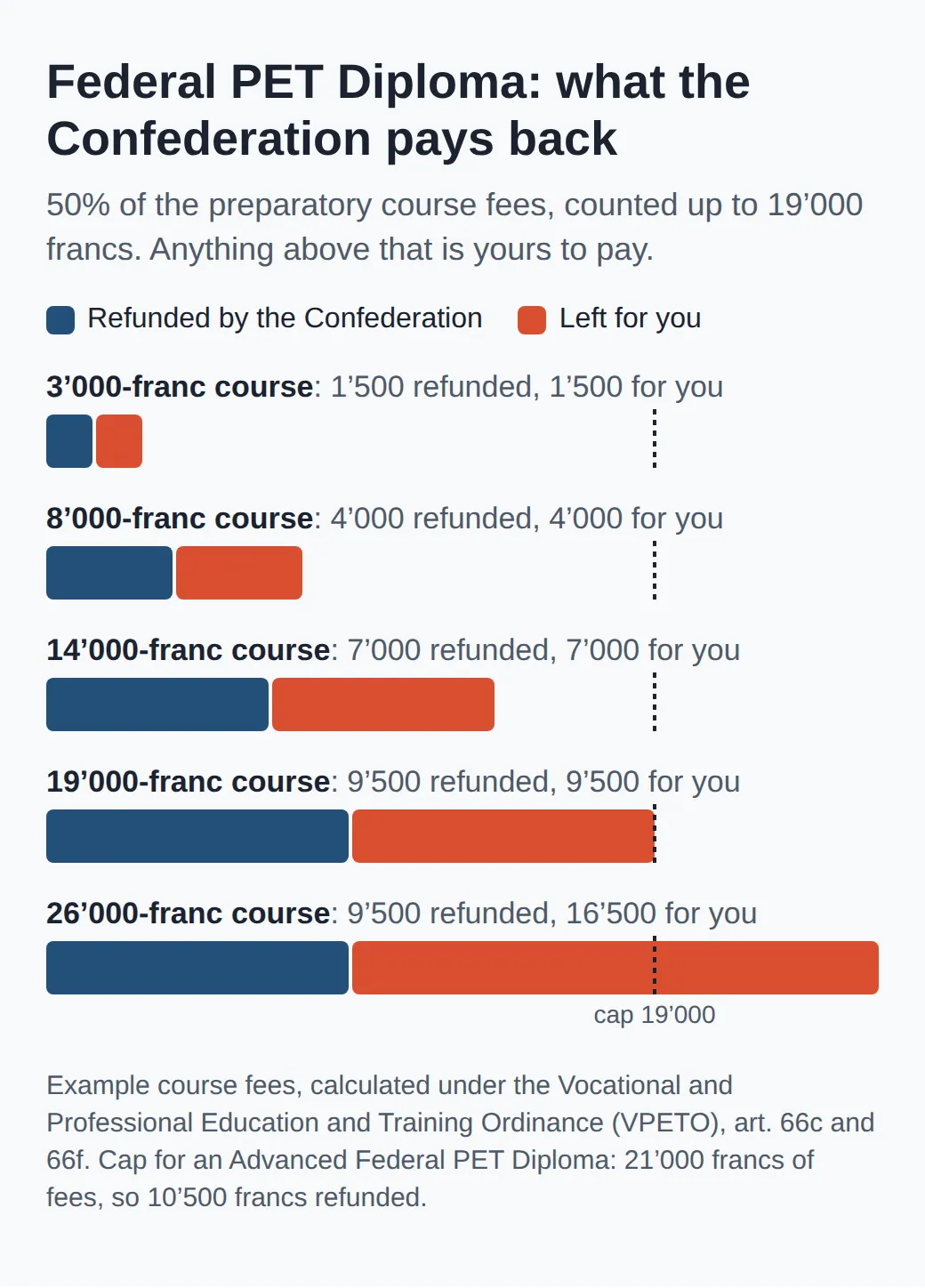
The conditions are precise (VPETO, art. 66c). The course must be on the official list of preparatory courses in the year it starts, cost more than 1’000 francs in total and have started no more than seven years before the exam result. You must have your tax domicile in Switzerland when that result is issued and apply within two years of it. Only course fees you paid yourself count: not travel, meals or hotel nights. The catch is cash flow: as a rule, you pay everything up front and the money arrives after the exam. If your last tax assessment had you paying less than 88 francs of direct federal tax, you can ask for part of the subsidy before the exam, for more than 3’500 francs of fees per application (art. 66e).
In Vaud, the FONPRO foundation also refunds part of what you paid yourself, if you work for a Vaud company when you apply. Its guidelines set 25% of the course fees, up to 2’500 francs, plus the final exam fee, up to 3’000 francs. Self-employed and unemployed people aren't eligible. In Geneva, shorter courses have their own tool: the annual training cheque.
Employed in Geneva: the annual training cheque
The annual training cheque (chèque annuel de formation, CAF) pays up to 750 francs a year towards a course that's useful for your work, the price of 40 hours of classes (LFCA, art. 9A). Unused cheques can be pooled over three years at most. For a course that's part of a programme leading to a qualification, such as preparing for a CFC, a Federal PET Diploma or another recognised qualification, or for a basic course in reading, writing, maths or computer skills, the State can pay up to 2’250 francs in one go, three cheques' worth, for 120 hours of classes. For a language or IT course with no recognised exam at the end, the cap drops to 500 francs.
Adults who have lived and paid tax in Geneva for at least a year are eligible, and so are people who have held a G permit for cross-border commuters for at least a year, and Swiss citizens from a border area who have worked in the canton for a year. The income limit is based on the unified determining income (revenu déterminant unifié, RDU), which adds up your income, any benefits you receive and one fifteenth of your assets. It's 72’000 francs for a single person and 116’000 francs for a married couple or registered partners, plus 8’000 francs per dependent child (conditions on ge.ch).
You apply online with your AVS number, and always before the course starts. With an e-démarches account, the decision can come straight away. Otherwise a letter follows within 10 days (ge.ch). The cheque isn't money paid into your account: you give your reference number to the school, which takes the amount off the price and claims it back from the State (questions and answers on the CAF). So the school must be approved by the State for the cheque. Ask whether it accepts it before you enrol, not after.
The CAF covers a module or a refresher course. For a real career change lasting several years, you'll need an income while you train, and that's where unemployment insurance or a grant comes in.
Unemployed: what the ORP pays for, and what it turns down
Unemployment insurance does pay for retraining courses, but only if they help you get back into work. The Unemployment Insurance Act lists individual and group retraining courses among its training measures by name (LACI, art. 60). They're meant for insured people who are hard to place for reasons linked to the labour market (LACI, art. 59). Wanting a change isn't enough: your adviser at the ORP, your regional employment centre, decides whether your old trade still has openings.
The order of the steps matters. If you find a course yourself, send a reasoned request to the ORP at least ten days before it starts. If you send it after the course has begun, without a valid excuse, the insurance only pays from the date of your request (OACI, art. 81e). During an approved course, you don't have to be available for work if the course requires it. If you're over 50, you can attend training measures until the end of your benefit period, even once your daily allowances have run out. How the allowances themselves are worked out, how long they last and what you owe the ORP are in our article on unemployment in Switzerland.
The training allowance: a paid apprenticeship with up to 3’500 francs a month
For adults without a diploma, unemployment insurance has a more powerful and little-known tool: the training allowance (allocation de formation, AFO). It lets you do a full apprenticeship, up to three years, on an income close to a wage. You must be at least 30 and have no vocational qualification recognised in Switzerland, or have great difficulty finding work with the one you have (LACI, art. 66a). People with a degree from a university or a university of applied sciences, and those who have passed the exam for a Federal PET Diploma or an Advanced Federal PET Diploma, are excluded. Geneva opens it from 25 by exception.
Here's how it works. You sign an apprenticeship contract with a training company. The employer usually pays you a final-year apprentice's wage, and the insurance tops up the difference to a maximum of 3’500 francs a month (OACI, art. 90a). Your benefit period is extended until the end of the training, and you no longer have to look for a job. The request goes in eight weeks before the apprenticeship starts. In Lausanne, the ORP points out that the allowance is renewed every year, two months before the new training year.
From the 2024 school year, Geneva added a cantonal top-up of 800 francs gross a month, for an income of 4’300 francs throughout the training (Council of State announcement). It's a pilot project. In February 2026, the canton was still featuring an apprentice who received it, but no end date has been published, so ask the OCE, Geneva's cantonal employment office, whether it applies to your contract. The real difficulty lies elsewhere: finding the apprenticeship place is up to you. Training companies in Vaud post their apprenticeship places too. If it's your health, not the market, that forces the change, the ORP is no longer the office to see.
When your health forces the change: disability insurance
Disability insurance (AI) pays for retraining in a new occupation if your health problem makes it necessary and the measure is likely to maintain or improve your earning capacity (LAI, art. 17). Before that, it can fund career guidance if your condition makes your old job difficult (art. 15). If the measure keeps you from working for at least three days in a row, or if your incapacity for work reaches 50% (art. 22), you receive a basic daily allowance of 80% of the income from the last job you did without health problems, up to a cap (art. 23).
The threshold isn't written in the law but in case law. The Federal Supreme Court restated it in a ruling of 15 February 2018 (9C_23/2018): the right to retraining requires a loss of earning capacity of about 20%. In that case, a winegrower with an injured ankle had already had two commercial clerk courses paid for by the AI, and dropped out of both. With a disability rate of 18% and doubts about his ability to finish, he didn't get a third measure. There are two lessons: below that threshold, the AI isn't the right door, and a measure you abandon counts against the next one.
Don't wait for a pension before you come forward. You can report your own case to your canton's AI office as soon as you're unable to work, or at risk of being so for a long time (art. 3b). The office decides within 30 days whether early intervention measures are called for. It can also advise you, and your employer, before any formal application. If neither the AI nor unemployment insurance covers you, there are still grants.
Grants when you already have a trade
Cantonal grants aren't only for 20-year-old students, but as an adult you have to prove that the career change is necessary. Geneva has a dedicated retraining grant for this, which can reach 41’830 francs a year, plus 4’000 francs per dependent child. The cap is high because the grant also has to cover your living costs during the training.
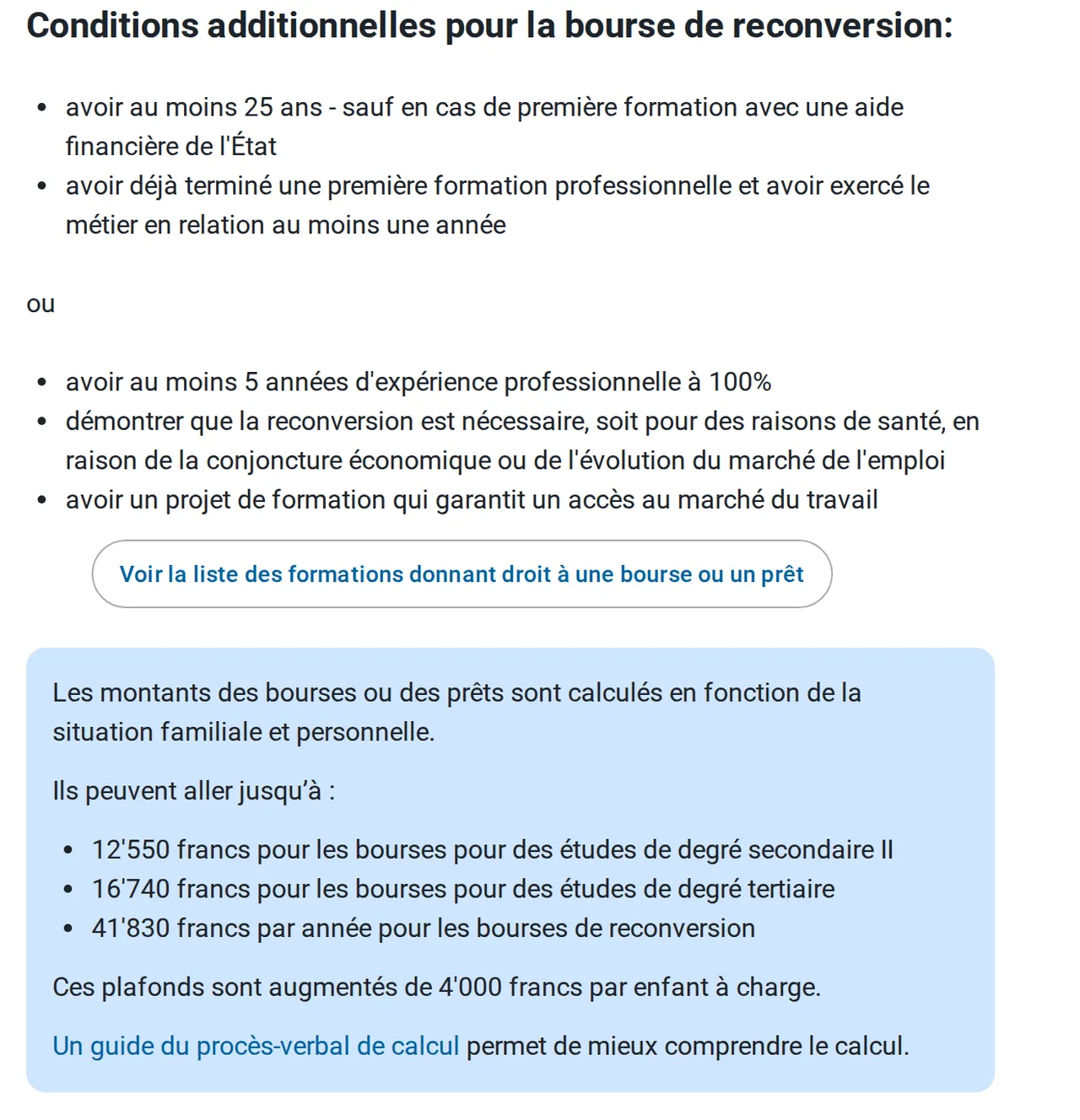
These conditions come on top of those for any Geneva grant, which are mostly about where you live (ge.ch). You must be at least 25, have completed initial training and worked in that trade for at least a year, or have five years of full-time experience. You also have to show that the change is necessary, for health reasons, because of the economic situation or because the labour market has changed, and choose training that leads to a job. Apply no later than six months after the start of the school year. Applications are accepted from the May before, and applying early makes processing easier.
Vaud has no separate retraining grant, but its general rule bends. A grant is normally only paid towards a higher qualification than the one you already have. One exception covers exactly a career change made necessary by your health or the economic situation, with evidence (vd.ch). If your case fits none of these exceptions, a loan may be possible, to be repaid after the training. If your parents don't live in the canton, you can still apply for a Vaud grant if you've lived there for at least two years and your work has made you financially independent after initial training.
Where to start
First, book a public career guidance interview, or viamia if you're 40 or over. It's often free, and the adviser will tell you which of the doors above is yours. If you're unemployed, talk to your ORP adviser about your plan before you sign anything with a school. If your health is the issue, report to the AI office without waiting for a final medical decision.
Then do the sums before you resign. How much does the training cost, how many months will you go without a full salary, and how much of it will the CAF, the federal subsidy or a grant cover? Compare the pay in the job you're aiming for with your own, using our figures on salaries in French-speaking Switzerland. A part-time job often lets you train without giving up all your income, and it counts towards the years of experience the adult CFC requires.
Finally, work out how you'll tell the story of your change. A recruiter reads a career change as a risk until you show what you bring from your old job. Our guide to the cover letter shows how to say it in a few lines.
Common questions
- Will unemployment insurance pay for retraining if I quit my job to change careers?
- Rarely. Leaving a suitable job without another one lined up normally counts as a serious fault, punished by 31 to 60 days of suspended benefits. After that, the ORP, your regional employment centre, only funds a course if it improves your chances of finding work on today's job market. Wanting a change isn't enough: negotiate training alongside your job instead, or start with a career review.
- Do I have to pass the exam to get the federal subsidy for a Federal PET Diploma course?
- No. You must have sat the federal professional examination or the advanced one, but the pass or fail decision is enough to apply. You have two years from that decision to send your application to SERI, the State Secretariat for Education, Research and Innovation, with the invoices and the school's proof of payment.
- Can I deduct retraining costs from my taxes in Switzerland?
- Yes, for direct federal tax, up to 13’000 francs a year, if you already have an upper secondary qualification such as a CFC or a Matura, or if you're at least 20 and the course leads to something other than a first qualification at that level. Training paid for by your employer isn't taxed as salary. The cantons set their own caps, so check the one on your tax return.
- Is there an age limit for retraining in Switzerland?
- Not for the adult CFC or for the federal subsidy on Federal PET Diploma courses. Some forms of help do have a minimum age, though: 25 for the Geneva retraining grant, 30 for the unemployment training allowance, with exceptions, and 40 for the free viamia career review. The canton of Vaud names no age limit for its grants on its official page.
More posts
All posts
Temporary work in Switzerland: your rights as a temp in 2026
2 days' notice, at least CHF 25.70 an hour, 13th salary, pension and sick pay: what Swiss law and the staff hire CLA guarantee temps in Romandy.

Foreign diploma recognition in Switzerland: who decides
Regulated job or not: who recognises your French diploma in Switzerland (SERI, Red Cross, FOPH, EDK), the fees, the processing times and the language rules.

Average salary in Geneva, Vaud and Romandy: 2024 figures
Median salary in 2024: CHF 7,893 in Geneva, 6,810 in Vaud, 6,434 in Valais. Official figures by canton and sector, plus minimum wages in Romandy.