Average salary in Geneva, Vaud and Romandy: 2024 figures

The official figures
In 2024, the median salary for a full-time job was CHF 7,893 gross a month in Geneva, CHF 6,810 in Vaud, CHF 6,669 in Fribourg and CHF 6,434 in Valais, against CHF 7,024 for Switzerland as a whole. For Neuchâtel and Jura we found no cantonal figure for 2024: their major region, Espace Mittelland, stands at CHF 6,964.
All these figures come from the same source, the Swiss Earnings Structure Survey (ESS) run by the Federal Statistical Office (FSO), which surveys companies every two years. The cantonal statistics offices draw their own results from it, published between November 2025 and April 2026. Pages on the subject often mix up the years, confuse the average with the median, or quote job sites whose figures don't measure the same thing. We took every figure from its official source, canton by canton, then sector by sector, along with the minimum wages and their dates.
How much do people earn in French-speaking Switzerland?
Once every job is converted to full time, half of employees earn less than the median salary and the other half earn more. In French-speaking Switzerland, that midpoint runs from CHF 6,434 in Valais to CHF 7,893 in Geneva, a gap of almost CHF 1,460 a month between two neighbouring cantons.
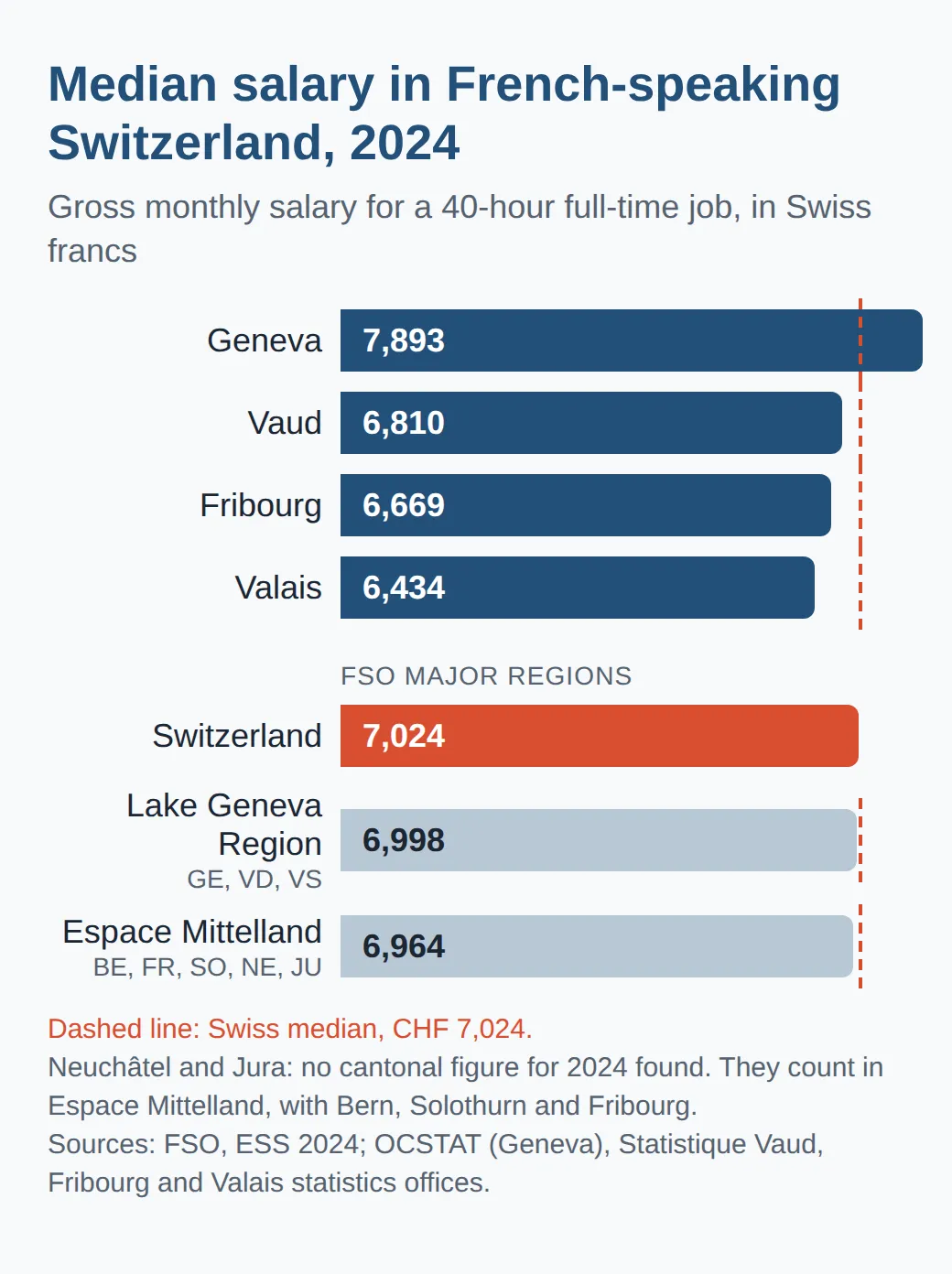
The FSO's press release of 25 November 2025 gives the national median: CHF 7,024 in 2024. Its full text, in French, compares this with CHF 6,788 in 2022. The survey covers about 34,000 companies and 2.9 million employees, and the FSO says it is representative for Switzerland and for its seven major regions. For French-speaking Switzerland that means two regions: the Lake Geneva Region (Geneva, Vaud, Valais) at CHF 6,998 and Espace Mittelland (Bern, Fribourg, Solothurn, Neuchâtel, Jura) at CHF 6,964, according to the FSO's regional table.
A reliable cantonal figure needs a bigger sample than the national survey's. Fribourg says it pays for that larger sample, and Valais has boosted its own too: 72,597 salaries from 1,648 companies for 2024. Geneva and Vaud also publish their own results. Neuchâtel and Jura have published nothing for 2024 that we could find, and the Espace Mittelland median blends their salaries with Bern's. Before you hold these figures up against your payslip, though, you need to know what they measure.
Average salary or median salary: two different numbers
The average salary is almost always higher than the median, sometimes by a lot. The average adds up every salary and divides by the number of employees, so a handful of very high salaries is enough to pull it up. The median hardly moves. The FSO's release warns against confusing the two, and it publishes the median as its reference figure.
Geneva shows the gap clearly. According to a table from OCSTAT, the canton's statistics office, the average salary there was CHF 9,810 in 2024, nearly CHF 1,920 more than the median of CHF 7,893. For men, the average reaches CHF 10,489 against a median of CHF 7,961. If you search for "average salary" and find a figure of around CHF 7,000, it's almost always a median.
Both figures are also "standardised". The survey takes the gross salary for October and converts it to 40 hours a week and four and a third weeks a month. It adds the employee's own social security contributions, supplements for night, shift or Sunday work, one twelfth of the 13th-month salary and one twelfth of the year's bonuses. Family allowances are left out. A standardised salary is therefore neither your contract salary nor your take-home pay: it's a tool for comparing jobs with one another. Let's start with the best-paid canton.
Geneva: CHF 7,893, with wide gaps
Geneva is the only French-speaking canton above the Swiss median: CHF 7,893 a month in 2024, according to OCSTAT's statistical bulletin of December 2025. That works out at about CHF 45.54 an hour. The gap between women and men is small in the middle of the scale: CHF 7,804 against CHF 7,961, or 2.0%. It widens towards the top: for the best-paid 10%, the threshold is CHF 13,245 for women and CHF 17,237 for men.
The sector you work in matters more than anything else. Here are Geneva's 2024 medians from OCSTAT's table by sector:
| Sector in Geneva | Median salary 2024 |
|---|---|
| Financial services | CHF 12,682 |
| Wholesale trade | CHF 10,835 |
| IT and information services | CHF 9,560 |
| Public administration | CHF 9,543 |
| Education | CHF 9,404 |
| Health and social work | CHF 7,922 |
| Construction | CHF 6,624 |
| Retail trade | CHF 5,233 |
| Accommodation and food services | CHF 4,745 |
Finance and trading pull Geneva's median up. Between restaurants and financial services, the gap in medians reaches CHF 7,937 a month, within the same canton. The best-paid quarter of Geneva's whole economy earns more than CHF 10,720, the lowest-paid quarter less than CHF 5,935.
That level has a less visible consequence. OCSTAT sets a low-pay threshold based on Geneva's own median, at CHF 5,262: 19.3% of jobs in the canton fall below it, according to its table of low wages. With the national threshold of CHF 4,683, the share drops to 10.7%. Finally, these figures leave out the international public sector: staff at the UN and the other organisations have their own pay scales, which we cover in our article on international organisations. Vaud sits one notch lower.
Vaud: CHF 6,810, or CHF 39.30 an hour
In Vaud, the median salary was CHF 6,810 in 2024, which is CHF 39.30 an hour and about CHF 210 below the Swiss median. Statistique Vaud, the canton's statistics office, published it on 14 April 2026 in the salary edition of its Numerus bulletin, based on 247,481 salaries reported by 2,387 companies and public employers.
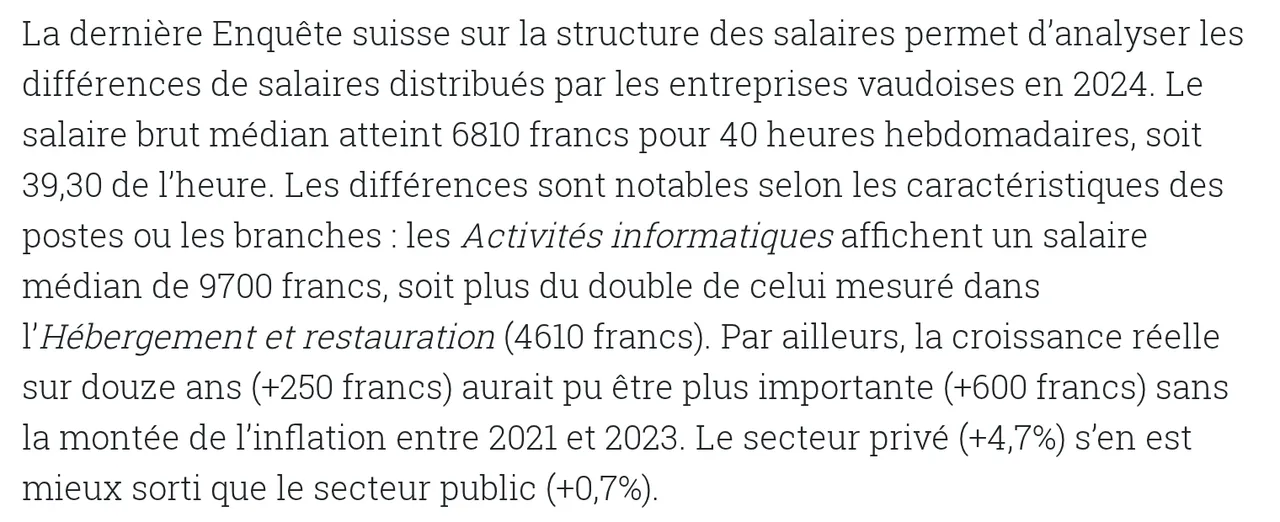
The range across sectors looks like Geneva's, only tighter at the top. IT leads with CHF 9,700, ahead of financial services (CHF 9,100), insurance (CHF 8,780) and education (CHF 8,210). Health and social work stand at CHF 6,750, construction at CHF 6,500 and retail at CHF 5,160, while accommodation and food services bring up the rear at CHF 4,610.
Two details in Numerus deserve your attention. The gap between women and men, CHF 6,700 against CHF 6,880 or 2.6%, is not statistically significant in the canton, whereas it's 8.4% nationally. And length of service pays: a job held for more than 30 years has a median of CHF 8,890, against CHF 6,330 for less than three years. Under-25s are at CHF 5,040, over-55s at CHF 7,680.
One point of method matters if you live in Vaud. The figures cover companies based in the canton and all their employees, including those who work at a site outside it. Over twelve years, the Vaud median rose by 9.7% on payslips, but by only 3.8% once inflation is taken out, or CHF 250 more a month. Further east and north, salaries drop again.
Valais, Fribourg, Neuchâtel and Jura
The other four French-speaking cantons are all below the Swiss median, but for different reasons, and they don't publish their figures the same way.
Valais: CHF 6,434, 21st among the cantons
Valais has the lowest median salary in French-speaking Switzerland: CHF 6,434 in 2024, according to the April 2026 bulletin of the cantonal statistics office (Service de statistique et de péréquation). The office ranks the canton 21st in comparisons between cantons. The main difference is that the top of the scale is lower than elsewhere: the best-paid 10% earn more than CHF 10,428, against CHF 12,526 for Switzerland as a whole.
The public sector in Valais pays better than the private sector: a median of CHF 7,793 against CHF 6,148. The bulletin puts this down to how the two sectors are made up, since hotels and retail don't exist in the public sector. Education is the best-paid sector (CHF 9,012), ahead of chemicals (CHF 8,564) and electricity (CHF 8,039). Accommodation and food services stand at CHF 4,654, and a third of their jobs (33.5%) are low-paid.
The bulletin also gives the median by permit, which Geneva publishes too. C permit holders earn CHF 6,071, cross-border commuters CHF 5,692, B permit holders CHF 5,344 and L permit holders CHF 5,189, against CHF 6,905 for Swiss employees. These gaps partly reflect the sectors people work in and the jobs they hold. For the steps to get a cross-border permit, see our article on the G permit.
Fribourg: CHF 6,669, private and public sectors together
Fribourg publishes two figures, and that causes a lot of confusion. For the private and public sectors together, which is the figure comparable with the other cantons, the median was CHF 6,669 in 2024, according to a table from the cantonal statistics office (CHF 6,785 for men, CHF 6,475 for women). The canton's salary page highlights the private sector alone: CHF 6,330, 5.8% below the Swiss private-sector median (CHF 6,722).
In Fribourg's private sector, the table by sector gives CHF 8,044 in information and communication, CHF 7,595 in finance and insurance, CHF 6,395 in construction, CHF 6,320 in health and social work, and CHF 4,596 in accommodation and food services. The gap between women and men in the private sector, 11.0%, has narrowed since 2012, when it stood at 17.6%.
Neuchâtel and Jura: only the regional median
For Neuchâtel and Jura, the closest official figure is still the one for Espace Mittelland: CHF 6,964 in 2024. The lowest-paid 10% in the region earn less than CHF 4,737, the best-paid 10% more than CHF 11,734. If you come across a "Neuchâtel median salary" accurate to the franc somewhere else, ask where it comes from: we found no official publication of that figure for 2024.
The FSO's regional table does say something useful about the Jura Arc, though. In the sector that groups watchmaking with electronics and optics, the Espace Mittelland median is CHF 6,647, against CHF 7,903 in the Lake Geneva Region. The pharmaceutical industry there stands at CHF 9,123. Gaps between sectors like these turn up in every canton.
The same sector, from one canton to the next
The canton often matters less than the sector. In hotels and restaurants, the median varies by barely CHF 135 between Geneva, Vaud and Valais, while the overall gap between those cantons is more than CHF 1,400. The best-paid sectors make the difference, as this table of 2024 medians in francs shows. It only includes sectors that all three offices define the same way:
| Sector | Geneva | Vaud | Valais |
|---|---|---|---|
| Accommodation and food services | 4,745 | 4,610 | 4,654 |
| Retail trade | 5,233 | 5,160 | 4,967 |
| Education | 9,404 | 8,210 | 9,012 |
| All sectors | 7,893 | 6,810 | 6,434 |
So if you work in a restaurant, a job in Geneva doesn't pay much more than one in Valais, even though rents are in another league. In education, Valais comes close to Geneva. It's in finance, trading and IT that Geneva and Vaud pull ahead. At the bottom of the scale, minimum wages set the limit.
Low pay and minimum wages, canton by canton
Three French-speaking cantons have a legal minimum wage: Geneva, Neuchâtel and Jura. Vaud, Valais and Fribourg don't. Fribourg and Vaud have already voted on the question, and Valais votes next.
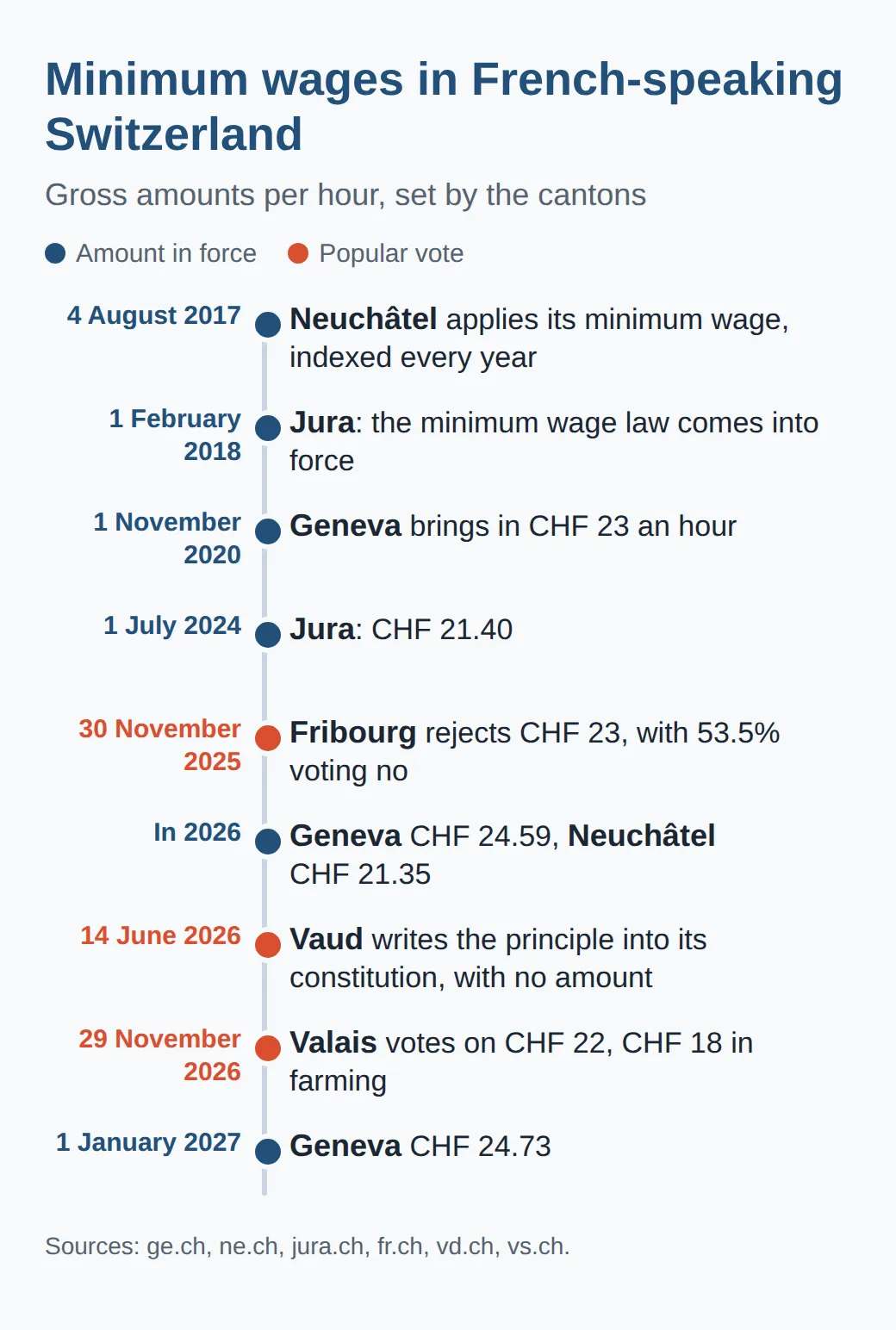
In Geneva, the minimum wage has been CHF 24.59 gross an hour since 1 January 2026, or CHF 4,262.27 a month for 40 hours, and it goes up to CHF 24.73 on 1 January 2027. If you receive a 13th-month salary, your basic hourly wage must be at least CHF 22.70 in 2026. Neuchâtel applies CHF 21.35 in 2026, indexed to prices every year. Jura has been at CHF 21.40 since 1 July 2024, but its law doesn't apply to sectors covered by a collective labour agreement that has been declared generally binding and sets a specific minimum wage.
Elsewhere, the votes keep coming. Fribourg turned down an initiative for CHF 23 an hour on 30 November 2025, with 53.5% voting no. On 14 June 2026, Vaud voters agreed to write the principle of a minimum wage into the cantonal constitution, but rejected both the legislative initiative and the counter-proposal, two laws that would have set it at CHF 23 an hour. No amount applies for now. Valais votes on 29 November 2026 on an initiative for CHF 22, with CHF 18 in farming, which the cantonal government and the Grand Council recommend rejecting.
To put these amounts in context: Geneva's minimum is worth a little more than half of Geneva's median hourly salary. In the cantons with no minimum, the floor is set by sector collective labour agreements and by your contract. That leaves the question of where your own salary sits.
How to compare your salary with these figures
Start by putting your salary on the same basis as the survey. Add one twelfth of your 13th-month salary, one twelfth of your annual bonus and your night or shift supplements to your gross monthly salary, then divide by your weekly hours and multiply by 40. Statistique Vaud gives this example in Numerus:
A contract for CHF 6,000 gross a month for 42 hours a week, with a hardship allowance of CHF 460, a 13th-month salary and a bonus of CHF 2,160 for the year: (6,000 + 460 + 6,000 ÷ 12 + 2,160 ÷ 12) ÷ 42 × 40 = CHF 6,800 standardised.
That CHF 6,000 a month therefore lands almost exactly on the Vaud median. If you work part time, the same formula does the job: with your actual hours, it converts your salary to full time, just as the survey does.
Then compare it with the right benchmark: your canton, your sector and, if possible, your level of education and responsibility. Two public tools do this work for you. Salarium, the FSO's statistical salary calculator, is built on the survey data. The national salary calculator run by SECO and the cantonal employment offices gives the usual salaries by occupation, in German, French or Italian. The canton of Fribourg itself points people to both tools.
Finally, keep in mind that all these amounts are gross. They include the employee's social security contributions, which come off your pay, and tax at source comes off too if you pay it: our article on correcting tax at source explains what you can claim back.
What the 2024 figures don't tell you yet
Salaries have kept rising since the survey. According to the Swiss Wage Index published on 21 April 2026, nominal wages rose by 1.8% in 2025 and real wages by 1.6%. The full release, in French, shows that the rise was not the same everywhere: 3.3% in public administration, 0.4% in health and social work. The index gives no figures by canton, and the next earnings structure survey covers the year 2026.
So for a pay negotiation or a job change, bear in mind that the 2024 medians date from before this rise: if anything, they understate the salaries paid since. The most telling comparison is with the salaries employers are advertising in your canton now. You'll find current openings on our pages for the canton of Geneva, the canton of Vaud, Valais, Fribourg, Neuchâtel and Jura.
Common questions
- Are UN and international organisation staff included in Geneva's median salary?
- No. Geneva's cantonal statistics office publishes its figures excluding the international public sector and agriculture. Geneva's CHF 7,893 therefore describes the canton's companies, associations and Swiss public authorities. Salaries at international organisations follow their own pay scales.
- Have salaries in Switzerland gone up since 2024?
- Yes, on average. According to the FSO's Swiss Wage Index, nominal wages rose by 1.8% in 2025 and real wages by 1.6%, with inflation at 0.2%. The rise varies by sector: 3.3% in public administration, only 0.4% in health and social work. The index gives no figures by canton.
- Is CHF 4,500 a month a low salary in French-speaking Switzerland?
- For a full-time job, yes, by the Swiss definition: the FSO sets the low-pay threshold for 2024 at CHF 4,683 gross a month, two thirds of the national median salary. Several cantonal offices also work out a threshold from their own median: CHF 5,262 in Geneva, CHF 4,540 in Vaud and CHF 4,289 in Valais, where CHF 4,500 is therefore just above the line.
- How much do cross-border commuters earn in Geneva and the rest of Romandy?
- Geneva and Valais publish this figure for 2024. In Geneva, the median salary of G permit holders was CHF 6,825, against CHF 8,895 for Swiss employees; in Valais, it was CHF 5,692 against CHF 6,905. Nationally, cross-border commuters without a management role earn CHF 5,950 and those in high-responsibility positions CHF 11,207, according to the FSO.
More posts
All posts
Swiss unemployment benefits 2026: how much, how long
70 or 80% of insured earnings, 200 to 520 daily allowances, waiting days by income: Swiss unemployment benefits worked out to the franc, and ORP registration.

Swiss G permit 2026: cross-border rules, renewal, LAMal
Swiss G permit from France: who qualifies, going home weekly, renewal, and the three-month LAMal or French health insurance choice, costed for 2026.
Temporary work in Switzerland: your rights as a temp in 2026
2 days' notice, at least CHF 25.70 an hour, 13th salary, pension and sick pay: what Swiss law and the staff hire CLA guarantee temps in Romandy.