Geneva and Vaud tax at source: correction or TOU by 31 March

Before 31 March
A correction fixes an error in the tax withheld from your salary: the salary used, the tariff, a child left out, your spouse's income. To deduct pillar 3a payments, a pension fund buy-in or childcare costs, you need a subsequent ordinary assessment, known by its French abbreviation, TOU. In Geneva and the canton of Vaud alike, the request must arrive by 31 March of the following year: 31 March 2027 for your 2026 salary.
That deadline forgives nothing. An employee living in France, a father of four, filed his correction request for 2023 on 3 April 2024 so that his children would be taken into account. Three days late. The Geneva tax administration refused to examine it, the Administrative Court of First Instance upheld that decision, and so did Geneva's Cour de justice, in a ruling of 11 November 2025 that also left him with CHF 700 in court fees. Yet his salary certificate and his tax at source statement both showed they had been issued on 15 December 2023. We'll come back to what he could have done. First, the question that decides everything: which of the two procedures applies to you.
Correction or TOU: two different procedures
A correction challenges your employer's calculation; a TOU replaces that calculation with a full tax assessment. Since the tax at source reform took effect on 1 January 2021, the line between the two has been clear.
With a correction, you ask the tax administration for a formal decision on the amount withheld and the tariff applied. This is article 137 of the Federal Act on Direct Federal Taxation (DFTA, LIFD in French): you can demand that decision until 31 March of the following year if you dispute the deduction shown on your statement, or if your employer never gave you one. Geneva calls this request a DRIS, short for demande de rectification de l'imposition à la source. Vaud calls it a new calculation (nouveau calcul). The current version of the act has no English translation, and the cantonal pages only in French, so we link the French versions.
A TOU, short for taxation ordinaire ultérieure, goes much further. You fill in a complete tax return, like anyone taxed the ordinary way, and the tax administration calculates your tax from your real income and deductions. The tax already withheld from your salary is then credited against it, without interest. Without a TOU, the law is plain: tax at source replaces ordinary tax, and no further deductions are granted afterwards (DFTA, art. 89a).
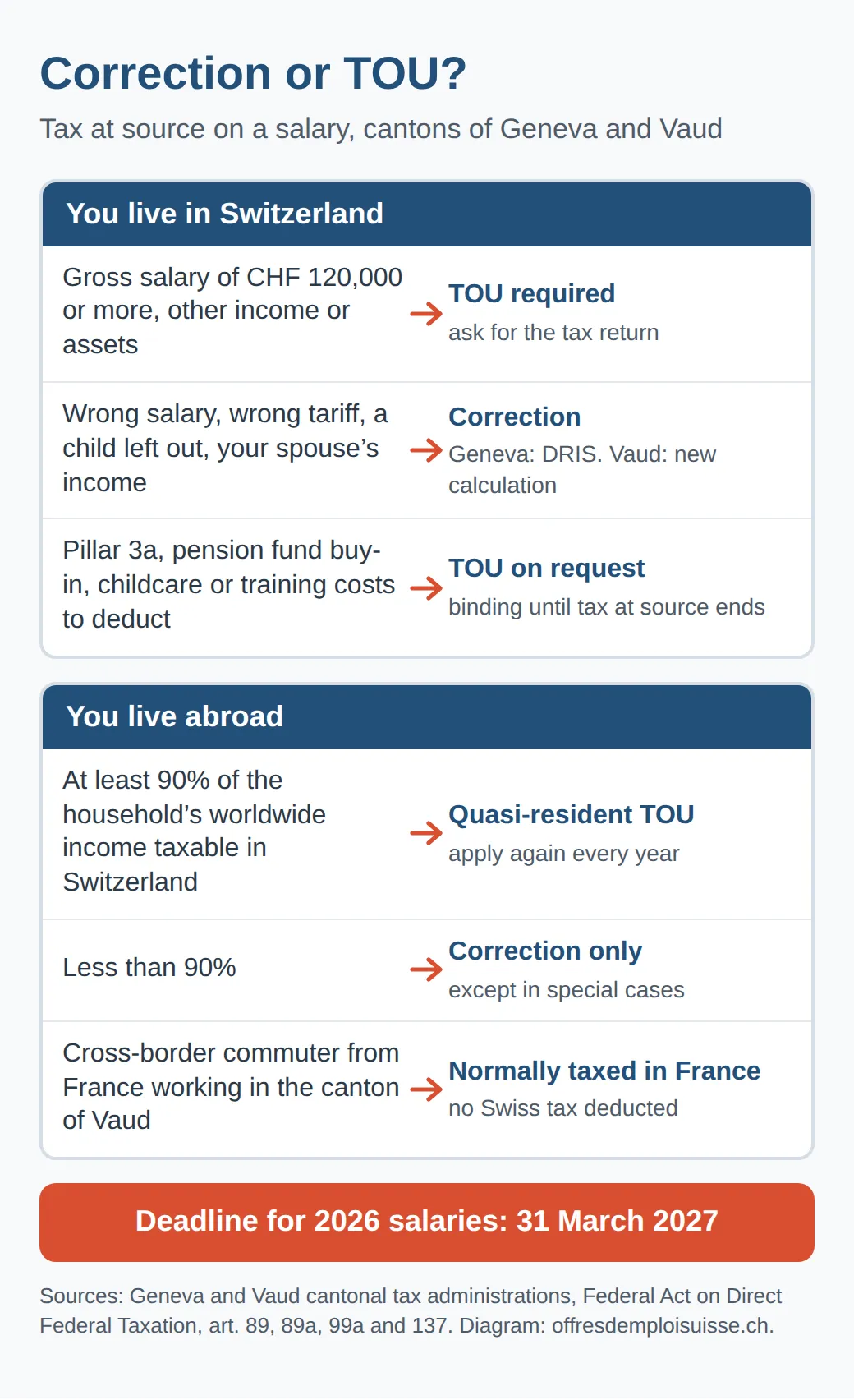
The diagram sums up the rule, but each box hides details that matter. Let's start with what a simple correction can still achieve.
What a correction can fix
A correction fixes the basic data behind the calculation, never your expenses. Geneva's page on why to request a correction lists them: the salary used, the tariff or rate applied, your spouse's actual income if you are on tariff C, and a child your employer did not count. It also covers three particular situations: unmarried parents, a child in alternating custody when the conditions for an equal split are not met, and an adult child you pay maintenance to. A child over 25 who is still an apprentice or a student can be added too, subject to limits on the child's income and assets. A change in your family situation counts from the following month.
In the canton of Vaud, the new calculation is limited to three cases: a wrong gross salary subject to tax at source, a wrong annual income used to set the rate, or the wrong tariff. Extra deductions are not allowed.
Married couples where both partners work have one more reason to check. Tariff C has no way of knowing your spouse's salary, so it assumes a notional income equal to yours, capped at CHF 69,300 in the canton of Vaud, and the total sets your rate. If you earn CHF 100,000, your rate is calculated on CHF 169,300, even if your spouse earns only CHF 30,000. With your spouse's salary certificates, you can ask for a new calculation based on the couple's real income. If your spouse is also taxed at source in the canton, the Vaud tax administration then recalculates their tax as well, on the couple's combined income.
What a correction never touches is your actual expenses or your pension savings. Geneva spells it out: since 2021, a DRIS no longer lets you deduct pillar 3a, a pension fund buy-in, childcare costs, training costs or maintenance paid for children under 18. For those you need a TOU, and before you ask for one, it's worth knowing what the tariff already gives you.
What the tariff already includes
The tax withheld is not calculated on your bare gross salary. The tariff builds in flat-rate amounts for social security contributions, work expenses and health insurance, and Geneva publishes them every year. According to its 2026 deductions table for cantonal and municipal tax, the tariff allows among other things 5.3% for old-age, disability and income compensation insurance (AVS/AI/APG), 6.5% for the 2nd pillar, work expenses of 3% capped at CHF 1,817, and CHF 7,032 of health and accident insurance premiums for a single person.
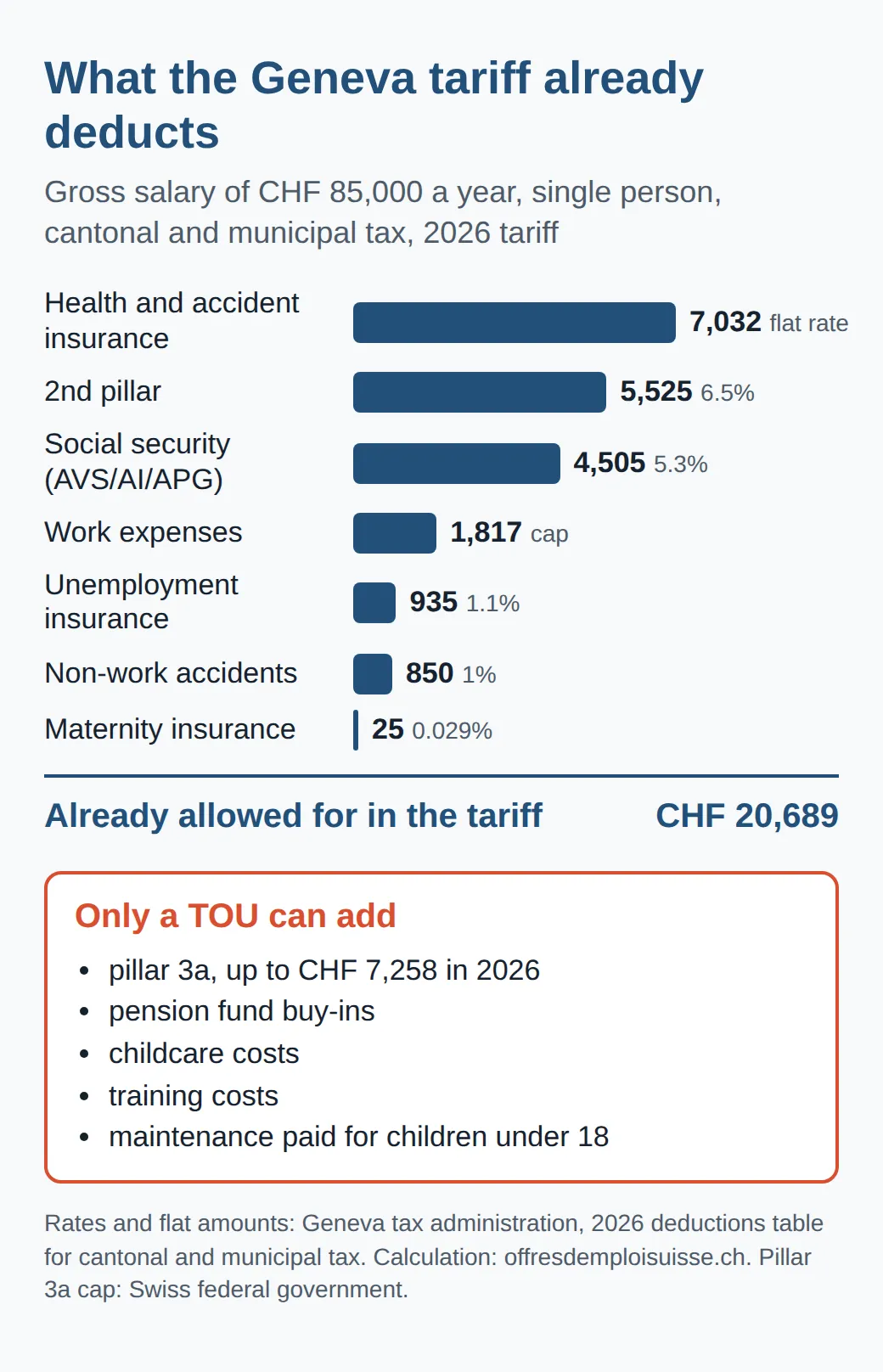
On a gross salary of CHF 85,000, we arrive at about CHF 20,689 already taken into account. What's missing are the deductions each person manages in their own way. Pillar 3a is the clearest example: up to CHF 7,258 in 2026 for someone with a pension fund, and CHF 7,373 in 2027 (federal announcement, in French). A pension fund buy-in can weigh far more.
The catch lies elsewhere. A TOU doesn't just add your deductions to your employer's calculation: it redoes everything with your real figures. If your pension fund takes less than the 6.5% flat rate, for example, part of the saving can disappear. The canton of Vaud says it bluntly: the result can be higher or lower than the tax withheld. That's why we don't give a typical saving; it depends too much on your situation. To estimate your total tax, Geneva points you to its online tax return and the GeTax software: run the numbers before you commit. Sometimes the question doesn't even arise, because the TOU is compulsory.
When is a TOU compulsory?
If you live in Switzerland, a TOU is compulsory once your gross salary reaches CHF 120,000 a year. The threshold comes from a federal ordinance, and Geneva and Vaud apply it as it stands. For a married couple, it's enough for one of you to reach it, and a spouse who lives with you is assessed together with you (DFTA, art. 89).
Other income or assets also trigger a TOU. Geneva requires it from CHF 3,000 a year of income not covered by tax at source, such as maintenance you receive, investment income or rent you collect, and from anyone who owns property, is self-employed or has taxable assets (Geneva tax administration). The Geneva list contains further cases: read all of it before you conclude it doesn't concern you. Vaud targets other income not taxed at source and any movable or immovable assets, in Switzerland or abroad.
With side income, it's up to you to act. You have until 31 March of the following year to ask for a tax return. The canton of Vaud warns that otherwise you risk proceedings for tax evasion, and offers a voluntary disclosure form to those who forgot.
Once you're in the TOU system, you stay in it until tax at source ends for you, even if your salary drops again. Geneva adds that this also applies to your spouse, even after a separation or divorce. The way out is a C permit or Swiss citizenship. The same lock applies when you ask for a TOU yourself.
A TOU on request is a one-way choice
If you live in Switzerland and meet none of the conditions for a compulsory TOU, you can request one until 31 March of the following year (DFTA, art. 89a). A single request is enough: it applies to every following year, with no renewal.
That is also its limit. The request can't be withdrawn, even if the assessment goes against you, and it binds you until tax at source ends, spouse included. A one-off pension fund buy-in may justify a TOU for one year, but afterwards you'll file a full tax return every spring until you get a C permit, whether or not you have deductions to claim. Do the sums over several years, not just the year of the buy-in.
If you leave Switzerland, the timing changes: you must request the TOU when you deregister before leaving, not by the following 31 March. For people who live abroad, the logic is reversed: nothing is final, and everything is decided again each year.
Quasi-resident status: the 90% rule
If you live abroad, a TOU is only possible if at least 90% of your household's worldwide gross income is taxable in Switzerland. Federal law speaks of the predominant part of your worldwide income, your spouse's included (DFTA, art. 99a), and Geneva and Vaud both set it at 90%. This status is called quasi-resident, and you have to apply for it again every year, before 31 March.
The threshold is harder to reach than people think, and Geneva publishes two examples that show it. In the first, a person living in France earns CHF 132,200 gross in total, including a salary of CHF 100,000 in Geneva: only 75.64% of their income is taxable in Switzerland, so no TOU. In the second, a person earns CHF 75,000 in Geneva and their spouse CHF 35,000 in the canton of Vaud. The spouse's Vaud salary is taxed in France under the 1983 agreement between France and Switzerland on cross-border commuters, so only CHF 75,000 out of 110,000 counts for Switzerland: 68.18%, no TOU either.
That second example has a direct consequence. A cross-border commuter who lives in France and works in the canton of Vaud normally has no Swiss tax deducted at all, provided they return home every working day (at least four days a week when full-time), give their employer a certificate of tax residence and work no more than 40% from home. So there is nothing to correct in Switzerland. In Geneva, by contrast, cross-border commuters' salaries are taxed at source. For the permit itself and health insurance, see our article on the G permit for cross-border commuters.
To check the threshold, Geneva and Vaud each offer an Excel calculator. Geneva also allows a TOU below the threshold in two particular situations: income in your country of residence too low to claim certain deductions there, or foreign pension contributions that Switzerland must accept under a double taxation agreement. These requests go by post, with supporting documents, to the Direction des affaires fiscales, case postale 3937, 1211 Genève 3, always before 31 March. The threshold doesn't apply either if you share alternating custody and the support of your children equally with the other parent and meet Geneva's criteria for splitting taxation between parents. And if you own property or are self-employed in Geneva, or are married to someone who is, the tax administration can open a TOU on its own initiative.
31 March, no exceptions
All these procedures share a single deadline: the request must be received by 31 March of the year after the tax was withheld. It cannot be extended. Geneva specifies that if your form hasn't arrived by 31 March, you must prove you sent it in time, for example with a registered mail receipt dated 31 March at the latest.
Back to our father of four. Before the Cour de justice, he explained that the accountant preparing his documents had returned them late, and that his family was counting on the refund. The court replied that he had had his documents since 15 December 2023 and that, in any case, nothing stopped him from filing the request on time and sending the documents later. Financial difficulties are not force majeure, which requires an unforeseeable event beyond your control. The court also confirmed that a child left out of the calculation falls under this strict deadline.
The lesson fits in one sentence: file first, complete later. Geneva states it in black and white: the request must arrive by 31 March even if supporting documents are still missing. While the tax administration examines your request, your employer keeps deducting tax as before (DFTA, art. 137). That leaves the question of how to file, which differs between the two cantons.
In Geneva: the DRIS/TOU form
Geneva uses a single form for both procedures, the DRIS/TOU form, which you fill in online in your tax area on the e-démarches portal or on paper. Online requests are handled first, and you get proof of filing straight away.
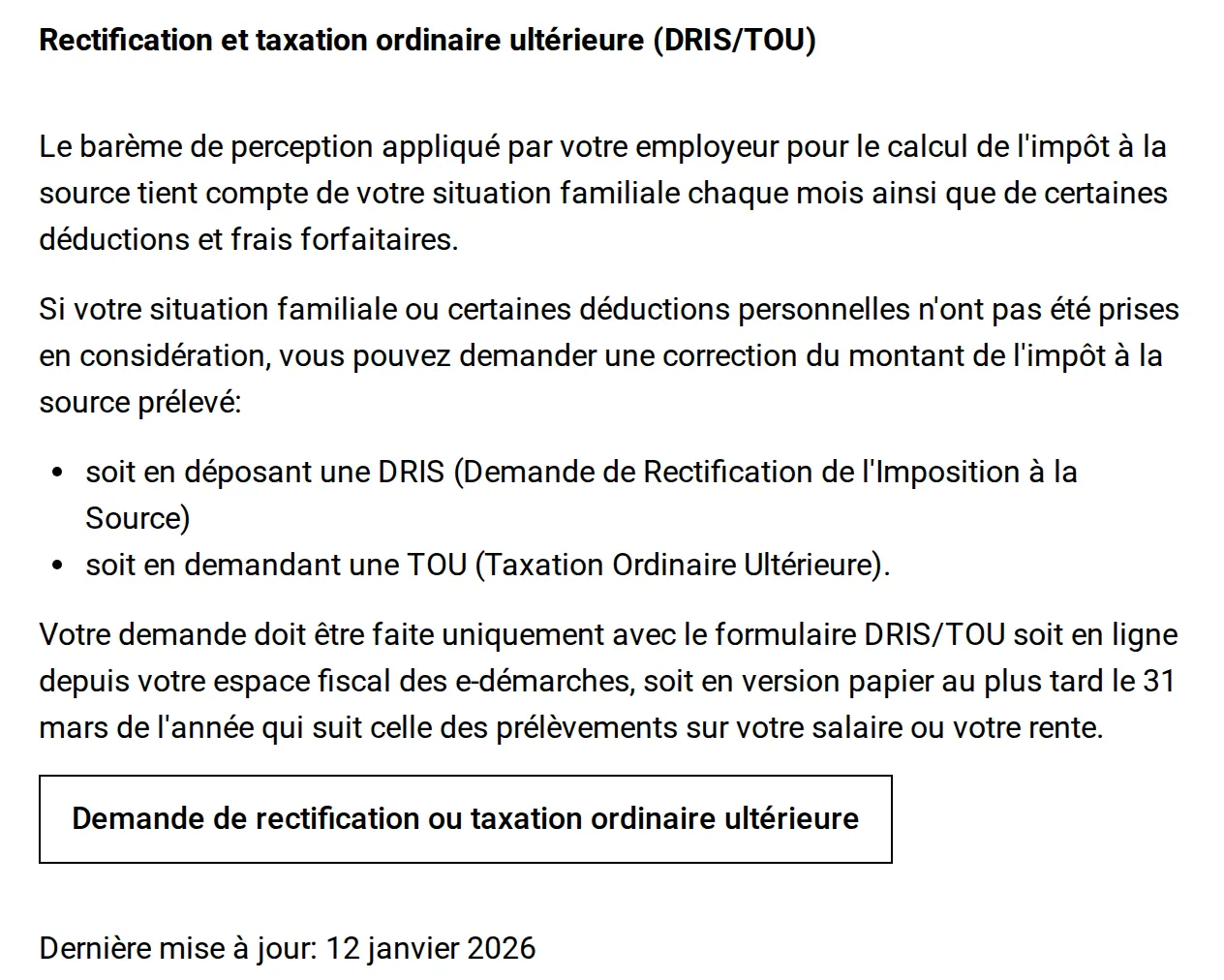
The paper form arrives in December, one per couple. If you live in Switzerland, it's sent to your home; if you live abroad, to your employer or your correspondence address. If you have switched on e-correspondence, you get no paper and file online. The signed paper version goes to the Administration fiscale cantonale, Service de l'impôt à la source, case postale 3841, 1211 Genève 3. Once filed, the request can't be withdrawn (Geneva tax administration).
After that, you need patience. A DRIS can take several months. For a TOU, you receive a tax return to send back within two months, and Geneva asks you not to call before you've had a letter from them. The final decision includes the tax bills, the notice of assessment and an account statement: if you paid too much, the difference is refunded by bank transfer within 30 days; if you owe more, you have 30 days to pay (processing your request).
If you expect to owe more, Geneva recommends voluntary payments during the year, with QR-bills ordered through the e-démarches portal. The full tax is due on 31 March, and compensatory interest runs from that date on whatever is still unpaid.
In the canton of Vaud: new calculation or a written TOU request
The canton of Vaud keeps the two procedures clearly apart. You ask for a new calculation before 31 March, with supporting documents, for one of the three cases above. You request a TOU in writing within the same deadline, and the Vaud Cantonal Tax Administration (ACI) provides form 21049 for this on its page for people taxed at source, along with the calculator for quasi-resident status and the one for a corrected tariff C.
Tax at source in Vaud is handled by the tax office for the districts of Lausanne and Ouest lausannois: Office d'impôt des districts de Lausanne et Ouest lausannois, rue Caroline 11bis, case postale 1142, 1001 Lausanne. For questions, you can write to info.aci-source@vd.ch, with your taxpayer number and the reason in the subject line. To challenge a decision, though, an email isn't enough: the objection must be signed and sent by post within 30 days of the decision.
Vaud also explains what happens when your situation changes. If you get a C permit, or marry a Swiss citizen or a C permit holder, you switch to ordinary taxation for the whole year, and the deduction stops from the following month. Separating from that spouse brings you back to tax at source, with a TOU from the following month.
Between now and 31 March 2027
For your 2026 salary, everything happens between January and March. As soon as you have your salary certificate and the statement of tax withheld, compare them with your actual situation: the right tariff, all your children, your spouse's real income. An error of that kind is settled with a correction, with no commitment for later years.
If you're considering a TOU, gather your pillar 3a certificates, your pension fund buy-in statements and your childcare receipts, then run an honest simulation. Do you live in Switzerland? Your choice will hold until you get a C permit. Do you live abroad? Check the 90% with your canton's calculator, and do it again every year.
Either way, don't aim for 31 March. File in February, online in Geneva, by registered mail if you send paper, and keep a copy. An incomplete file can be completed; a request that arrives on 3 April, as our father of four learned, can't be saved.
Common questions
- Can I still correct my tax at source for an earlier year?
- In practice, no. Each year has its own deadline of 31 March of the following year, and a request that arrives later is rejected without being examined. Only an unforeseeable obstacle beyond your control, such as force majeure, can excuse a late request, and the courts apply very strict conditions.
- Can a TOU cost me more than the tax deducted at source?
- Yes. A TOU recalculates your whole tax with your real figures, and the canton of Vaud points out that the result can be higher or lower than the tax withheld. Once filed, the request cannot be withdrawn. In Geneva, if you expect to owe more, you can make voluntary payments to avoid the interest that runs from 31 March.
- What if I leave Switzerland during the year?
- If you live in Switzerland and want a TOU for your last year, ask for it when you deregister with your commune before leaving. In that case federal law does not let you wait until the following 31 March.
- What if my employer applies the wrong tax at source tariff?
- For the months ahead, tell your employer: the federal tax at source ordinance also requires you to tell them about any change that affects the deduction. For the past year, the tax administration decides, on a request from you that must arrive by 31 March. Until it decides, your employer keeps deducting tax as before.
More posts
All posts
Working for an international organisation in Geneva
UN, WHO, ICRC or an NGO in Geneva: legitimation card, tax, AVS and health insurance by employer, UN salaries in 2026 and how to apply.

Swiss G permit 2026: cross-border rules, renewal, LAMal
Swiss G permit from France: who qualifies, going home weekly, renewal, and the three-month LAMal or French health insurance choice, costed for 2026.

Cover letter in Switzerland: structure and examples
One A4 page, three parts, a subject line citing the advert: how to write a cover letter in French-speaking Switzerland the ORP way, with phrasing to adapt.