Working for an international organisation in Geneva

What changes everything
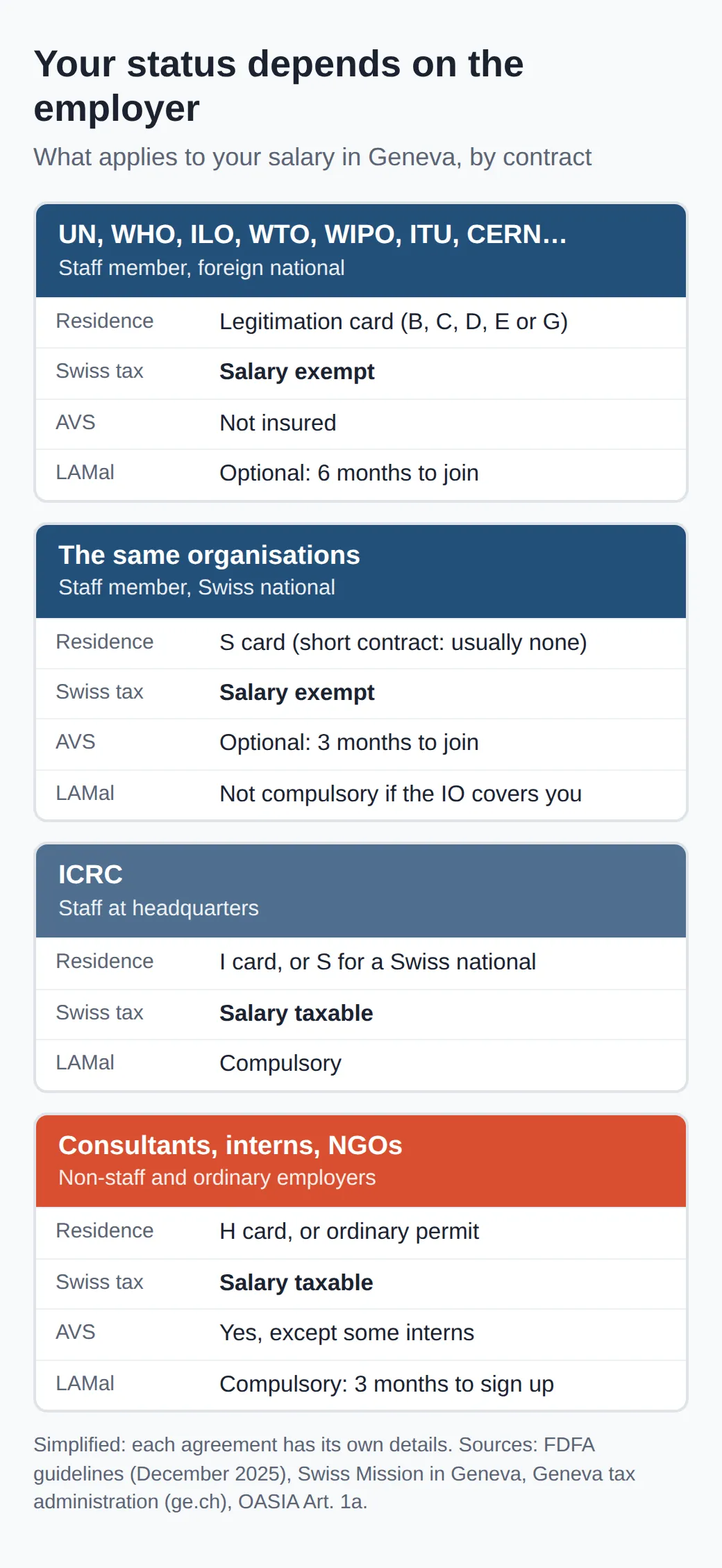
It all depends on the employer, not the job. At the UN, WHO and most organisations with a headquarters agreement with Switzerland, you get a legitimation card from the Federal Department of Foreign Affairs (FDFA) instead of a permit, and your salary is exempt from Swiss tax. At the ICRC, at an NGO or as a consultant, Swiss tax and social insurance apply.
People like to talk about the prestige of International Geneva, much less about what happens on your payslip. Yet two people sitting in the same office can be on very different terms: one pays no Swiss tax and no AVS (state pension) contributions, the other files a tax return like any resident. We start from the official texts, those of the Swiss Mission in Geneva (part of the FDFA), the Geneva tax administration and the cantonal statistics office, to show what applies to which contract.
Your status depends on the employer, not the job
In March 2025, 29,011 people worked for the 38 international organisations based in the canton of Geneva, according to the annual survey of the cantonal statistics office (OCSTAT, in French). Those 38 organisations do not all have the same agreement with Switzerland, and that agreement is what decides your status.
Twenty-four have a headquarters agreement: the UN, WHO, ILO, WTO, WIPO, ITU, CERN, IOM, the Global Fund, Gavi, the ICRC and the International Federation of Red Cross and Red Crescent Societies, among others. Their staff get a legitimation card. Three have only a tax agreement (ISO, IATA and the IEC) and eleven an agreement on privileges and immunities, such as the World Economic Forum or the Drugs for Neglected Diseases initiative (DNDi). OCSTAT puts it bluntly: the staff of these fourteen organisations do not get a legitimation card. They live and work on an ordinary permit.
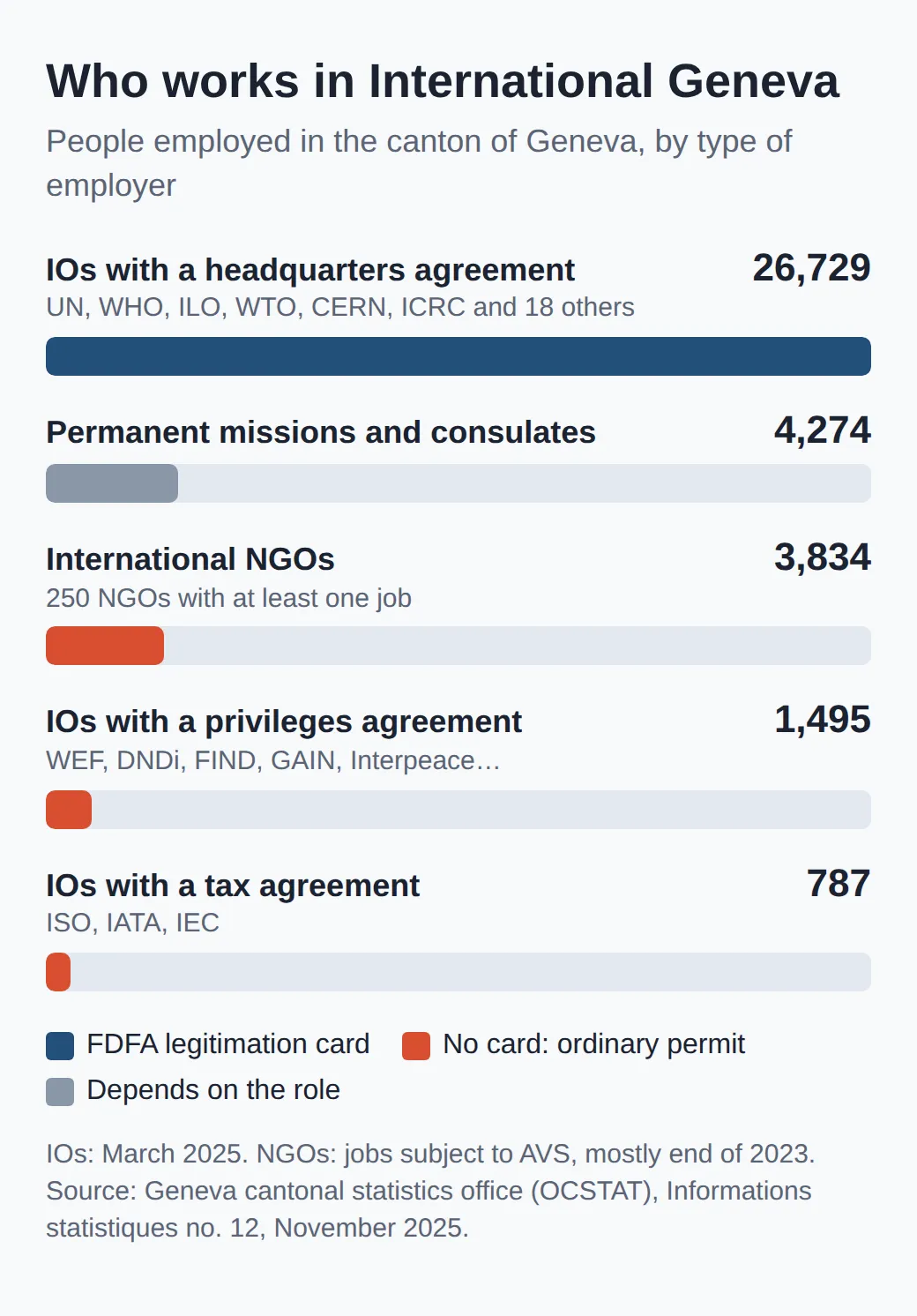
The sector is going through a round of cuts. OCSTAT notes that the effects of the budget reductions were not yet visible in March 2025, but that the number of active legitimation cards at the organisations fell by 4.5% between the end of March and the end of October 2025. In September 2026, the federal government said job losses in the international sector had been held to 9.1%, without saying over what period. Organisations are still hiring, but fewer people, and the type of contract on offer decides everything that follows.
The legitimation card replaces the permit
The FDFA legitimation card is your residence document. It certifies any privileges and immunities you hold and exempts you from visa requirements while you serve, as the Swiss Mission's guidelines, amended in December 2025, explain. You do not apply for it yourself: your organisation registers you with the Swiss Mission when you take up your post, and without that registration you may not work for it.
The letter on the card says who you are. B for senior management, C for high-ranking officials, D for the Professional category, E for General Service, G for short contracts, young UN volunteers and seconded staff. The ICRC has its own letter, I, the Red Cross Federation the letter L, and Swiss nationals get an S card. Non-staff, meaning consultants and interns, get an H card.
A few practical rules follow from this. The card is issued for the length of the contract, or for five years at most for an open-ended contract. With it and your passport, you can stay up to three months in the rest of the Schengen area, without working there. If you are not Swiss, you do not have to register with your municipality. And if you already lived in Switzerland on a B or C permit, you must exchange it for the card.
Above all, the card ties you to your organisation. It does not let you work for another organisation or on the Swiss labour market, and the rule is full-time work. Part-time work needs authorisation from the Swiss Mission, and in that case your family normally gets no card.
Tax: exempt at the UN, taxable at the ICRC
At the UN, WHO, ILO, WTO, CERN and most organisations with a headquarters agreement, your salary is not subject to Swiss tax, whether you are Swiss or not. The Geneva tax administration publishes the tax rules for each organisation (in French). If you are a foreign national at one of these organisations, your savings and securities, and the income from them, are exempt too.
It does not come for free. These organisations levy their own internal tax on your gross salary, which the UN calls staff assessment: from 17% to 34% per income bracket, according to the scale of the International Civil Service Commission (ICSC). That is why Switzerland does not tax the same income a second time.
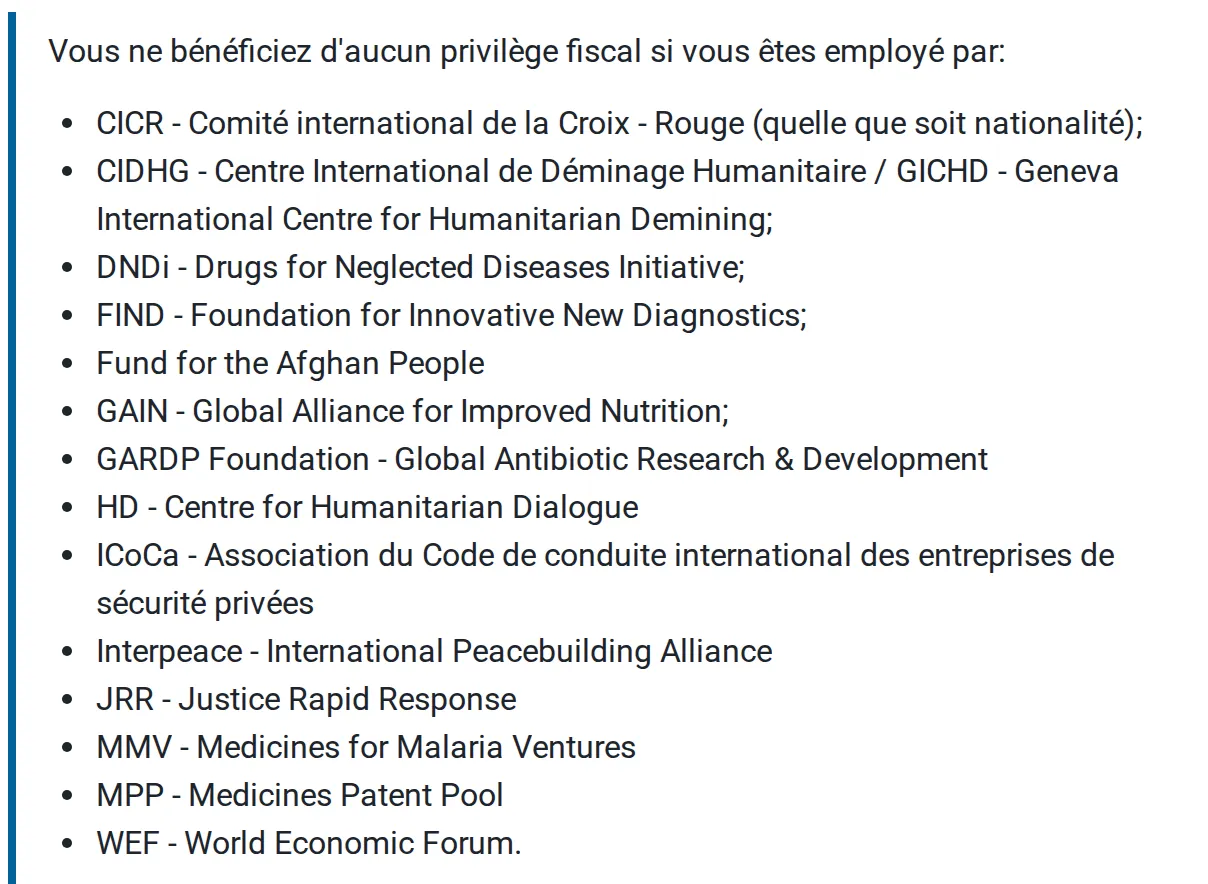
The ICRC is the exception that surprises people most. It has a headquarters agreement and its staff get a legitimation card, yet Geneva puts it at the top of its list of employers whose staff get no tax privilege at all, whatever their nationality.
Between these two extremes there are intermediate cases. At the Global Fund, Gavi or the Red Cross Federation, your salary is exempt but declared, to set the tax rate on your other income: this is known as exemption with progression (taux global). At ISO, IATA and the IEC, foreign nationals are on the same regime, but Swiss nationals are not exempt at all.
Some income stays taxable in every case: income from property, and for Swiss nationals the income from their savings. A spouse who works on a permit is taxed under the ordinary rules (ge.ch). A foreign national's exemption ends the day they become Swiss. And in retirement, your pension from the organisation is taxed normally if you stay in Geneva (ge.ch).
How much does the UN pay in Geneva?
An entry-level UN Professional (grade P-2) earns around CHF 7,000 a month in Geneva, after the internal tax but before pension contributions, by our calculation from the official figures for October 2026. Pay in the Professional category has two parts, both set in US dollars: a base salary, the same worldwide, and a post adjustment that offsets the cost of living at the duty station (ICSC).
For Switzerland, the post adjustment has been 80.3% of base salary since 1 October 2026, according to the ICSC's monthly circular. We applied it to the net base salary at step I of each grade, then converted the result at the UN operational rate of exchange of CHF 0.832 to the dollar:
| Grade, step I | Net base, USD a year | With post adjustment, USD a year | About, CHF a month |
|---|---|---|---|
| P-2 | 56,046 | 101,051 | 7,000 |
| P-3 | 71,335 | 128,617 | 8,900 |
| P-4 | 86,027 | 155,107 | 10,750 |
| P-5 | 103,165 | 186,006 | 12,900 |
| D-1 | 117,953 | 212,669 | 14,750 |
Treat these figures as a rough guide. The multiplier can change every month with the dollar (it was still 83.7 in September), and so can the exchange rate. Allowances are added depending on your family, while pension fund contributions and health insurance are deducted. Since the salary is already net of the internal tax, the fair comparison with a private-sector offer is net to net, not gross to gross. General Service staff (secretaries, logistics staff, technicians) are paid on a local scale that the ICSC sets by surveying salaries in Geneva.
The ICRC does it differently: salary is paid in thirteen instalments, and the ICRC pays 17% of insured salary into the pension fund, while the employee pays 8.5% (careers.icrc.org). Swiss tax comes on top.
AVS and unemployment: the Swiss safety net does not always cover you
If you are a foreign national working for an organisation with privileges, you are not insured under AVS, the Swiss old-age and survivors' insurance (OASIA, Art. 1a). Your retirement comes from the organisation's pension fund. The consequence becomes clear the day your contract ends: unemployment insurance only takes contributions from employees insured under AVS (UIA, Art. 2). So your years at the UN do not entitle you to Swiss unemployment benefits.
Swiss nationals have a choice. A Swiss staff member covered by their organisation's pension scheme is not insured automatically, but can join AVS, disability insurance (AI), income compensation (APG) and unemployment insurance, or unemployment insurance alone, within three months of joining the organisation's pension fund (Swiss Mission). The application goes to the AVS compensation office of your canton of residence, in Geneva the Caisse cantonale genevoise de compensation. You can cancel at the end of any month, but the cancellation then holds for the rest of your time with the organisation. A spouse who lives in Switzerland without gainful employment can join AVS, AI and APG within the same deadline.
That three-month deadline is the classic trap: the notice gives no other window to join. If you want to stay covered against unemployment, especially on a fixed-term contract, sort it out as soon as you arrive.
At the ICRC, the Swiss Mission states that these rules do not apply. The ICRC says its mobile staff who are Swiss or already resident in Switzerland pay into AVS, AI, APG and unemployment insurance, and that the others are covered by an internal social plan, without unemployment insurance.
Health insurance: six months to decide
Staff with privileges do not have to take out Swiss basic health insurance (LAMal), since their organisation has its own scheme. They can still join a Swiss insurer within a strict six-month deadline after receiving their card, with retroactive effect (Swiss Mission notice). Swiss staff covered by the organisation are in the same position.
For the family, the rule is reversed. A spouse or child who is Swiss or holds a permit and lives in Switzerland, or who lives in the European Union and works in Switzerland, must in principle take out LAMal cover. They can ask to be exempted if they are covered by the organisation's insurance, but only within three months of joining it, and the choice cannot be undone as long as they stay covered by the organisation. The request goes to the health insurance office, the Service de l'assurance-maladie, at route de Frontenex 62 in Geneva.
ICRC staff, consultants, interns and volunteers with an H card are subject to LAMal like any resident. Staff who leave their organisation also have three months to request an exemption, if they remain covered on equivalent terms.
Consultants, interns, volunteers: the H card
A consultancy contract is not a staff post, and the difference costs you. A foreign consultant gets an H card if the contract runs at least three weeks, an intern or volunteer if the assignment lasts more than 90 days. If you already lived in Switzerland on a permit, or if you are Swiss, you get no card at all.
In all these cases, ordinary Swiss law applies. You register in writing with the tax authority of your canton of residence, which sends you a tax return every year, and with the cantonal AVS compensation office, which works out your contributions and bills you, since the organisation does not have to pay them (Swiss Mission). Swiss health insurance is compulsory within three months. An intern insured abroad can apply for an exemption, and an intern on a flat-rate allowance with a limited contract may be exempt from AVS contributions.
Two more limits matter. Family members of non-staff get no card and are not admitted under family reunification. And an internship ends abruptly: the courtesy period is only two weeks, compared with two months for a staff member.
Working for an NGO in Geneva
An NGO is a Swiss employer like any other: you need an ordinary permit, you pay into AVS, you take out LAMal cover and you pay tax, withheld at source if you are a foreign national without a C permit. According to OCSTAT, 497 international NGOs work with the organisations in Geneva, 250 of which employ at least one person, for 3,834 jobs in all. Nearly half work in humanitarian action, human rights and migration.
These NGOs are small: two out of three have fewer than ten jobs. The eleven organisations with a privileges agreement, such as the World Economic Forum, Interpeace or the Medicines Patent Pool, give you no card, and Geneva lists all of them among the employers with no tax privilege. If your tax at source is wrongly calculated during the year, you can request a correction, within a set deadline. And if you live across the border in France, the cross-border G permit applies, as it does for any Geneva employer.
Applying: portals, programmes and federal support
Each organisation posts its vacancies on its own portal, and the FDFA points to those of the UN and its funds, programmes and agencies (careers page, in German). Professional posts are open to international recruitment, the ICSC notes: you are competing with candidates from all over the world. You apply online, on the organisation's own form, and your cover letter has to say in a few lines why this post and not another.
For a first post, there are two programmes (FDFA). The Junior Professional Officer programme (JPO) is funded by a member state for its own nationals: on the Swiss side, you must be a Swiss citizen, aged 32 or under, with a master's degree and three years of relevant experience, for an assignment of two to three years. All posts funded by Switzerland are published by cinfo, the Swiss competence centre for international cooperation careers. The UN Secretariat's Young Professionals Programme runs through an entrance exam and usually lasts two years, with nationality restrictions depending on how well each country is represented.
The federal government also funds about twenty UN Volunteer places a year, but not UN internships, which you apply for directly. It holds an International Career Day every year, the next one planned for spring 2027, and cinfo offers Swiss nationals some application advice free of charge. For a senior post of political interest, the FDFA can back your candidacy in the final selection. To assess it, the FDFA needs your complete application: vacancy notice, cover letter and CV.
Your spouse can work on a Ci permit
For your family, the legitimation card never allows work, not even unpaid volunteering. A spouse, partner or child who wants a job must exchange it for a Ci permit at the Cantonal Office for Population and Migration (OCPM), with a contract or a job offer (Swiss Mission). The permit opens the Swiss labour market whatever their nationality or qualifications, and work can start as soon as the application is filed. A child must have arrived in Switzerland before turning 21 to qualify.
The Ci permit lasts as long as the contract, two years at most, and can be renewed. On that salary, your spouse pays tax, usually withheld at source, and pays into AVS, unemployment insurance and the occupational pension (second pillar). For a small job of at most ten hours a week (fifteen for a student), they can keep their card, with written authorisation. The Ci permit lapses as soon as you lose the right to your card.
One point for families living across the border in France: the family of a French staff member, and the French family members of a foreign staff member, get no legitimation card if they live in France. Before you settle on the French side, the Swiss Mission asks you to check with the French authorities whether, and on what terms, you may live there, unless you are an EU national.
When the contract ends
When your post ends, you get a two-month courtesy period, and so does your family. It gives you time to plan your departure, sort out your residence status in Switzerland or find another post at an organisation. A staff member who retires can ask for three months, provided the request is made while still in service. Interns and volunteers get only two weeks.
After that, you must leave Switzerland or apply for an ordinary residence permit at the cantonal population office (ge.ch). If you held a B or C permit before taking up your post, you can get it back. Otherwise, you apply for a permit like any newcomer, for a job, studies or a stay without gainful employment, on the ordinary terms.
So before you sign, ask your future employer three questions: which card letter, which tax regime on the Geneva list, and which health insurance and pension fund. If you are Swiss, put the three-month AVS and unemployment deadline in your diary. And if the post is a consultancy contract, compare it with an ordinary job: you carry the costs without the security. Geneva vacancies outside the organisations are on our jobs in Geneva page.
Common questions
- Do years on a legitimation card count towards a C permit?
- It depends on where you started. If you already had a permit before you were hired and exchanged it for a card, your years of service count towards the C permit, and you get your old permit back when you leave. For a spouse who chose the card instead of their own permit, those years do not count.
- Can a UN staff member have a side job in Geneva?
- Yes, within narrow limits and only if you live in Switzerland. The FDFA guidelines allow a non-commercial side activity of at most ten hours a week, with prior authorisation from the cantonal population office, which consults the Swiss Mission before it decides. Without that authorisation, the card allows no other work.
- Do children of international civil servants get a legitimation card?
- Unmarried children under 25 who live with the staff member get the same card, and those studying abroad can keep it. Once they turn 25, an H card is possible case by case, but it puts the holder under ordinary Swiss law. To work on a Ci permit, a child must have arrived in Switzerland before turning 21.
- What happens to my legitimation card during unpaid leave?
- Up to two months, nothing: the organisation does not have to report it. Beyond that, it must notify the Swiss Mission of the exact start date of the leave, under the same rule as when a contract ends. Ask your HR department what happens to your card and your family's cards before you sign the leave request.
More posts
All posts
Geneva and Vaud tax at source: correction or TOU by 31 March
Geneva and Vaud: what a tax at source correction fixes, when to ask for a TOU (subsequent ordinary assessment), the 90% rule and the 31 March 2027 deadline.

Swiss G permit 2026: cross-border rules, renewal, LAMal
Swiss G permit from France: who qualifies, going home weekly, renewal, and the three-month LAMal or French health insurance choice, costed for 2026.

Temporary work in Switzerland: your rights as a temp in 2026
2 days' notice, at least CHF 25.70 an hour, 13th salary, pension and sick pay: what Swiss law and the staff hire CLA guarantee temps in Romandy.