Temporary work in Switzerland: your rights as a temp in 2026

Before your assignment
In Switzerland, a temp is employed by the agency, not by the company where they work. In the first three months of an assignment with no end date, either side can end it with two working days' notice, then seven days up to the sixth month. In 2026, the staff hire collective labour agreement guarantees at least CHF 25.70 gross an hour in French-speaking Switzerland, holiday pay, public holidays and 13th salary included, and more in Geneva, around Lake Geneva or with a VET diploma.
An assignment contract is often signed in a hurry, sometimes the evening before, and a year-end job helping out in a warehouse or a shop is no exception. This guide sets out what the Federal Act on Recruitment and the Hiring of Services (known in French as the LSE, and published only in German, French and Italian), its ordinance (the OSE) and the collective labour agreement for staff hire (CLA, CCT Location de services) lay down. The Federal Council has extended that agreement to the whole industry until the end of 2027. We cover notice, pay, sickness, pensions and what happens if the company wants to keep you.
Temp work in French-speaking Switzerland in figures
One temp in three in Switzerland is placed by an agency in Romandy. In 2024, agencies in French-speaking Switzerland placed 135,126 people, out of 420,973 nationwide, and hired out 71.3 million hours, out of 220.5 million, according to the latest report by the employment observatory for French- and Italian-speaking Switzerland (Observatoire romand et tessinois de l'emploi, ORTE), based on SECO statistics. It was a mixed year: hours hired out fell by 1.4% across Switzerland but rose by 0.3% in Romandy.
| Canton | Hours hired out 2024 | Change on 2023 | Temps 2024 |
|---|---|---|---|
| Geneva | 27.7 million | +11.1% | 48,182 |
| Vaud | 22.2 million | −4.5% | 44,561 |
| Valais | 8.0 million | +10.8% | 18,098 |
| Neuchâtel | 6.2 million | −16.0% | 10,860 |
| Fribourg | 5.0 million | +2.4% | 9,795 |
| Jura | 2.2 million | −35.5% | 3,630 |
Geneva alone accounts for almost four in ten hours hired out in Romandy. The profile of temps stands out too: 80% are foreign nationals in French-speaking Switzerland, against 69% nationally, and 31% are women. Across Switzerland, the ORTE puts temp work at 121,693 full-time jobs, or 2.8% of employment, up from 0.7% in 1995.
These figures don't tell you how an assignment works in practice. For that, you first need to know who employs you.
Who is your employer?
Your employer is the agency. It signs your employment contract, pays you, registers you for social insurance and can dismiss you. The company where you work, which the law calls the hirer, gives you your day-to-day instructions and pays the agency for your hours. The two sign a staff hire contract between them, which you usually don't see.
Your own contract must normally be in writing (LSE, art. 19) and agreed before your first day. It states the type of work, the place and start date, the length of the assignment or the notice period, the working hours, the wage and deductions, what you are owed for overtime, sickness, accidents or holidays, and the paydays. In practice, many agencies have you sign a framework contract once, then an assignment contract for each company. In an emergency, the signature may follow as soon as possible, and for an assignment of six hours or less it may be missing altogether (OSE, art. 48).
An agency needs a cantonal licence to hire you out (LSE, art. 12). You can check it in SECO's public register of licensed agencies at vzavg1.admin.ch. Without a licence the contract is void, but the Code of Obligations still protects the work you have already done. And whatever the agency's status, it can't charge you a registration fee or costs of any kind.
Because the agency is your employer, it also decides when the contract ends, with far shorter notice periods than in a permanent job.
Notice periods: two days, seven days, then one month
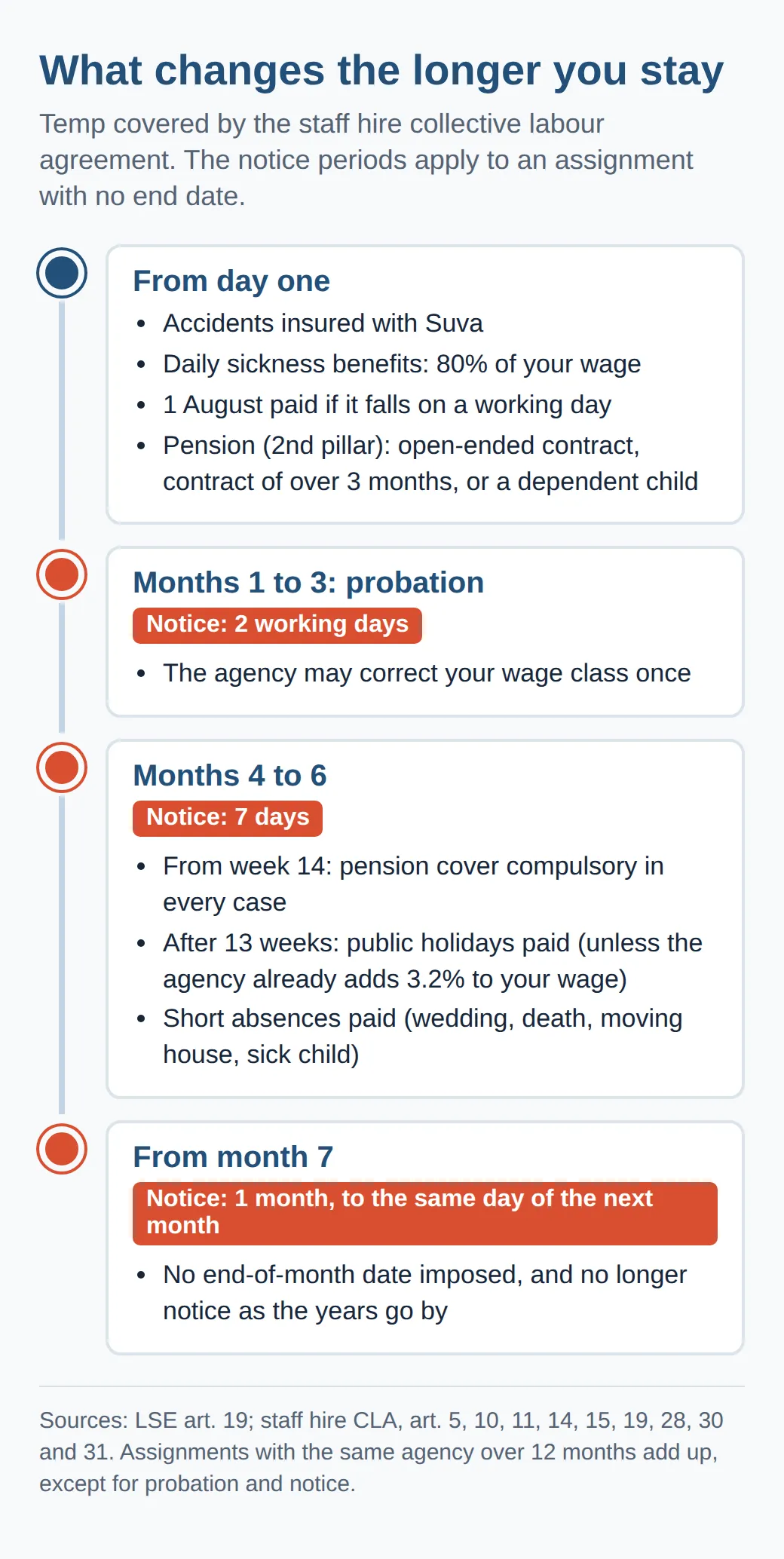
If your assignment has no end date, the law lets it be ended with two days' notice during the first three months of uninterrupted employment, then seven days from the fourth to the sixth month. The rule works both ways: you can leave as quickly as the agency can let you go.
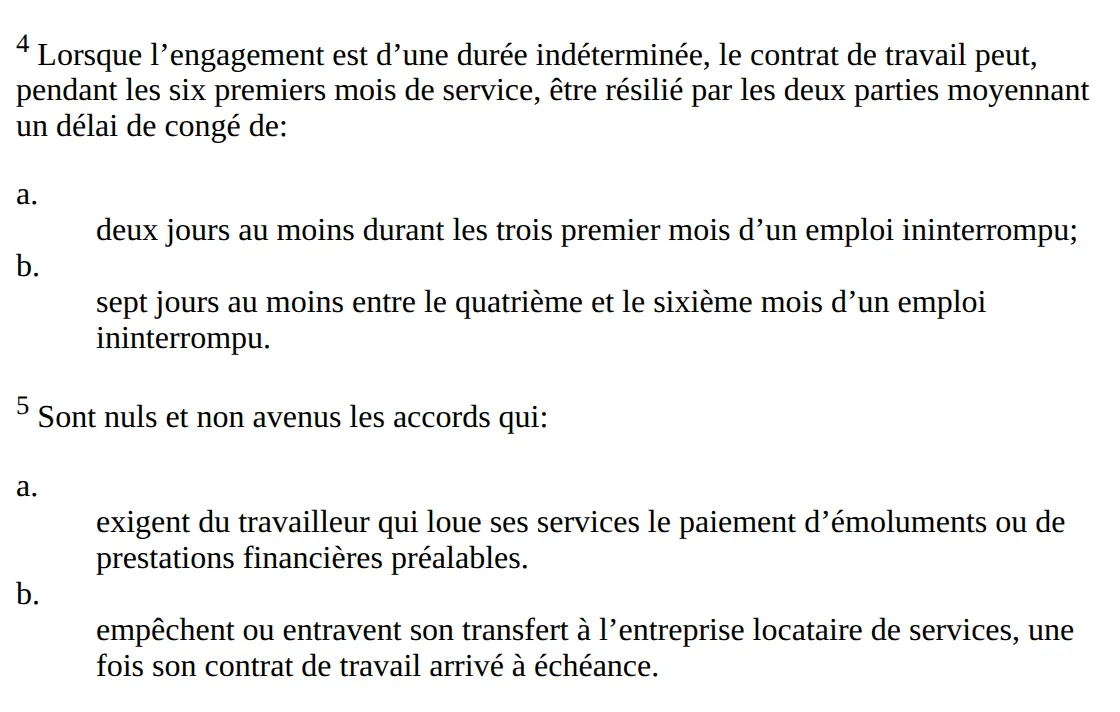
The agreement fills in the rest (CLA, art. 10 and 11). The first three months of an open-ended contract are a probation period, with two working days' notice. From the seventh month, notice rises to one month, "to the same day of the following month": notice given on 12 March takes effect on 12 April, not at the end of April as in a permanent job. That month never gets longer with the years, whereas the Code of Obligations sets two months from the second year of service.
A fixed-term assignment, such as extra help until 24 December, ends automatically on the agreed date, with no notice. It still has a probation period: the first two thirds of the assignment, three months at most. For six weeks, that makes four weeks in which you or the agency can end it with two working days' notice.
These short notice periods are based on unbroken time at the same agency. For other rights, such as public holidays or pension cover, assignments with the same agency over twelve months add up, even with gaps in between. Those rights start with the most concrete one: your pay.
The 2026 minimum wage for temps under the staff hire CLA
The agreement sets three levels of minimum wage depending on your training, with higher amounts in high-wage regions. The Federal Council extended these amounts to every agency in the country from 1 January 2026, in a decree of 11 December 2025. The extension makes them binding on agencies that are not members of the employers' association that signed the agreement, too.
For an employee with no vocational training, the minimum base wage is CHF 21.22 an hour in most of Romandy, CHF 22.39 in the high-wage regions and CHF 22.70 in Geneva. With a Federal VET Diploma (CFC), three years of basic training suited to the job, or a Federal VET Certificate (AFP) plus three years' experience, it rises to CHF 25.86, or CHF 27.62 in the high-wage regions. A so-called skilled employee, who doesn't hold the diploma but has at least four years' experience in a trade for which formal training exists, and works 1,000 hours a year, is entitled to 88% of the trained minimum: CHF 22.76, or CHF 24.30 in the high-wage regions.
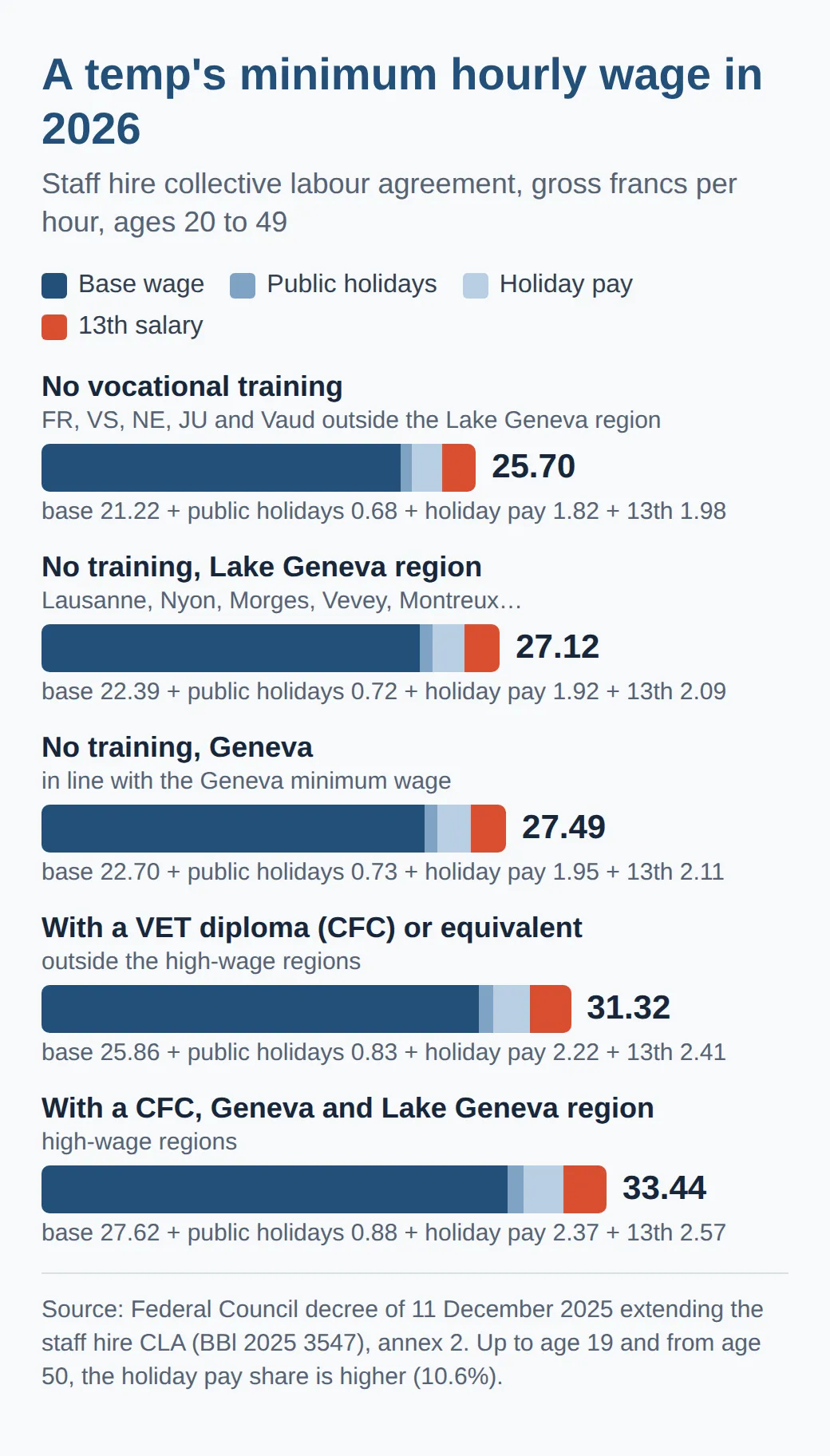
In French-speaking Switzerland, the high-wage regions are the whole canton of Geneva and the Vaud shore of Lake Geneva, the arc lémanique. The agreement lists them by postcode, from Coppet to Villeneuve: Nyon, Gland, Rolle, Morges, Renens, Crissier, Lausanne, Pully, Lutry, Vevey, Montreux and dozens of other places. What counts is where the company you work at is located, not where the agency is or where you live (CLA, art. 22).
Two exceptions change the sums. First, if the hirer is covered by another extended collective agreement, such as construction or hotels and restaurants, its wages and working hours apply to you (LSE, art. 20). Second, cantonal minimum wages take precedence if they are higher. Geneva's statutory minimum wage is CHF 24.59 an hour in 2026 and will rise to CHF 24.73 in 2027. Paid over thirteen months, it equals a base of CHF 22.70, exactly the Geneva line of the agreement. In Neuchâtel, the minimum of CHF 21.35 is compared with the base plus the 13th-salary share, excluding holiday and public holiday pay: the CLA's CHF 21.22 plus its 13th share, CHF 22.99, is already above it. The same goes for Jura, whose cantonal page gives CHF 21.40 since July 2024, 13th-salary share included.
The agreement's amounts are adjusted for inflation every 1 January. In mid-October 2026, the 2027 figures had not yet been published, so check your January payslip. And read it line by line, because the minimum hourly rate doesn't stop at the base.
Holidays, public holidays and 13th salary: what your hourly rate contains
Paid by the hour, you receive three supplements on top of the base, and the holiday pay must be shown separately on your payslip. Public holidays are worth 3.2% of the base. Holidays are worth 8.33% of the base plus public holidays, which is four weeks a year, or 10.6% up to age 19 and from 50, which is five weeks. The 13th salary adds another 8.33% of the total (CLA, art. 13, 14 and 18).
Holiday pay may only be paid out with your wage for a single assignment of three months or less. For any longer engagement, the holiday money builds up and is paid when you take your holidays, or at the end of the contract. The balance must appear on every payslip. For public holidays, the agency can either pay the 3.2% or, after thirteen weeks, pay the public holidays themselves. 1 August is paid from day one if it falls on a working day.
Take a six-week year-end assignment in a warehouse in Crissier, without training, at 42 hours a week, at a company with no other extended agreement. Crissier is in the Lake Geneva region, so the minimum is CHF 27.12 an hour. Over 252 hours, that comes to CHF 6,834.24 gross, including CHF 526.68 of 13th salary, CHF 483.84 of holiday pay and CHF 181.44 for public holidays. The holiday pay can be paid out each month, since the assignment lasts less than three months.
The standard week is 42 hours. From the 43rd to the 45th hour, overtime is paid without a supplement or compensated with time off. Beyond 45 hours a week or 9.5 hours a day, it is paid at 25% extra. Sunday work earns 50% extra and occasional night work, between 11 pm and 6 am, 25%; these supplements don't add up, only the highest applies (CLA, art. 12, 24 and 25). Wages are paid at least once a month, by the 5th of the following month at the latest.
From the gross amount, the agency deducts the usual social contributions, a professional contribution of 0.4% that funds the agreement's enforcement and further training, and your share of the daily sickness benefits insurance. That insurance deserves a closer look.
Sickness and accidents: 80% after two days at most
If you fall ill during an assignment, a collective daily sickness benefits policy pays you at least 80% of your last normal wage, after a waiting period of two working days at most. Cover starts on the day you were due to start work, and it also pays for partial incapacity from 25% (CLA, art. 28 and 29). You pay no more than half the premium, and at most 3.5% of your wage.
How long it pays depends on your situation, and the gap is huge. You are entitled to benefits for 720 days within 900 days if the hirer applies an extended collective agreement, or if the agency insures you for the occupational pension (LPP). Otherwise, it's 60 days within 360. A six-week Christmas assignment, with no children, at a company with no extended agreement falls into the second case.
Tell the agency straight away, not just the team leader at the company: the agreement requires it, because the agency is your employer. For work accidents, you are insured with Suva from your first to your last day of work; non-work accidents follow Suva's rules (CLA, art. 30). The next question, your pension, also depends on the length of your contract.
Pension (LPP): when the second pillar starts
You are insured for the occupational pension (LPP, the second pillar) from day one if your contract is open-ended, if it was agreed for more than three months, or if you have a duty to support a child. A contract of under three months that is extended beyond that becomes insured as soon as you learn of the extension. And from the 14th week of work, cover is compulsory in every case (CLA, art. 31).
The agreement works out contributions by the hour. Its own example starts from a wage of CHF 25.75, subtracts a coordination deduction of CHF 12.10 and insures CHF 13.65 an hour, or CHF 2,047.50 for a month of 150 hours. Assignments with the same agency over twelve months add up for these calculations. When you leave the agency, your savings go with you: you transfer them to your next employer's pension fund, or to a vested benefits account.
This is often when many temps start to wonder: what if the company offers me a permanent job?
When the assignment turns into a permanent job
The agency can't stop you. The law makes void any agreement that hinders your move to the hirer once your contract has ended, and any agreement that bars the company from hiring you once the hire has ended (LSE, art. 19 and 22). A non-compete clause slipped into your assignment contract therefore doesn't bind you on this point.
The only claim the agency has is against the company, not you. If the hire lasted less than three months and the company takes you on within three months, the agency can charge it a fee, provided their contract says so. It cannot exceed what the company would have paid in costs and margin for a three-month hire, minus what it has already paid on that basis. From you, the agency can claim nothing: the law forbids it from charging the worker fees.
In practice, first end your contract with the agency by giving the required notice, or wait until the assignment ends. Ask for a statement of your holidays and any unpaid hours, your employment reference (certificat de travail), and the address of the pension fund so your LPP savings can be transferred. The new contract is an ordinary employment contract: it can include a probation period, one month unless agreed otherwise and three months at most (CO, art. 335b). You already know the job, which gives you an argument for negotiating a short probation.
Your length of service starts again from zero with the new employer, and the Code of Obligations notice periods replace those of temp work: after probation, one month to the end of a month during the first year of service. If temp work ends without a permanent job, your assignments count as contribution months for unemployment insurance; our guide to unemployment benefits in Switzerland explains the calculation.
Before you sign your next assignment
Before you sign, ask the agency three things: your wage class and the hourly base that goes with it, the name of the collective agreement that applies at the hirer, and the terms of the daily sickness benefits insurance, which the agreement requires the agency to give you in writing. Compare the base with the minimum for your category, and check whether the company is in a high-wage region.
During the assignment, keep your payslips and a record of your hours. If an amount is missing, write to the agency with your calculation. The joint committees for staff hire inspect agencies, and your wage claims only lapse after five years (CO, art. 128).
Cross-border commuters starting an assignment in Switzerland will find the permit rules in our article on the G permit. Current assignments are on our temporary job pages for Geneva, the canton of Vaud, Valais, Fribourg and Neuchâtel.
Common questions
- Can a temp agency in Switzerland charge me a registration fee?
- No. The federal law on recruitment and staff hire makes void any agreement requiring a temp to pay fees or money up front. An agency asking for a registration or file fee has no right to keep it, and you can ask for it back.
- Is my temp assignment valid if I never signed a contract?
- Yes, the work you have done must still be paid. The written contract should normally be signed before your first day, or as soon as possible in an emergency, and it may only be missing for an assignment of six hours or less. If it is missing or incomplete, local and industry practice or the law applies, unless you agreed better terms orally.
- Can a cross-border commuter do temp work in Geneva or Vaud?
- Yes. The agency is your employer and handles the paperwork. An EU or EFTA national hired for three months or less needs no permit: the employer registers you online by the day before you start at the latest. For longer, you need a permit, the G permit if you return home at least once a week.
- What can I do if my temp agency pays less than the CLA minimum?
- First ask in writing for your wage class and how your hourly rate was worked out. If the answer does not convince you, the joint committee for staff hire inspects agencies and can impose contractual penalties. Wage claims only lapse after five years, so you can still claim after the assignment has ended.
More posts
All posts
Swiss unemployment benefits 2026: how much, how long
70 or 80% of insured earnings, 200 to 520 daily allowances, waiting days by income: Swiss unemployment benefits worked out to the franc, and ORP registration.

Foreign diploma recognition in Switzerland: who decides
Regulated job or not: who recognises your French diploma in Switzerland (SERI, Red Cross, FOPH, EDK), the fees, the processing times and the language rules.

Career change in Switzerland: who funds retraining in 2026
Free career review from 40, a 750-franc cheque in Geneva, unemployment, disability insurance, grants, adult CFC: who funds retraining in Romandie.