Short-time work in Switzerland: what you get as an employee

What you get paid
On short-time work (réduction de l'horaire de travail, RHT, also called chômage partiel, or Kurzarbeit in German), your employer pays the hours you work as normal and 80% of the salary for the hours lost. With 40% of hours lost, you keep 92% of your gross salary. You can refuse. And until 31 January 2027, a company can use short-time work for 24 months at most.
Almost everything written about short-time work is aimed at employers: how to fill in the advance notification, when to send the claim. This post looks at the other side of the payslip. How much you have left in francs, what your boss can and cannot impose, what happens to your holidays, your overtime and your 13th salary, and what you can do if a dismissal follows. Our regional case is the Jura Arc, home of the watch industry, a sector the Federal Council names among the hardest hit, alongside the machinery industry.
Who can be put on short-time work?
Any employee on a permanent contract who pays unemployment insurance contributions and whose working hours are recorded. There's no minimum contribution period: you can be on short-time work from your first day at the company. Where you live and which permit you hold don't matter either. SECO's directive on short-time work (in French) says so explicitly: cross-border commuters are entitled from their first day of paying contributions, like everyone else. If you live in France and work in Neuchâtel or Porrentruy, your Swiss employer applies for short-time work and pays you the compensation.
The law does exclude several groups (Unemployment Insurance Act, art. 31 and art. 33; the act has no English version, so these links go to the French text):
- people whose contract has been terminated, whoever gave notice;
- apprentices, temporary agency workers and fixed-term contracts;
- on-call workers, according to SECO's FAQ;
- people who influence the company's decisions (partners, members of management) and their spouses employed in the company;
- people who have reached the AHV/AVS retirement age.
One condition concerns you directly: the company must record your working time every day, managers included. Time clock, timesheet or software, it doesn't matter, but without that record the fund doesn't pay. It's also your best proof if a statement looks wrong to you. Which leaves the question of what short-time work actually pays you.
How much you get: 80% of the loss, not 80% of your salary
The compensation is 80% of the loss of earnings, meaning the salary for the lost hours only (Unemployment Insurance Act, art. 34). The hours you work are still paid at 100%. So you lose a fifth of the part not worked: 4% of your gross pay at 20% short-time work, 8% at 40%, 10% at 50%, and 20% if work stops completely.
Take a gross salary of CHF 5,500 a month, paid twelve times a year, with 40% of hours lost. Your employer pays you CHF 3,300 for the 60% you work. The lost hours were worth CHF 2,200, and the compensation covers 80% of that, or CHF 1,760. Total: CHF 5,060 gross instead of 5,500.
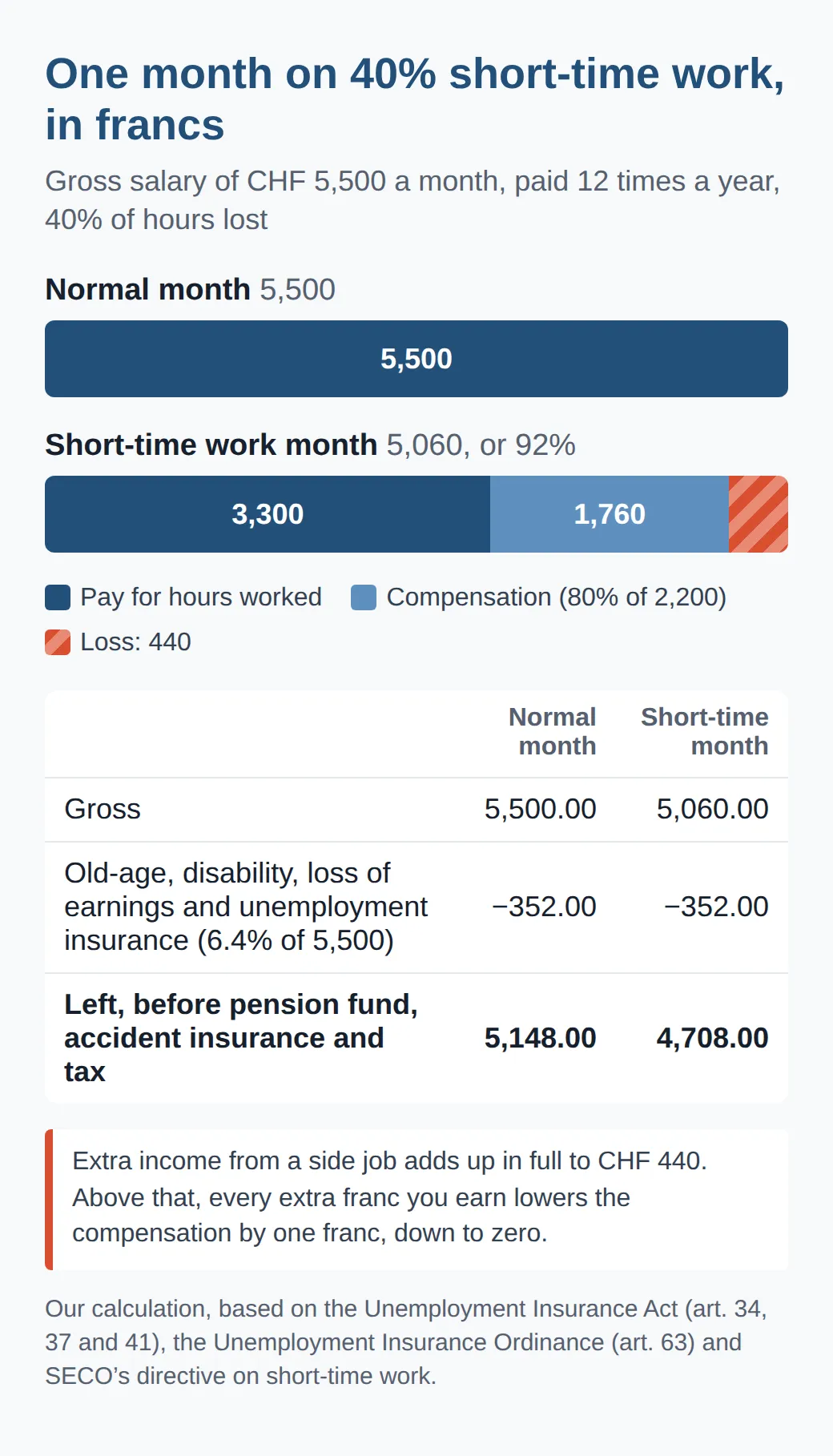
Your net pay drops a little more than your gross. Your employer must keep paying all social insurance contributions as if you were working full time, and may deduct your share on that full salary (Unemployment Insurance Act, art. 37). For old-age, disability, loss of earnings and unemployment insurance (AHV/AVS, IV/AI, EO/APG and ALV/AC on your payslip), that share is 6.4% according to SECO's directive: CHF 352 out of 5,500, on short-time work just as in normal times. Occupational pension and accident insurance are also still calculated on 100%. There's an upside: your AHV/AVS account and your pension fund keep being credited on your full salary.
A ceiling works against high earners: the salary taken into account stops at CHF 12,350 a month, as for unemployment benefits. If you earn CHF 15,000, the compensation is calculated as if you earned 12,350, and the part above isn't covered. Two rules, on the other hand, work in your favour. Each month the insurance deducts one waiting day from the lost working time, but that day is borne by the employer, who cannot pass it on to you (Unemployment Insurance Ordinance, art. 50, French text, and SECO directive, C42). And if the compensation is refused after the fact through your employer's fault, the employer cannot ask you to pay it back (Unemployment Insurance Act, art. 95).
The compensation arrives with your salary, on the usual payday. It's taxable like any income that replaces a salary (Direct Federal Tax Act, art. 23, French text), and if you're taxed at source, it's subject to withholding tax too (art. 84). We go through that tax in our post on correcting withholding tax. All of this assumes one thing: that you said yes.
Can you refuse short-time work?
Yes. Your employer must get your written consent before putting you on short-time work, and confirms it to the cantonal office when it files the advance notification (SECO directive, D27). If you refuse, it must keep paying your full salary (Unemployment Insurance Act, art. 33). SECO itself points out where that right stops.
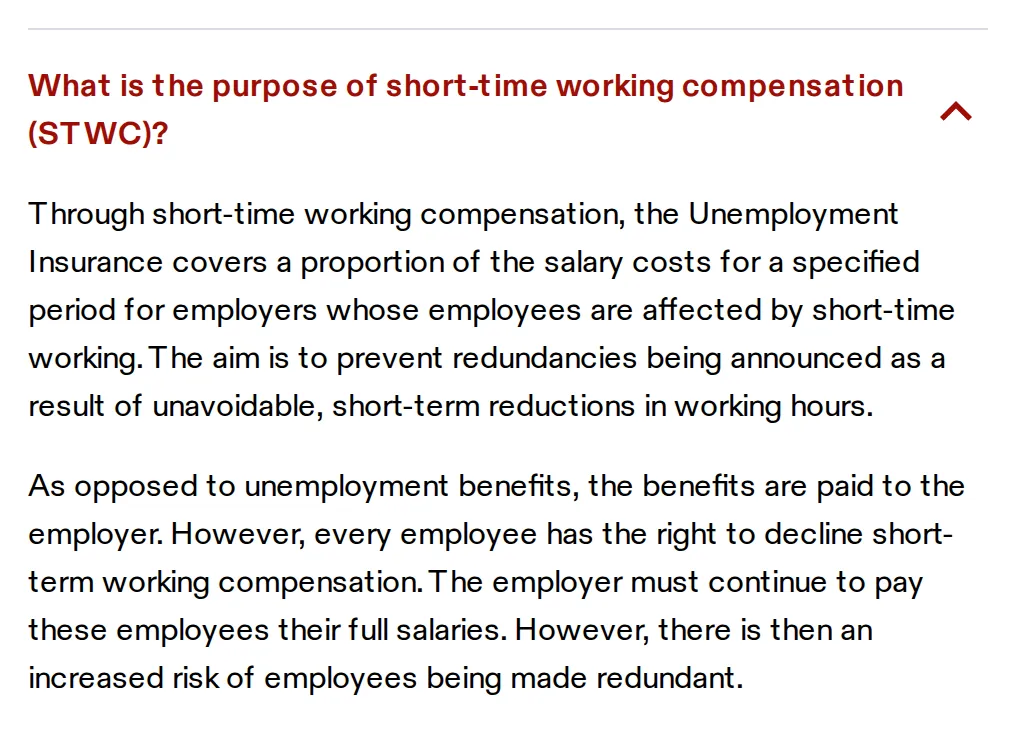
So refusing isn't free. Short-time work exists to avoid dismissals, and someone who refuses it costs more to keep. Your consent can also be confirmed by a representative chosen by the staff, as SECO's directive allows. Before you sign, ask for three things in writing: the planned rate of reduction, the period announced to the cantonal office (an approval lasts three months at most and must then be renewed) and how the lost hours will be spread across the week. With those three answers you can work out your pay for the coming months and check your payslips. That leaves your holidays and the hours you've already built up.
Holidays, public holidays and overtime
Your holidays are still paid at 100%. A day of holiday isn't a lost hour: your employer owes you your full salary for your holidays (Code of Obligations, art. 329d), and that day doesn't count as short-time work. The Code of Obligations lets the employer choose the dates, taking your wishes into account (art. 329c). In the watch industry, the collective labour agreement puts limits on that choice: the holiday schedule must be set by 31 December at the latest, and days taken outside the general shutdown are agreed with you, with a schedule set by 31 March (art. 15.4 of the collective labour agreement for the watch industry, French text).
Public holidays have their own rule. Lost working time limited to the two days before or after a public holiday isn't compensated, and neither is lost time in the five days around the company shutdown (Unemployment Insurance Ordinance, art. 54). The insurance doesn't want to fund bridge days. If your employer announces short-time days right next to Christmas or the summer shutdown, ask who's paying for them.
Your overtime, by contrast, is used up first. Additional hours built up in the six months before short-time work (twelve months if the company already used it in the same qualifying period) are deducted from your lost hours (Unemployment Insurance Ordinance, art. 46). In practice, the insurance doesn't pay for those hours, and your employer has every reason to have you take them as time off before short-time work starts. For that, it needs your agreement (Code of Obligations, art. 321c). Until 31 December 2026, a flexitime balance of up to 20 hours isn't touched. From 1 January 2027 that exception goes: any flexitime balance will be deducted as well (amendment to the ordinance of 26 November 2025, French text). If you have built up extra hours, ask to take them as time off before the end of the year. Which brings us to the item that causes the most debate at year end.
Your 13th salary during short-time work
For unemployment insurance, your 13th salary is part of the pay on which the compensation is calculated. SECO's directive (E4) includes it pro rata, whatever month it's paid in, and gives an example: CHF 6,000 a month plus a 13th salary count as monthly earnings of CHF 6,500. The part of the 13th salary that matches your lost hours is therefore compensated at 80%, like the rest.
Back to our CHF 5,500, this time paid thirteen times, and a whole year on 40% short-time work. The 13th salary is worth CHF 5,500. The part linked to lost hours, 40%, comes to CHF 2,200, of which the insurance covers 1,760. That leaves 440 missing. Over the year, what you get for the 13th salary should therefore reach at least CHF 5,060: 3,300 for the hours worked and 1,760 in compensation.
What changes is the timing. If your employer passes on the compensated part every month together with the compensation, your December 13th salary will be lower, CHF 3,300 in our example, since you'll already have received the rest. If it keeps it all for December, you'll get the 5,060 in one go. The law doesn't choose between the two: your contract or your collective labour agreement decides. In the watch industry, the agreement calculates the 13th salary of monthly paid staff on the "normal monthly salary" (salaire mensuel normal), but says that if you're absent during the year it's paid pro rata to the salary actually paid under the contract (art. 19.3 and 19.4). The text doesn't say whether short-time hours count as absence. If your 13th salary drops, ask for the calculation in writing, and have your union check it if you're a member. Another way to limit the loss is to work somewhere else.
A side job: what it really earns you
You can work for another employer during short-time work, but beyond a certain point the earnings reduce your compensation. The rule: compensation and extra earnings together must not exceed 100% of the loss of earnings (Unemployment Insurance Ordinance, art. 63). In our example, the loss is CHF 2,200 and the compensation 1,760. So the first CHF 440 you earn elsewhere is added in full. Above that, every franc you earn lowers the compensation by a franc.
With a side job paying CHF 1,000, your compensation falls to CHF 1,200. You end the month at CHF 5,500 gross: 3,300 from your employer, 1,200 in compensation, 1,000 from the other job. You're back to your full salary, but most of that effort has benefited the insurance. It only pays off if the second job gives you something else: experience, a contact, a foot in the door at another company.
You must declare this income to your employer, who passes it on to the fund (Unemployment Insurance Act, art. 41). SECO provides a form for this, the certificate of income from interim employment (Attestation de revenu provenant d'une occupation provisoire, 10052f). Your main contract still applies, with its duty of loyalty: no work for a competitor, no trade secrets taken along. A temporary assignment is often the simplest option; we explain your rights as a temp in our post on temporary work. If business doesn't pick up, the question becomes one of dismissal.
If a dismissal follows short-time work
Once your contract is terminated, short-time work stops for you, whoever gave notice: the entitlement ends when the notice period starts, even if the letter was sent well before (SECO directive, B27 and B28). The fund then pays nothing more for you. During the notice period, the risk of having no work goes back to the employer: if it has no work to give you, it must in principle still pay your salary (Code of Obligations, art. 324). If your payslip during the notice period still shows short-time compensation, ask on what basis.
In the watch industry, the collective labour agreement guarantees minimum notice periods for economic dismissals: one month in the first year, two months after that and three months after nine years with the company (art. 6.9). Those are the Code of Obligations periods, but your contract can't go below them. The real extra is for older staff: after eight years of service, an employee over 60 is entitled to three extra months' notice, or an equivalent payment (art. 12.1). During the notice period the employer must, if you ask, release you for a trial at another company and let you leave as soon as you've found a new job. Economic dismissals must also be discussed beforehand with the union and the employers' association (art. 6.2).
Register with the regional employment centre (RAV/ORP) as soon as you get the letter, without waiting for your contract to end. Our post on unemployment in Switzerland sets out how benefits are calculated and what to do. If you're a cross-border commuter, your country of residence pays your unemployment benefits today. The European Union has adopted a revision that would give that role to the country of last employment (European Parliament in July 2026, Council of the EU in September 2026), but it doesn't apply automatically in Switzerland: Switzerland would have to agree to take it over and is under no legal obligation to do so, according to SECO's page on the regulation. Our post on the G permit covers the rest of the status. Which leaves the question of how long your company can still count on short-time work.
24 months until 31 January 2027, and then?
The law provides for 12 months of compensation at most within a two-year qualifying period (Unemployment Insurance Act, art. 35). Since August 2024, the Federal Council has raised that ceiling in steps: to 18 months, then to 24 months from 1 November 2025 (press release of 8 October 2025, in French). On 27 May 2026, it extended the 24 months from 1 August 2026 to 31 January 2027, limiting the measure to six months so that the situation could be reassessed at the end of 2026 (press release of 27 May 2026, in French). As of 20 October 2026, the Federal Council had not taken a new decision.
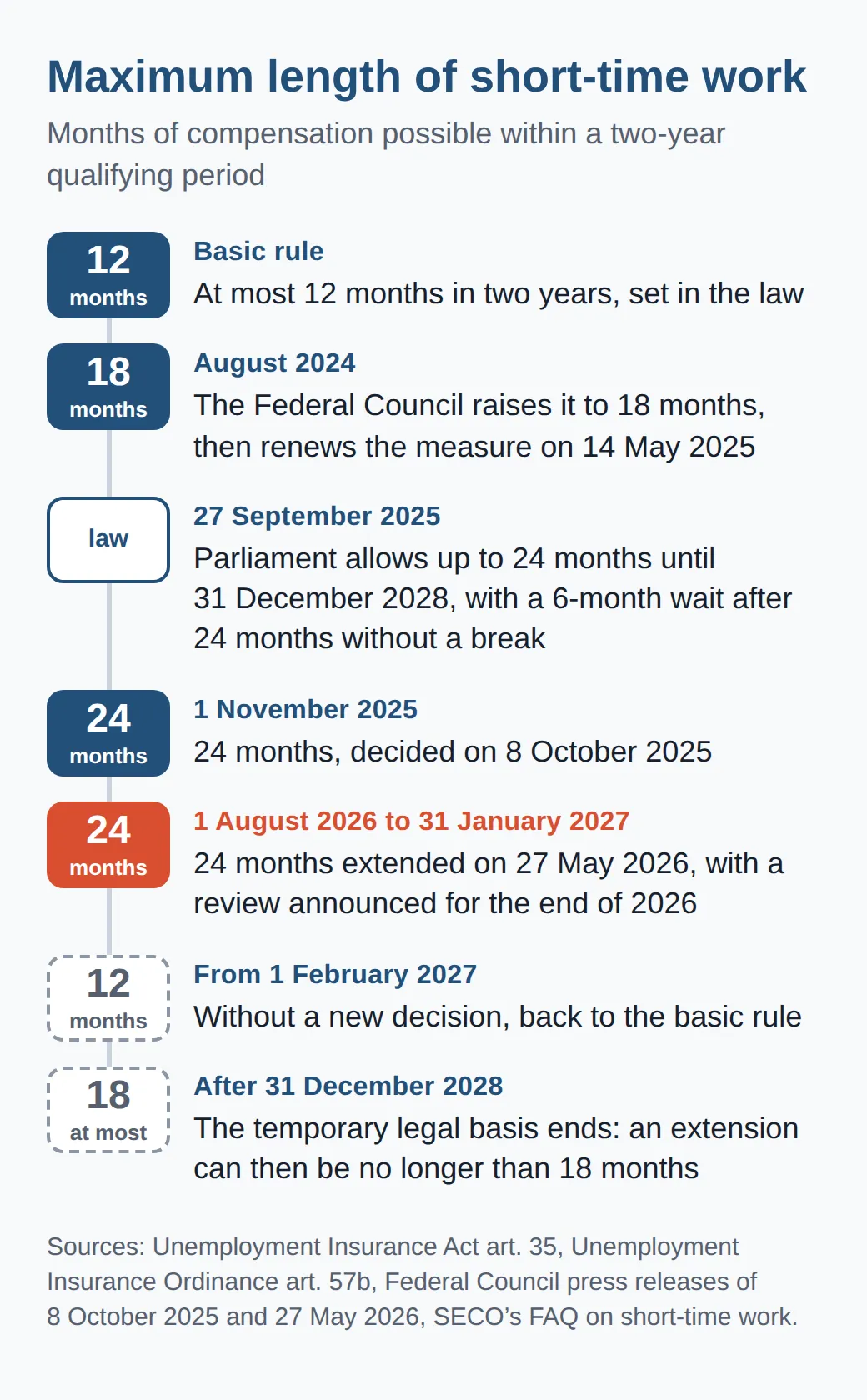
Those 24 months rest on a law declared urgent, passed by Parliament on 26 September 2025 and limited to 31 December 2028. It lets the Federal Council go up to 24 months as long as labour market forecasts show no improvement. The current version of the ordinance, however, only runs until 31 January 2027 (Unemployment Insurance Ordinance, art. 57b). Without a new decision, the basic 12-month rule applies again. A company that has already drawn more than 12 months in its qualifying period would then, in principle, get no more.
The same law also set a limit: a company that has drawn short-time compensation for 24 months without a break must wait six months before opening a new qualifying period. SECO's FAQ gives the example of a company whose qualifying period ran from 1 May 2024 to 30 April 2026: no short-time work possible before 1 November 2026. So ask your employer when its qualifying period started and how many months it has already used.
Across Switzerland, short-time work affected 8,339 people in 638 company departments in June 2026, according to fund data published by SECO on 6 October 2026 (SECO press release, in French). These figures lag three months behind and can still be revised. In the Jura Arc, the trend is tracked more closely.
The Jura Arc, among the hardest hit
As early as October 2025, the Federal Council named the machinery industry and watchmaking among the hardest hit. Figures from Jura and Neuchâtel show what that means on the ground.
Jura: fewer approvals
The canton of Jura publishes the number of companies approved for short-time work every month. That number has been falling since spring: 123 in March 2026, 115 in April, 111 in May, 102 in June, 86 in July and 76 in August, against 106 in August 2025 (Service de l'économie et de l'emploi, August 2026 bulletin, in French). In 2025, an average of 87 Jura companies a month drew the compensation, for 1,889 people (April 2026 bulletin). The canton's unemployment rate was 4.3% in August, and watchmaking was still the most common previous sector among the unemployed, with 214 people.
The fall in approvals can be read two ways: order books filling up again, or companies reaching the end of their short-time months. The bulletins don't settle it.
Neuchâtel and the watch industry agreement
In Neuchâtel, the cantonal bulletin gives no short-time work figure. Unemployment there was 4.4% in September 2026, and the statistics office notes that the sharpest fall in the number of unemployed that month was in watchmaking (unemployment figures, September 2026, in French).
If you work under the watch industry's collective labour agreement, it gives you two protections during short-time work: the company must in principle neither hire for equivalent jobs nor have overtime worked in the department concerned, and it must encourage further training (art. 6.8). The law provides for training too: the employer can use lost hours for training approved by the canton without losing the compensation (Unemployment Insurance Ordinance, art. 47). The training must also be useful to you with another employer, or be essential to your job, and must not mainly serve the company's interests.
What you can do now
Keep a copy of your time record every month and compare it with your payslip: hours worked paid at 100%, lost hours at 80%, any overtime balance deducted first. Ask your employer where its qualifying period stands and what it plans after 31 January 2027. Don't resign on impulse: unemployment insurance heavily penalises quitting without a new job lined up.
And make use of the time freed up. Lost hours are a good moment for training, a skills assessment or applications, before the short-time clock stops. Current openings in the region are on our pages for the canton of Neuchâtel and the canton of Jura, and if you're thinking about changing careers, our post on retraining reviews the support available.
Common questions
- Who pays short-time work compensation in Switzerland, your employer or the unemployment fund?
- Your employer. It advances the compensation and pays it to you with your salary on the usual payday. The unemployment insurance fund then reimburses the employer. You don't have to apply for anything yourself, but each month you sign the record of your lost hours.
- Does short-time work reduce your future AHV/AVS pension or pension fund savings?
- As a rule, no. During short-time work your employer must keep paying social insurance contributions as if you were working full time, including AHV/AVS, unemployment, accident and occupational pension contributions. Your AHV/AVS account and your pension fund keep being credited on your full salary.
- Can apprentices, temps or people on a fixed-term contract be put on short-time work?
- No. Apprentices, temporary workers placed by an agency and people on a fixed-term contract that cannot be terminated early are not entitled. On-call workers aren't either. The employer then has to pay them under their contract or find another solution.
- Can your employer hire new staff during short-time work?
- In the watch and microtechnology industry, the collective labour agreement in principle forbids it: during short-time work, the company may neither hire for equivalent jobs nor have staff work overtime in the department concerned. In other sectors, check your collective labour agreement or ask your union.
- What happens if you fall ill during short-time work?
- In the watch industry, the collective labour agreement covers this: you receive the reduced salary in line with the short-time rate, plus the compensation you would have received, but no more than you would have been paid when ill outside short-time work. Elsewhere, your contract, your collective labour agreement and your daily sickness allowance insurance decide. Report the illness straight away, with a doctor's certificate.
More posts
All posts
Average salary in Geneva, Vaud and Romandy: 2024 figures
Median salary in 2024: CHF 7,893 in Geneva, 6,810 in Vaud, 6,434 in Valais. Official figures by canton and sector, plus minimum wages in Romandy.

Maternity leave in Switzerland 2026: 14 weeks, 16 in Geneva
14 weeks at 80%, up to 220 francs a day, 16 weeks in Geneva, two weeks for the other parent: your rights canton by canton and what changes in 2027.

Temporary work in Switzerland: your rights as a temp in 2026
2 days' notice, at least CHF 25.70 an hour, 13th salary, pension and sick pay: what Swiss law and the staff hire CLA guarantee temps in Romandy.